
Gaza Herald – Inside one of Gaza’s displacement shelters, the sound of paintbrushes gliding across canvas rises above everything else. There are no musicians, no speeches, only girls gathered around small tables, trying to give color to emotions that words can no longer express.
 Here, painting is not seen as a hobby or a skill but as a temporary escape from the overwhelming weight of genocide.
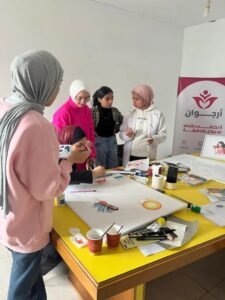
Bottles of acrylic paint are scattered across the tables as hands move cautiously between colors, hesitant at times, confident at others, as if searching for a way to reorganize the emotional chaos left behind by years of war.
The scent of fresh paint blends with that of the shelter that has become home to displaced families. No one asks the girls what they plan to paint. Instead, each is left free to tell her own story through lines, colors, or even empty spaces.
Now in its third year of Israeli war, Gaza continues to bear deep psychological wounds, particularly among adolescent girls whose lives have been shaped by fear, loss, and deprivation.
Their paintings cannot be understood through color alone. Behind every uncertain brushstroke lies a personal experience, and behind every dark shade is an emotion that never found its way into words.
Many of the girls did not begin painting with a clear idea in mind. They simply wanted to give visible form to what they carried inside.
One participant chose red, not to depict a scene of genocide, but to say she is still capable of feeling. Another covered her canvas in shades of blue, as though searching for the peace she has long been denied.
Though each painting is different, they share one purpose: they were created not to impress the eye, but to lighten the burden carried by the heart.
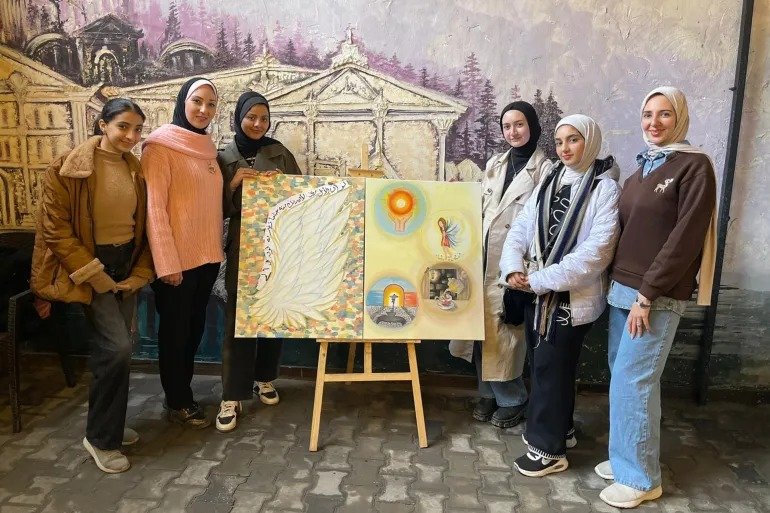
In this context, art becomes a language of expression, a goal embraced by the “Embodying the Canvas of Hope” initiative, which provides girls with a safe environment where they can express themselves freely and regain a measure of emotional balance amid an increasingly harsh reality.
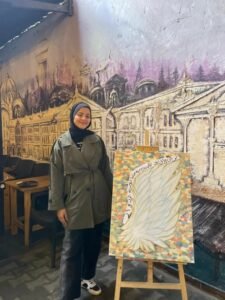
 At the center of the group’s collaborative artwork stands a large white wing, still unfinished yet occupying the largest space on the canvas. For the participants, it symbolizes more than flight; it represents the desire to rise above the weight of reality.
Beside the wing, the girls wrote a quote by Lebanese poet Elia Abu Madi:
“If hope could be seen, I would gift you a wing to soar above every pain.”
Nineteen-year-old visual artist Farah Ajjour said the workshop came during one of the most difficult periods of her life, after being displaced for the second time.
“My energy was completely gone,” she said. “I was no longer able to express what I was feeling.”
“After joining this workshop, I felt safe again. The goal wasn’t to create a beautiful painting; it was to create an honest one, and that alone made a huge difference.”
She believes art in Gaza is no longer a luxury but a means of psychological resilience.
“When we provide a safe space, emotions naturally transform into colors and messages,” she said.
Seventeen-year-old high school student Amal Darwish said participating in artistic activities changed the way she sees herself.
“I’ve become more optimistic and met positive people,” she explained. “Painting helped me understand my emotions, even the ones I couldn’t name.”
She added, “This space is important for every girl who feels there is something inside her that needs to be heard.”
For his part, Yasser Abu Jamei, director of the Gaza Community Mental Health Programme, said that during wartime, art has become far more than a recreational activity.
“It has become a tool for psychological survival, especially for girls carrying accumulated losses they cannot always express through words,” he said.
He explained that painting, embroidery, writing, and even simple coloring exercises help organize inner emotions and restore a sense of control in lives where so much has been taken away.
“When a girl picks up a brush or a pencil,” Abu Jamei said, “she is not merely creating a piece of art; she is trying to bring order to her inner chaos and give herself a moment to breathe amid the suffocating reality of everyday life.”

