
Gaza Herald _As Israeli bombardment continues to devastate Gaza’s historic landmarks, a group of young volunteers is risking everything to rescue centuries of Palestinian heritage before it disappears beneath the ruins forever.
While much of the world’s attention remains focused on the immense human toll of Israel’s war on Gaza, another tragedy has unfolded in silence. Across the devastated enclave, museums, archaeological collections, historical artifacts, and priceless cultural treasures have been buried beneath collapsed buildings or destroyed by relentless bombardment.
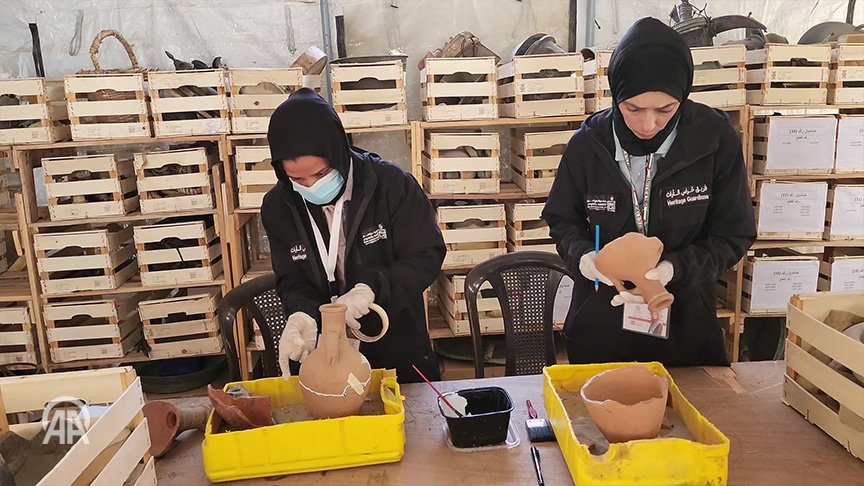
Amid the destruction, a group of Palestinian volunteers has launched an extraordinary effort to preserve what remains of Gaza’s historical identity. Working from a modest tent surrounded by displaced families in the Al Mawasi area west of Khan Younis, the youth-led initiative has transformed one of the war’s most unlikely spaces into a temporary sanctuary for Gaza’s surviving heritage.
A Museum Inside a Refugee Tent
The initiative, known as Guardians of Heritage, was established to recover cultural artifacts from destroyed museums, historical buildings, and archaeological sites before they are permanently lost.
Inside a simple canvas tent, wooden crates now serve as makeshift storage units for hundreds of rescued objects recovered from bombed locations across the Gaza Strip. Although the conditions are far from ideal, the collection has become a small improvised museum dedicated to safeguarding fragments of Palestine’s history until they can one day return to permanent institutions.
The project emerged after widespread destruction damaged museums and cultural landmarks throughout Gaza. Volunteers affiliated with the Mayasem Association began searching through rubble, carefully retrieving damaged historical objects, documenting their origins, restoring them whenever possible, and preserving them in temporary storage.
Young Volunteers Protecting Palestine’s Memory
Shaimaa Al Nattour, Assistant Coordinator of the Heritage Protection Program at the Mayasem Association, says the initiative was launched in 2024 by a team of twenty young volunteers united by a common goal: preventing Gaza’s cultural heritage from disappearing.
According to Al Nattour, the group’s first task was to identify museums and archaeological sites damaged during Israeli attacks before organizing recovery operations to salvage surviving collections.
Despite the enormous challenges, the volunteers have successfully recovered numerous historical artifacts buried beneath collapsed buildings. Every rescued item is cataloged, photographed, documented, and carefully archived before being placed inside specially prepared storage containers.
Saving Stories Alongside Artifacts
The initiative extends beyond rescuing physical objects.
Recognizing that heritage is preserved not only through artifacts but also through memory, the volunteers are recording oral histories connected to many of the rescued items. Elders and local residents are invited to share stories, traditions, and personal accounts associated with Gaza’s historical sites and cultural objects.
Al Nattour says preserving these narratives is just as important as protecting the artifacts themselves because they reflect the experiences, identity, and collective memory of generations of Palestinians.
“Our heritage is not only what we can hold in our hands,” she explains. “It is also the stories that define who we are.”
Heavy Losses Across Gaza’s Cultural Landscape
Israel’s military campaign has inflicted devastating damage on Gaza’s cultural infrastructure.
Among the institutions severely affected is the Qarara Museum, while numerous historical landmarks and archaeological sites have suffered extensive destruction.
According to the initiative’s estimates, approximately 3,500 museum artifacts have been lost during the war. Volunteers have also identified nearly 300 additional historical objects believed to remain buried beneath rubble in areas that remain inaccessible because of ongoing security risks.
The team says another challenge has emerged as residents clearing debris occasionally discover archaeological objects without realizing their historical significance, increasing the risk that valuable artifacts could disappear forever.
Racing Against Time
Despite working under extremely difficult conditions and lacking proper conservation facilities, the volunteers continue their work every day.
The tent offers only minimal protection against humidity, heat, and environmental damage, yet it remains the safest available location for the rescued collection until museums can eventually be rebuilt.
Al Nattour acknowledges that the temporary shelter cannot fully preserve fragile historical objects, but says it provides something equally important.
“It gives these artifacts a chance to survive.”
Gaza’s History Spans Thousands of Years
For thousands of years, Gaza has served as one of the eastern Mediterranean’s most important crossroads, shaped by successive civilizations including the Canaanites, Phoenicians, Greeks, Romans, Byzantines, and later the Islamic, Mamluk, and Ottoman periods.
Each civilization left architectural, archaeological, and cultural traces that collectively document the deep historical roots of Palestinian society.
That legacy, however, has suffered unprecedented destruction during the current war.
According to figures released by Gaza’s Government Media Office on December 31, 2025, approximately 208 of Gaza’s 325 documented archaeological and heritage sites have been destroyed since the war began.
Preserving Identity Amid Destruction
As Israel’s military campaign continues to devastate Gaza’s civilian infrastructure, the volunteers behind Guardians of Heritage believe their mission extends far beyond saving ancient artifacts.
Each recovered object represents another piece of Palestine’s collective memory rescued from disappearance. Each documented story preserves a connection between past and future generations.
Working from a refugee tent surrounded by displacement and destruction, these young Palestinians continue racing against time, determined that even if buildings collapse, Gaza’s history will not vanish with them.

