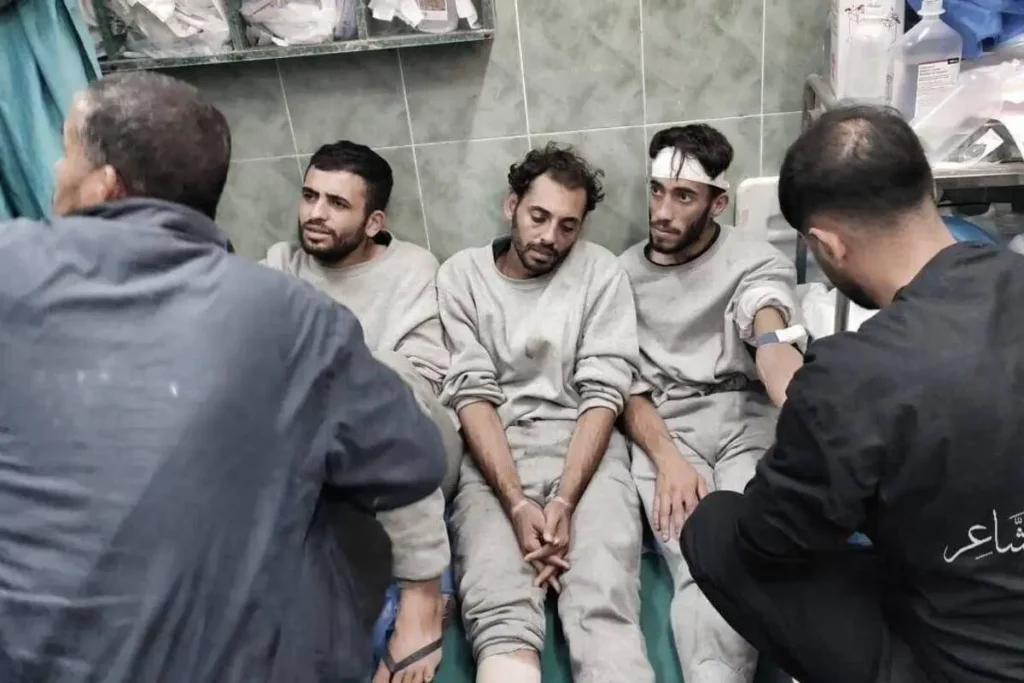
Gaza Herald – With every Palestinian detainee released from Israeli detention camps, new accounts emerge from behind the silent walls of interrogation centers and detention facilities.
Former detainees continue to recount strikingly similar experiences of physical and psychological torture, degrading treatment, and harsh detention conditions that begin from the moment of detain, continue through intensive interrogations, and persist for months inside prison cells under constant pressure and isolation.
One such testimony comes from Mohammad Monther Al-Najjar, a former detainee from Gaza City, who detailed a long series of abuses he says he endured following his arrest on 18 November 2023.
Detaining at Salah al-Din Checkpoint
Al-Najjar said he was detained at the Salah al-Din checkpoint, where field interrogations began immediately near the Gaza border. He stated that he and other detainees were subjected to beatings, stripped of their clothes, blindfolded, and restrained with their hands and feet bound.
He was then transferred to the Israeli military detention facility known as Sde Teiman, where he described the conditions as among the harshest he experienced. According to his testimony, detainees were subjected to severe beatings, humiliation, and prolonged deprivation of food and water.
Interrogation in Darkness
Five days later, Al-Najjar was moved to a Shin Bet interrogation center in Petah Tikva, where he spent approximately 45 days in dark cells.
During this period, he said he was subjected to continuous psychological and physical pressure during interrogations, describing the detention environment as one of complete isolation aimed at extracting confessions.
“The Graveyard of Hell”
After nearly 50 days, Al-Najjar was transferred to Ofer Prison, which prisoners reportedly refer to as “the graveyard of hell.”
Upon arrival, he underwent what detainees call a “welcome beating,” during which he says he suffered fractures to his hand and foot as well as a head injury.
He remained in Ofer for around six months. According to his account, detainees were beaten three times daily and provided with only one meal that was insufficient even for a child. The meal often consisted of a single slice of bread and a small cup of yogurt shared among several detainees.
Although Israeli prison authorities later increased the number of meals to three per day, Al-Najjar said the portions remained inadequate.
Daily Humiliation
On the first day of Eid al-Fitr 2024, Al-Najjar was transferred to Nafha Prison, where he says he was again subjected to a “welcome beating.”
He said that guards forced detainees to imitate barking dogs while assaulting them and routinely subjected them to verbal abuse and insults targeting their dignity and religious beliefs.
According to his testimony, these practices continued for nearly a year as part of a daily routine of beatings, deprivation, and humiliation.
Disease and Deteriorating Conditions
A year later, Al-Najjar was moved to Negev Prison, one of Israel’s largest detention facilities.
He described worsening health conditions inside the prison, including the spread of skin diseases such as scabies, large numbers of mosquitoes, poor sanitation, and severe shortages of medicine and hygiene supplies.
Total Isolation
Al-Najjar stated that detainees were denied access to lawyers, prevented from receiving visits from the International Committee of the Red Cross, and effectively cut off from the outside world throughout much of their detention.
He also claimed that surveillance cameras and microphones were installed inside cells, leaving prisoners with no privacy.
Religious Restrictions
During Ramadan, Al-Najjar said detainees were prohibited from performing collective religious rituals, including the call to prayer and Taraweeh prayers.
He further alleged that prisoners were denied access to copies of the Quran, books, paper, and pens, while Israeli prison authorities controlled the timing of iftar and suhoor meals, sometimes distributing food before sunset as a form of punishment.
Repeated Raids
Al-Najjar also described frequent prison raids involving special forces units and police dogs.
During these operations, detainees were stripped, beaten, and exposed to stun grenades and tear gas. Collective punishments reportedly included the denial of food, water, and clothing for days at a time.
He said solitary confinement cells were regularly used as a punitive measure, while constant surveillance left prisoners dependent on prison authorities even to know prayer and meal times.
Al-Najjar was released on 13 October 2025 as part of the “Tufan al-Ahrar” prisoner exchange agreement after years of detention and transfers between multiple prisons.
According to Palestinian prisoner advocacy groups, more than 9,350 Palestinian prisoners remain in Israeli jails, many under conditions that rights organizations have stated that they are harsh and inhumane.