
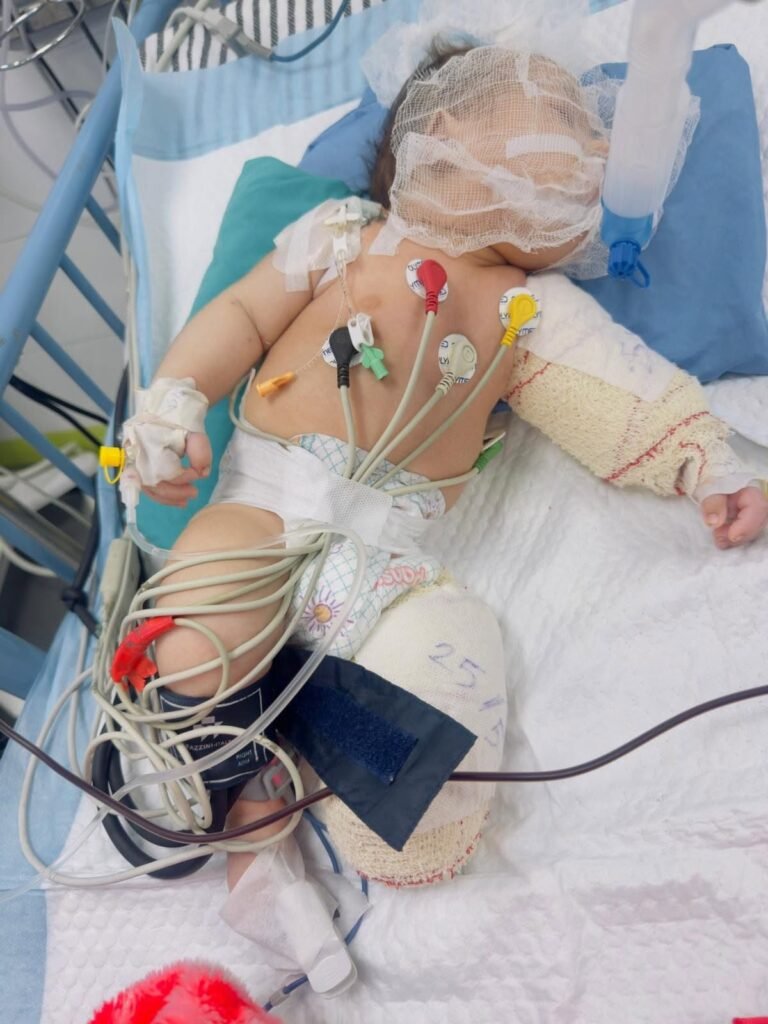
Gaza Herald _ At just four months old, Mohammed Ahmed Al-Khatib should have been learning to recognize the faces of his family, comforted by the warmth of his mother’s embrace and sheltered from the hardships of the world. Instead, he has become one of the youngest faces of Gaza’s ongoing humanitarian catastrophe.
Too young to understand the meaning of loss, war, or pain, Mohammed now lies in a hospital bed after surviving an Israeli airstrike that claimed his mother’s life and left him with life-altering injuries. His story reflects the suffering of countless Palestinian children whose lives have been permanently changed by the war.
A Mother’s Final Act of Protection
Mohammed was in his mother’s arms when an Israeli strike hit their area. According to relatives, she was holding him tightly and trying to shield him from the bombardment when she was killed.
Rescue teams later pulled the infant from beneath the rubble with severe injuries. Doctors were forced to amputate one of his legs, and his family now fears he may also lose a hand due to the seriousness of his wounds and the limited medical resources available in Gaza.
What should have been the beginning of a life filled with first steps and childhood memories has instead become a struggle for survival.
One Child’s Story, Thousands More Like It
Mohammed’s ordeal is not an isolated tragedy. Rather, it represents a broader crisis affecting thousands of Palestinian children throughout Gaza.
According to figures released by Gaza’s Health Ministry, approximately 6,000 amputations have been recorded among those injured since the war began. Children account for nearly a quarter of those cases, underscoring the devastating toll the conflict has taken on the territory’s youngest residents.
The scale of the crisis has prompted international organizations and United Nations officials to describe Gaza as home to the largest population of child amputees in modern history, amid continued bombardment, shortages of medical supplies, and limited access to specialized treatment.
Cries No One Can Explain
Mohammed’s uncle, Mahmoud Al-Khatib, says the infant has barely stopped crying since he was injured.
Family members struggle to understand the source of his constant distress. Is he crying because of the wounds covering his small body? Because of the pain from his amputated leg? Because he is hungry? Or because, somehow, he senses the absence of the mother whose arms were the last place he knew comfort?
Now cared for by his grandmother following his mother’s death, Mohammed spends his days moving between pain, uncertainty, and the efforts of loved ones trying desperately to soothe him.
A Family Watching Helplessly
Relatives describe a profound sense of helplessness as they watch a child begin life burdened by loss and injuries that may affect him forever.
For them, Mohammed’s condition is a heartbreaking reminder of the human cost of war. They speak of a baby who lost his mother before he could know her and whose future has been shaped by violence before he could even take his first steps.
A Race to Save What Remains
Family members say Mohammed urgently needs specialized medical treatment unavailable in Gaza. They are appealing for his transfer abroad, warning that the condition of his injured hand continues to deteriorate and could require amputation if treatment is delayed.
They fear that restrictions on medical travel and the broader collapse of Gaza’s healthcare system may deprive him of the opportunity to save what remains of his injured limbs.
A Symbol of a Larger Tragedy
Mohammed’s story is ultimately about more than one child. It is a reflection of the experiences of thousands of Palestinian children who have lost parents, limbs, homes, or entire families during the war.
As the conflict continues and the number of casualties rises, many of Gaza’s youngest survivors remain caught between ongoing violence, inadequate medical care, and an uncertain future.
For Mohammed Al-Khatib, life has only just begun. Yet his story already carries the weight of a tragedy that has come to define the childhood of an entire generation growing up amid rubble, loss, and grief.

