
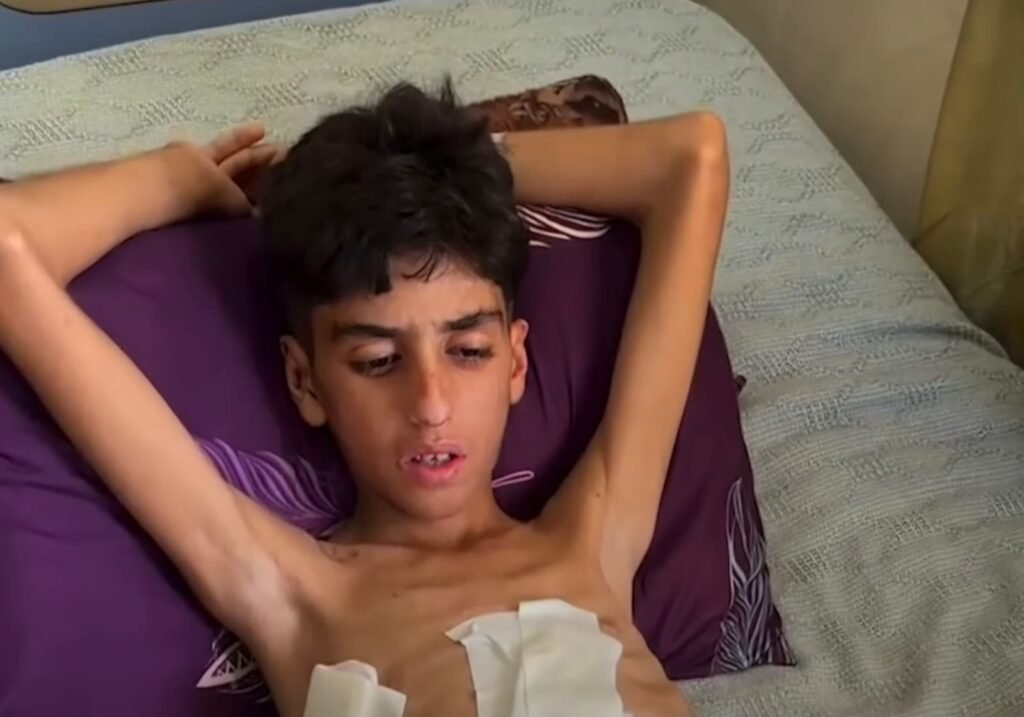
Gaza Herald – Fourteen-year-old Qusai Mahmoud Nasr never imagined that the meal he was sharing with his cousins would be the last moment they spent together. In an instant, what began as an ordinary family gathering turned into a scene of devastation when an Israeli drone struck the area, leaving him alone beneath the rubble and the sole witness to the loss of his childhood companions.
Recalling the moments that changed his life forever, Qusai says: “My cousins and I were eating when suddenly a missile from an Israeli drone fell on us.”
He explains that the first strike did not cause any fatalities, but the danger was far from over. Just minutes later, the area was targeted again by two additional missiles, turning what seemed like a narrow escape into a complete tragedy.
The Only Survivor
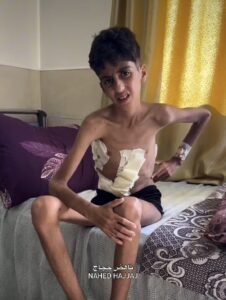 Qusai struggles to remember the second attack.
“I felt something pulling me with tremendous force, and then the rubble collapsed on top of me,” he says. “I was in severe pain, especially in the upper part of my body. When I finally opened my eyes, I realized I was the only survivor.”
All three of his cousins were killed in the strike, while Qusai suffered critical injuries from shrapnel that tore through his internal organs. One of his cousins remained trapped beneath the debris, and rescuers were unable to reach him because of the massive amount of rubble and stones covering his body.
A Painful Medical Journey
Surviving the attack was not the end of Qusai’s suffering; it was the beginning of another painful chapter.
He sustained severe damage to his spleen, colon, liver, and kidneys and underwent a series of complex surgeries. Doctors were forced to remove his spleen entirely, repair his colon, and continue treating serious liver injuries.
His kidneys eventually stopped functioning altogether, forcing him into a daily struggle with illness amid Gaza’s overwhelmed healthcare system and severe shortages of medical resources.
She Was Told He Had Died
Qusai’s mother, Hanadi Nasr, endured her own devastating ordeal.
Rescue teams initially informed her that her son had been killed in the attack. Only later did she discover that he was still alive.
“I was shocked to learn that he had survived,” she says. “His injuries were extremely serious. His condition remains very difficult. He depends on painkillers, and we later discovered that he is suffering from kidney failure in addition to the internal injuries caused by the shrapnel.”
She explains that the psychological pain her son carries is no less severe than his physical wounds. To this day, he has struggled to process the loss of the cousins who were sitting beside him only moments before they were killed.
“Since the attack,” she says sadly, “Qusai has wished that he had killed with them.”
A War That Never Ends
Months after the attack, Qusai’s condition has worsened due to severe malnutrition and food shortages caused by the continued closure of crossings.
The effects of war continue to accumulate on a body already weakened by injuries and repeated surgeries, while his chances of receiving the specialized treatment he needs inside Gaza grow increasingly limited.
Today, Qusai continues his fight for survival under extremely difficult humanitarian and medical conditions, requiring advanced care that is unavailable in the Strip.
A Dream of Recovery
Despite the loss, the pain, and the long months of suffering, the fourteen-year-old still clings to a small dream that gives him a reason to keep going.
Qusai is appealing to the relevant authorities to allow him to travel abroad for treatment, hoping to save his life and continue his recovery journey. He dreams that one day he will become a doctor, helping patients and giving them a chance at life, just as he now waits for his own chance to survive.

