
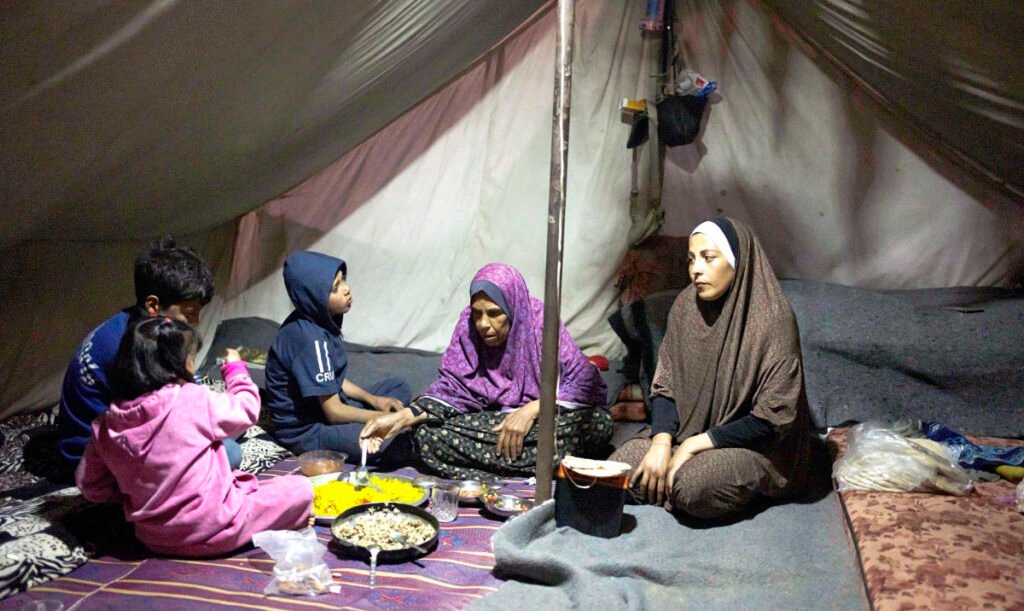
Gaza Herald- Safe spaces have disappeared, schools remain damaged, and hundreds of thousands of children are growing up amid displacement, uncertainty, and the lasting psychological effects of war.
A Generation Growing Up Without Safe Spaces
Gaza Herald _In a small displacement camp west of the Nuseirat refugee camp in central Gaza, dozens of children spend their days among rows of crowded tents. Some attempt to create games from scraps of wood and scattered pieces of plastic, while others wander through narrow pathways with little to occupy their time.
There are no nearby parks, no functioning playgrounds, and few facilities capable of offering children structured activities or meaningful engagement. While adults discuss aid deliveries, reconstruction efforts, and fragile ceasefire arrangements, Gaza’s children are often left waiting, filling endless hours in environments that offer little relief from the hardships surrounding them.
For many of Gaza’s children, the war is not a chapter that has ended. Its consequences continue to shape nearly every aspect of daily life. Although large-scale bombardment has eased under a fragile ceasefire, children remain surrounded by destroyed homes, damaged schools, and communities struggling to recover from years of devastation.
A Childhood Put on Hold
Under normal circumstances, children spend much of their time in schools, playgrounds, sports fields, and community centers. In Gaza, however, years of conflict, widespread destruction, and repeated displacement have dramatically reduced access to such spaces.
Many public parks have been damaged or rendered unusable, while schools and public facilities that once served educational and recreational purposes have been converted into shelters for displaced families. Even as military activity has decreased in some areas, thousands of families continue to live in temporary housing or overcrowded camps where opportunities for recreation and social development are virtually nonexistent.
Humanitarian workers say many children spend long hours without structured programs, educational activities, or safe environments where they can interact with their peers. As a result, concerns are growing about the impact this prolonged isolation is having on their emotional well-being, behavior, and ability to adapt to post-war realities.
Play Is Not a Luxury
Child development specialists stress that play is far more than entertainment. In conflict-affected communities, opportunities for recreation and social interaction are considered essential components of emotional recovery and healthy development.
Child protection experts at the UNICEF have repeatedly emphasized that child-friendly spaces and organized activities help young people process trauma, rebuild routines, and regain a sense of safety after experiencing conflict.
In previous statements, UNICEF spokesperson Jonathan Crickx noted that the overwhelming majority of Gaza’s children require psychological and social support after enduring prolonged exposure to violence and instability. According to child welfare specialists, emergency aid alone cannot address the needs of a generation that has experienced years of disruption. Children also require secure environments where they can learn, play, and gradually recover from the effects of war.
The Danger of Prolonged Isolation
Experts warn that the lack of educational opportunities, recreational spaces, and community programs could become one of the most serious long-term challenges facing Gaza’s younger generation.
With many schools destroyed, damaged, or operating only partially, countless children have lost access to stable educational environments. Without classrooms, playgrounds, or community centers, children become increasingly vulnerable to social withdrawal, psychological distress, learning difficulties, and developmental setbacks.
Specialists argue that many children now require more than conventional counseling sessions. They need environments that allow them to reconnect with their peers, rebuild confidence, and experience moments of normalcy that have been absent from their lives for years.
A Crisis Beyond Statistics
United Nations agencies estimate that more than one million children across Gaza require protection services as well as psychological and social support. Humanitarian organizations continue to struggle to meet growing needs amid limited resources and ongoing operational challenges.
In March 2026, Sima Alami, Youth and Adolescents Program Officer at the United Nations Population Fund, stated that most children in Gaza had experienced severe levels of fear, stress, and emotional hardship throughout the war, highlighting the urgent need to expand psychosocial support services.
Yet experts emphasize that recovery involves more than treatment programs. It requires rebuilding communities in ways that allow children to reclaim ordinary experiences and participate in daily life without constant exposure to instability and hardship.
Rebuilding Childhood Alongside Reconstruction
Despite ongoing efforts by local and international organizations, the scale of destruction and displacement continues to overwhelm available resources. Recent United Nations assessments indicate that demand for protection and mental health services remains significantly higher than current capacities.
Many existing programs operate within emergency response frameworks, while the psychological and social consequences of war are expected to persist for years. Specialists argue that reconstruction efforts focused solely on infrastructure will fall short if they fail to address the developmental needs of children.
In Gaza today, rebuilding is not simply about restoring homes, roads, and public facilities. It is also about recreating the social environment that allows children to grow, learn, and thrive. Parks, playgrounds, cultural centers, sports facilities, and child-friendly spaces are not secondary concerns. They are essential foundations for community recovery.
Experts believe that investing in such spaces can help reduce the long-term effects of trauma, strengthen social cohesion, and offer children an opportunity to reclaim parts of their childhood that conflict has taken away.
Waiting for More Than Reconstruction
As ceasefire efforts remain fragile and reconstruction progresses slowly, hundreds of thousands of children continue to live between the hardships of the past and uncertainty about the future.
Amid tents and damaged neighborhoods, many children create their own small spaces for play and imagination, trying to preserve fragments of normal life despite overwhelming challenges. Yet the true measure of recovery may not be how many buildings are rebuilt, but whether an entire generation is allowed to regain the childhood it has lost.
For Gaza’s children, the greatest reconstruction project may ultimately be the rebuilding of childhood itself.

