
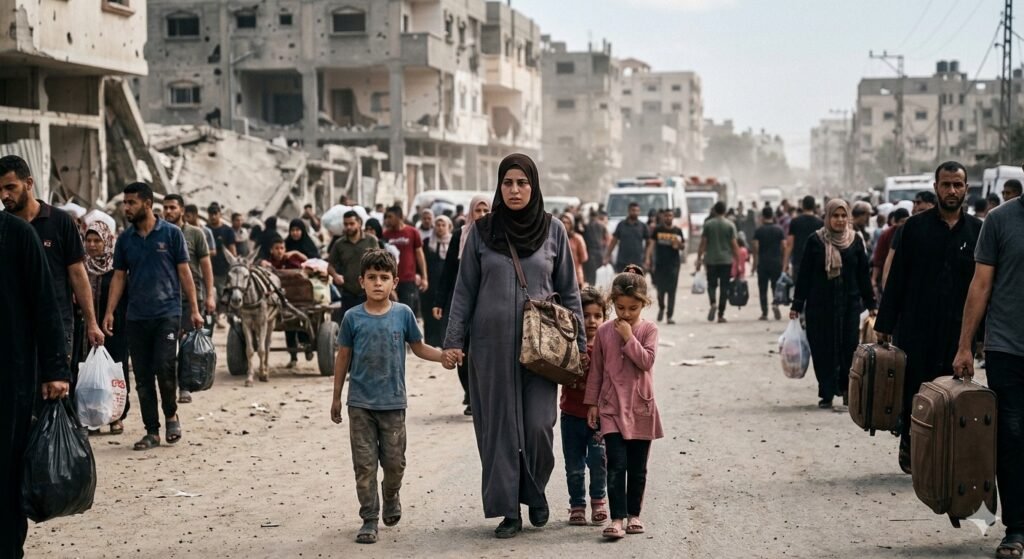
Gaza Herald – Rasha, 27, carried a small bag containing her children’s passports, a few pieces of bread, and a bottle of water before closing the door of her home in northern Gaza without knowing if she would ever see it again. Her only choice was to flee to save her children from the relentless attack of war.
Eight months pregnant and mother of three, Rasha also suffers from thalassemia, a blood disorder that weakens hemoglobin production and makes even the smallest movement exhausting. Yet the war left her no space to think about her illness or pregnancy; her only priority became keeping her children alive.
Food Scarcity
Since the beginning of the genocide, the family has lived under constant bombardment and severe shortages of food and basic necessities. Meals were often reduced to one a day, typically consisting of lentils, beans, or canned goods, while even the simplest needs of children became a daily struggle.
Rasha recalls: “When I had only one can of infant formula left, I would put a small spoon of it in a bottle of water just so my child could smell the milk before drinking.”
Diapers became a rare commodity, used only at night, while children spent their days without them. Over time, signs of deprivation became visible as malnutrition and illness spread among them.
The Decision to Flee
This was not the first time the family had been forced to flee, but it was the most difficult. As shelling intensified over Gaza City, staying home was no longer possible.
Her three children, aged between three and seven, lived in constant fear. As the family prepared to leave, the children asked painful questions: Where are we going? What will happen to our toys? Will we ever return home?
Rasha says: “We promised them we would buy them new toys and clothes after the war, trying to calm them while hoping that promise would one day come true.”
A Journey Through a “Hellish” Road
At 11 a.m., the family began their journey toward Khan Younis, where Rasha’s parents live. But the route was not a normal displacement; it was a passage through scenes of destruction and death.
“We walked through unimaginable scenes,” she says. “We saw the wounded and destruction everywhere, but we were not allowed to stop, and we couldn’t help anyone.”
Crowds of displaced families filled the roads, while tanks and soldiers lined the route. Her children walked silently, heads lowered, crying as fear surrounded them from every direction.
“My children were terrified. They were crying as they walked, while death seemed present everywhere around us,” she adds.
A Heavy Burden on an Exhausted Body
For Rasha, the journey was physically overwhelming. She had run out of iron supplements needed for her condition, while pregnancy complications worsened due to malnutrition and exhaustion.
“I was in constant pain and had lost a lot of weight,” she says. “What frightened me most was that I stopped feeling my baby move for long periods.”
With the collapse of the healthcare system and lack of access to doctors, she had no one to monitor her condition, increasing her fears for both herself and her unborn child.
A Temporary Refuge
When the family finally reached her parents’ home in Khan Younis, Rasha felt some relief, but it was mixed with fear and uncertainty.
With healthcare services collapsing, she began to consider the possibility of giving birth at home if she could not reach a hospital.
“This is not what I ever wanted,” she says, “but it may become the only option available. This is the harsh reality when medical care becomes out of reach.”
A Childhood Transformed
Her eldest daughter, Mimi, 7, did not return from the journey the same child.
She describes what she saw: “It was very scary. I saw destroyed homes and killed Palestinians in the streets. What frightened me most were the Israeli tanks.”
Before the war, Mimi loved drawing flowers, the sun, and her family. Today, her drawings have changed completely.
“I draw tanks, planes, and dead people because that is what I see around me,” she says. “I want to draw beautiful things like before, but there is nothing joyful anymore.”
Despite everything, the child still holds onto one simple dream: that the war will end, she will return home, and once again draw sunshine and flowers in peace with her family.

