
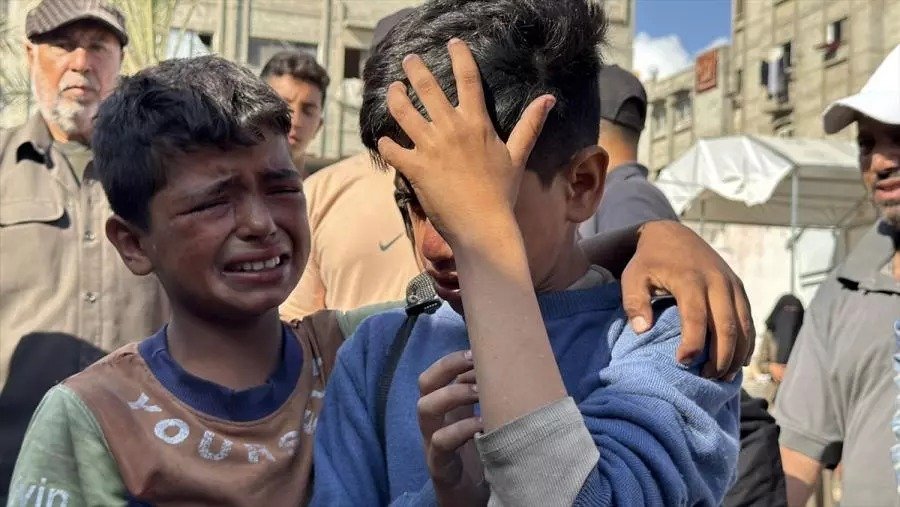
Gaza Herald – At around 10 p.m. on Tuesday, Palestinian mother Reem Zidan left with several of her children toward the American-Israeli aid distribution center west of Rafah, hoping to arrive early before thousands of hungry people gathered at dawn.
She Went Looking for Food and Returned in a Shroud
The mother of seven was searching for a food package that could save her children from the hunger consuming their bodies after the family had failed for days to obtain any aid.
But the journey that began in search of a bag of flour and a bottle of oil ended with a sniper’s bullet lodged in her head.
Her 14-year-old son, Abdul Rahman Zidan, says his mother “was killed while she herself was hungry,” after the road to humanitarian aid turned into an open field of death.
We Started Crawling Under Gunfire
Abdul Rahman recalled the final hours with his mother, saying the family left before dawn hoping to stand near the front of the lines, as reaching aid centers had become a deadly gamble.
“When we approached the distribution center, heavy gunfire began from the Israeli army, along with tear gas canisters,” he said. “We couldn’t see anything anymore. People were running and screaming in every direction.”
Amid the chaos, Reem instructed her children to crawl on the ground and stay low while drones and naval boats opened fire toward civilians gathered near the aid point.
“My mother kept repeating the shahada,” Abdul Rahman said. “She told us: ‘If we are killed, let it be for Palestine. And if we return safely, we will share the aid with those who found nothing to eat.’”
The Bullet That Ended Her Life
Despite the ongoing gunfire, the family continued moving forward, hoping to reach the distribution site.
Minutes later, Reem collapsed in front of her children after being shot in the head by a sniper.
“I started reciting the shahada into her ear and begged her to move or support herself, but she couldn’t,” Abdul Rahman recalled.
In her final moments, the mother urged her children to leave her behind out of fear they would meet the same fate.
She removed her only ring and handed her children her shoes and a few personal belongings, as though she knew those moments were her final goodbye.
Her youngest son, 12-year-old Ahmad, said: “She told us to leave so we wouldn’t all be killed.”
“She Killed So We Could Eat”
The children returned to their tent with neither food nor their mother.
Ahmad described Reem as the family’s “only source of safety.”
“When the bombing intensified, we used to sleep in her arms,” he said. “She always tried to keep us warm and feed us no matter what.”
Then, through tears, he added: “My mother was killed so we could eat, just for a bag of flour.”
The boy described being forced to leave his wounded mother behind under gunfire as “the hardest moment of his life.”
“Your children should die from hunger with dignity,” he said, “than to go to those aid centers and leave your mother bleeding in front of you while you can do nothing to save her.”
Three Hours Searching for Her
After fleeing the scene, the children began a painful search through hospitals and medical centers, hoping someone had rescued their mother.
Three hours later, they found her inside the morgue of a field hospital among unidentified bodies recovered from the vicinity of the aid distribution center.
“She was still alive when we left her,” Abdul Rahman said. “But we found no one who could save her.”
“Death Traps”
The American-Israeli aid distribution centers in southern Gaza have increasingly become as “death traps,” amid repeated Israeli shootings targeting starving civilians gathering in search of food.
According to the United Nations, nearly 1,500 Palestinians in Gaza have been killed while trying to obtain food, either near militarized aid distribution points or along aid routes, since the new distribution mechanism was introduced in late May 2025.
The tragedy unfolds as more than 2.4 million Palestinians in Gaza continue to endure catastrophic humanitarian conditions under Israel’s blockade, border closures, and severe restrictions on aid entry. Israel currently allows only dozens of aid trucks into the territory each day, despite Gaza requiring hundreds of life-saving humanitarian deliveries daily.

