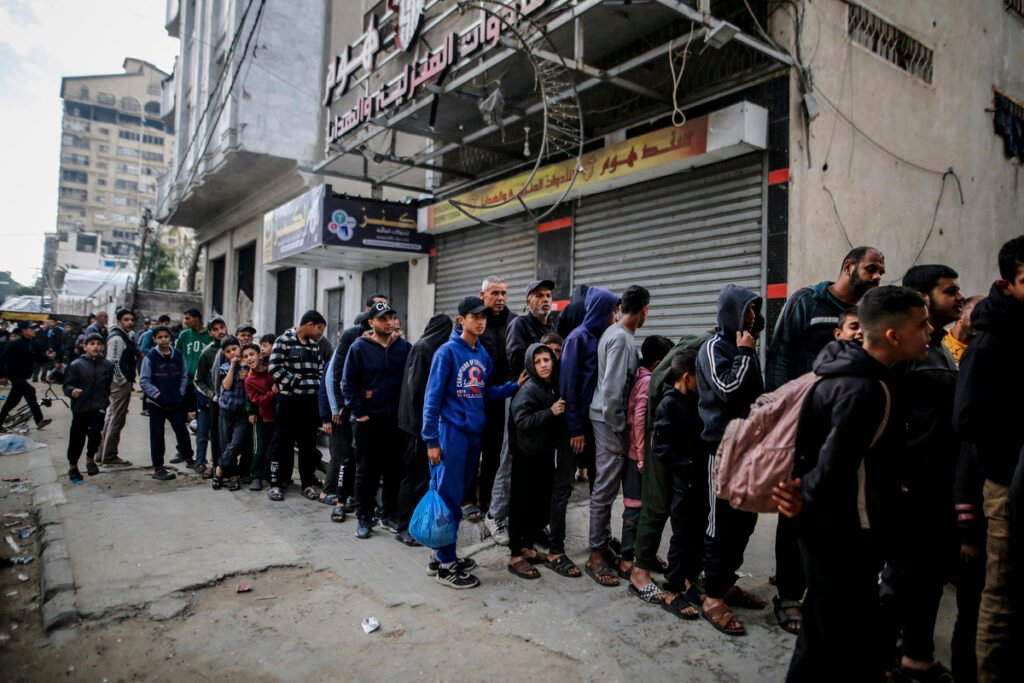
Gaza Herald – The bread crisis remains one of the most pressing daily challenges for civilians in the Gaza Strip. Production has declined, several bakeries have halted operations, and shortages of fuel and flour persist. This has led to long queues outside distribution points and bakeries, turning the simple task of obtaining a loaf of bread into a strenuous journey starting in the early hours of the morning.
The crisis highlights a clear imbalance in the local food market. Production has dropped by more than 30% while demand remains high, widening the gap between supply and demand. This has fueled rising prices and the emergence of a black market, at a time when most residents rely on humanitarian aid to meet their basic needs.
Although a loaf of bread subsidized by the World Food Programme is sold at only 3 shekels ($0.90), prices on the open market range between 7 and 15 shekels, placing a heavy burden on households. Flour prices have also surged, with a bag increasing from 25 to 100 shekels, making bread, an essential staple linked directly to food security, a daily struggle for thousands of families.
Residents describe the ordeal as exhausting. Samir Baroud explained that obtaining a loaf of bread now requires extraordinary effort due to extreme congestion at points of sale and limited availability. He said many people have to arrive extremely early, hoping to secure enough bread for their families. “Our struggle starts just after dawn,” he said, “standing in long queues, knowing that arriving a few minutes late could mean coming home empty-handed,” Baroud emphasized that the crisis goes beyond bread alone, affecting parents’ ability to meet their children’s basic needs, with hardship growing each day.
Wail Darwish added that the challenge is not only waiting in line but also securing the small amount of money needed to buy the subsidized loaf. “Many families face a daily struggle just to pay three shekels,” he said. “The lack of small change often complicates the situation more than standing in the queue for hours. Some residents must borrow money or find change before going to buy bread, adding another layer of difficulty.”
The scale of the crisis reflects the mounting pressure on residents, as the problem encompasses far more than long queues; it is a chain of obstacles, starting with securing money and ending only when reaching the point of sale. Bread remains the most affordable and vital food option for families, but access has become increasingly challenging.
Bakery owner Mahmoud Kilani, operating a licensed point under the World Food Programme, explained that the quantities received are no longer sufficient to meet the population’s needs. Before Ramadan last month, his bakery received around 1,000 loaves per day, which was reduced to 750 per day this month. Kilani said this reduction placed distribution workers in a difficult position with neighborhood residents, especially as the number of people in need continues to rise and many families rely on the limited quantities.
“The demand far exceeds what is available,” Kilani said, “forcing us to give each family only one loaf, whether the household is large or small, to ensure that as many people as possible benefit. Even though one loaf is insufficient for larger families, we have no choice but to distribute it this way to avoid depriving others.”
Kilani added that resolving the crisis requires increasing supply, reopening bakeries, and urgently providing flour, fuel, and necessary spare parts.