
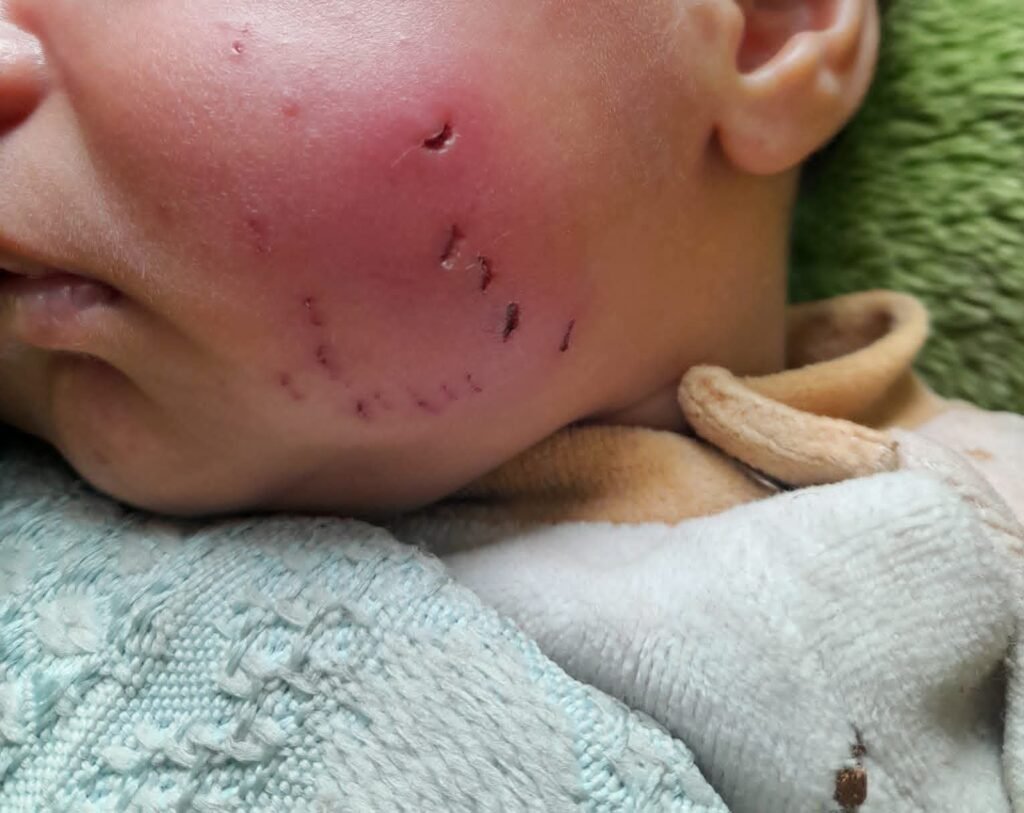
Gaza Herald- In the stillness of a cold night inside a makeshift tent in western Gaza City, a newborn’s cry pierced the silence, sharper, more urgent than usual. When his father rushed to check on him, he was met with a horrifying sight: his 28-day-old son, Adam Al-Ustadh, lay bleeding, a deep bite wound carved into his tiny cheek.
Adam is now under close medical supervision at Al-Rantisi Children’s Hospital, having narrowly escaped a potentially life-threatening infection. But his story is far from an isolated incident, it reflects a grim, often overlooked reality for thousands of displaced families across Gaza.
A Night of Horror
Adam’s father, Yousef, recalls waking shortly after 1 a.m. to the sound of distressed crying. As he approached his child, he noticed blood covering the infant’s face. A rat had just fled the tent.
With no time to think, he rushed his son to the hospital, driven by instinct and fear. Inside their fragile shelter, there were no doors, no barriers—nothing to keep out the rats that had become an unavoidable part of daily life in displacement camps.
Life in Unsafe Shelter
For families like the Al-Ustadhs, displacement has meant more than losing a home; it has meant losing safety altogether. Their house in Sheikh Radwan was destroyed earlier in the war, forcing them into repeated cycles of displacement before ending up in a tent that offers little protection from the elements, or from the dangers creeping within.
With waste piling up, sanitation systems collapsing, and overcrowding intensifying, rats and insects now thrive in these camps. They move freely between tents, exploiting an environment stripped of basic infrastructure.
A Worsening Humanitarian Crisis
According to international reports, Gaza’s displacement camps are facing severe overcrowding and deteriorating water and sanitation conditions. With ongoing hostilities and a prolonged blockade, essential services remain largely absent, increasing the spread of disease, especially among children, who are the most vulnerable.
Doctors warn that rodent bites can transmit serious infections, requiring urgent treatment and close monitoring. Adam remains under observation, as his parents anxiously await signs of recovery.
A Pattern, Not an Exception
Incidents like Adam’s are quietly circulating among displaced families, shared in hushed conversations, often without reaching wider attention. With local authorities overwhelmed and resources stretched thin, there are few effective measures to curb the spread of rodents.
The tents themselves, lacking proper flooring, doors, or insulation, leave families exposed not only to harsh weather but also to constant environmental threats.
Childhood Under Threat
What should have been an ordinary night turned into a traumatic ordeal for one family, but it echoes a broader crisis. Across Gaza, thousands of children are growing up in conditions that offer neither safety nor stability.
In this reality, danger no longer comes solely from the sky. It lurks in the everyday, within the shelter, in the water, in the air. The tent, once a temporary refuge, has become a fragile space where survival itself is uncertain.
For Gaza’s youngest, childhood is no longer just interrupted by war; it is being reshaped by it.

