Gaza Herald _Repairing the damaged apartment of Youssef Al-Hallak in Khan Younis, southern Gaza, was far more than a routine construction project. For his family, it felt like a delicate operation to revive a home wounded by war.
When teams from the Palestinian Ministry of Public Works and Housing arrived, supported by funding from the United Nations Development Programme, they did not bring trucks filled with cement or bricks. Israel’s restrictions prevent those materials from entering Gaza. Instead, they came with creative plans to transform limited resources into a safe place to live.
Carpenters began rebuilding the apartment using wooden shipping pallets, materials once used to carry imported goods. With careful craftsmanship, the pallets were fixed along the edges of the exposed apartment, forming protective barriers to prevent children from falling from the damaged building.
Sheets of heavy plastic and nylon were then stretched across the wooden frames, creating makeshift walls. Simple windows were added using wooden poles that could be lifted or lowered, allowing fresh air and sunlight to enter and replacing the darkness left by destruction.
Restoring Dignity at Home
In a corner that had once been reduced to rubble, a small kitchen was rebuilt. Pieces of marble, possibly salvaged from shops or recovered from debris, were used to create a modest cooking area.
For Al-Hallak’s wife, the kitchen represented more than a practical space. It allowed her to regain a sense of normal life, enabling her to wash dishes and cook safely without the constant fear of fire spreading through their tent or the humiliation of preparing meals outdoors.
One of the most meaningful improvements came with the installation of a small bathroom. Using opaque nylon sheets for privacy, along with a sink and a basic toilet, the family was finally able to escape the unsanitary conditions they had endured in overcrowded displacement shelters for months.
As the final touches were completed at sunset, workers installed the most anticipated addition, a door. After months of living behind a worn tent zipper or loose fabric flapping in the wind, the family once again had a real door they could close at the end of the day.
For Al-Hallak, the repairs were not a permanent solution, but they were enough to rescue his family from the harsh reality of life in tents.
Life in the Tents
The apartment building in the Al-Amal neighborhood had been struck by Israeli bombardment early in the war. Only the concrete columns remained standing, surrounded by piles of collapsed walls and debris.
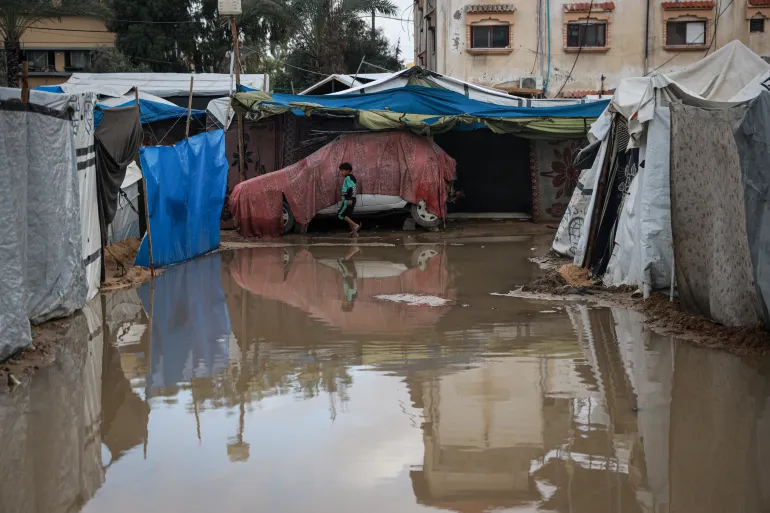
Since then, Al-Hallak and his family had been forced to live in a tent, moving repeatedly as the fighting spread. His four children, the youngest still an infant and the oldest just six years old, endured repeated displacement.
Their tent, measuring only about 12 square meters, offered little protection. It also became a breeding ground for illness, exposing the children to skin infections and intestinal diseases that required repeated hospital visits.
Reflecting on the assistance he received, Al-Hallak expressed deep gratitude and urged authorities to continue supporting similar projects to help other families escape the harsh conditions of displacement.
Temporary Solutions to Ease the Crisis
Officials in the Palestinian Ministry of Public Works and Housing believe that these temporary repairs could offer relief for tens of thousands of families whose homes were damaged during the war.
According to the ministry’s reconstruction team, the government has developed a temporary shelter strategy focused on repairing partially damaged homes as a priority. At the same time, additional housing initiatives are being prepared, including the construction of prefabricated housing units that could serve as interim shelters until full reconstruction becomes possible.
Statistics indicate that around 60,000 housing units in Gaza have suffered partial or minor damage. Out of roughly 350,000 homes affected by the war, many could potentially be restored temporarily and used as alternatives to tents.
A project has already been launched in partnership with international partners to repair these homes using locally available materials such as wood and reinforced plastic.
These repairs provide families with basic living conditions, including temporary walls, a small kitchen, a toilet, and a water tank. For many people who have endured months in tents or overcrowded shelters, even such modest improvements represent a significant step toward restoring dignity.
Reconstruction Blocked by Restrictions
Despite these efforts, the ministry faces major obstacles due to the continued closure of Gaza’s crossings.
Without access to traditional construction materials, permanent rebuilding remains impossible. As a result, workers must rely on temporary materials such as nylon sheets and wood to carry out repairs.
The first phase of the program has already restored more than 200 housing units, while additional stages are being planned.
Behind these projects, local workers have also adapted their professions to the reality of war. Carpenter Mohammed Al-Helou, who once built furniture, now focuses on constructing protective walls and temporary structures.
He says demand for such work is high because many families want to escape the harsh conditions of life in tents, especially during the cold and rainy winter months.
High Costs for Displaced Families
Even these improvised solutions remain expensive for many displaced residents.
Due to the rising cost of wood and other materials, repairing a single room can cost around 1,000 shekels, about 320 dollars. Restoring an entire apartment may reach 3,000 shekels, or roughly 960 dollars.
Labor costs can range from 400 to 1,000 shekels depending on the scale of the work.
While finishing the final wooden wall of a recently repaired apartment, Al-Helou called on donors and aid organizations to support reconstruction initiatives rather than focusing solely on distributing tents.
A Worsening Housing Crisis
Officials in Gaza say the housing crisis has reached catastrophic levels. Tens of thousands of Palestinian families are living in harsh conditions inside fragile tents that lack even the most basic requirements for a dignified life.
Winter storms, strong winds, and heavy rains have made life even more difficult for displaced communities.
More than 90 percent of Gaza’s built environment has been damaged or destroyed during the war, forcing nearly two million Palestinians from their homes and creating an unprecedented housing disaster.
Today, more than 213,000 families are living in tents, representing over 60 percent of Gaza’s population of approximately 2.4 million people.
During the current winter season alone, over 127,000 tents have been torn or partially collapsed due to strong winds and rain, leaving many families even more vulnerable.