
📅 March 4, 2026
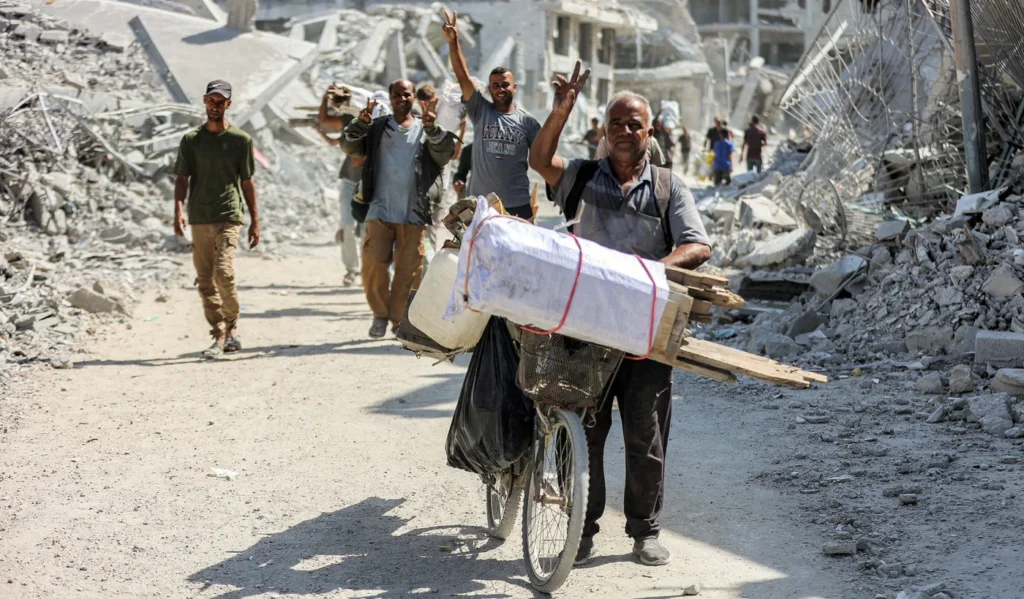
Gaza Herald _As regional tensions intensify following the US, Israeli military escalation against Iran, many Palestinians in Gaza are once again gripped by deep anxiety. Continuous news coverage, images of airstrikes, and reports of clashes in countries hosting U.S. military bases have revived painful memories of the devastating war that Gaza endured, marked by mass destruction, indiscriminate bombardment, and hunger.
For many residents, fear is no longer a passing emotion but a deeply rooted psychological response shaped by two years of relentless trauma. Every loud sound, every political statement, and every military development in the region is interpreted as a possible signal of renewed catastrophe. Even in the absence of clear indicators of imminent escalation in Gaza itself, past experience has left the population in a fragile psychological state, constantly bracing for the worst.
Forty-five-year-old Fouad Al Jamal describes living in a state of continuous anticipation and distress. After surviving two years of bombardment and deprivation, he says he cannot separate the current regional developments from his own lived trauma. When he heard that Gaza’s crossings were closed again due to the regional conflict, he found himself unable to sleep. The same suffocating anxiety he experienced during the war returned immediately. Even the sound of a distant reconnaissance aircraft triggers fear.
He explains that his children repeatedly ask whether another war is about to begin and whether they will be forced to flee once more. He struggles to reassure them. “I do not feel safe myself,” he says, “so how can I convince them that we are safe?”
Beyond fear of airstrikes, he notes that the specter of famine has resurfaced in people’s minds. On the first day regional tensions escalated, he observed sudden price hikes and the disappearance of certain goods from markets. For many, this immediately revived memories of prolonged hunger and humiliation.
Heba Al Akkad shares a different but equally painful concern. The closure of the Rafah crossing, triggered by regional instability, has jeopardized her child’s chance for medical evacuation. Her son, who has leukemia, has been waiting for months for treatment unavailable in Gaza. The crossing’s brief reopening had offered hope, but its closure has returned them to uncertainty. She fears that if tensions persist, the crossing may remain shut indefinitely, as it has in the past.
Some residents believe that Gaza’s fragile ceasefire could be further undermined. Kamal Abu Aker, 41, says that previous experiences suggest regional conflict often creates space for additional pressure on Gaza. He describes the current ceasefire as fragile, marked by daily violations, and fears that global attention focused on Iran could reduce scrutiny of actions affecting Palestinians.
Political analyst Wissam Afifa argues that Washington’s preoccupation with a broader regional confrontation may reduce pressure on the Israeli government to implement the second phase of the Gaza ceasefire agreement. He suggests this could result in delays or reinterpretations of key provisions, including withdrawal and reconstruction commitments. He also warns of a dangerous scenario in which Gaza becomes entangled in broader regional negotiations, turning the Strip into a bargaining chip in geopolitical struggles that overshadow its humanitarian needs.
Psychological Toll
Mental health specialist Dr. Khetam Abu Odeh explains that the current regional developments are reactivating collective trauma in Gaza. Continuous uncertainty and the repeated closure of crossings serve as triggers, particularly for those who lost family members or homes in previous assaults.
She notes that even hearing words like “war” or “bombing” can instantly revive feelings of terror and helplessness. These triggers activate automatic emotional and physical responses, including chronic insomnia, persistent tension, panic attacks, and an ongoing sense that danger is imminent.
According to Abu Odeh, many residents now live in a state of constant anticipation, as though violence could erupt again at any moment. This erodes concentration, weakens daily functioning, and strains social relationships. She describes the situation as a vicious cycle, where new developments reactivate old trauma, leaving the population increasingly vulnerable to long term psychological distress.
Gaza’s residents, she explains, are living with cumulative collective trauma shaped by years of blockade, repeated wars, famine, displacement, and loss. These experiences have embedded fear deeply into the community’s shared memory. As a result, even limited or distant crises can reignite widespread anxiety and despair.
She emphasizes that addressing mental health and ensuring a stable, secure environment are essential to breaking this cycle, particularly for children, women, and the elderly, who are often the most affected by repeated trauma. Without sustained psychological support and genuine stability, she warns, the invisible wounds of war will continue to shape daily life in Gaza long after the headlines fade.

