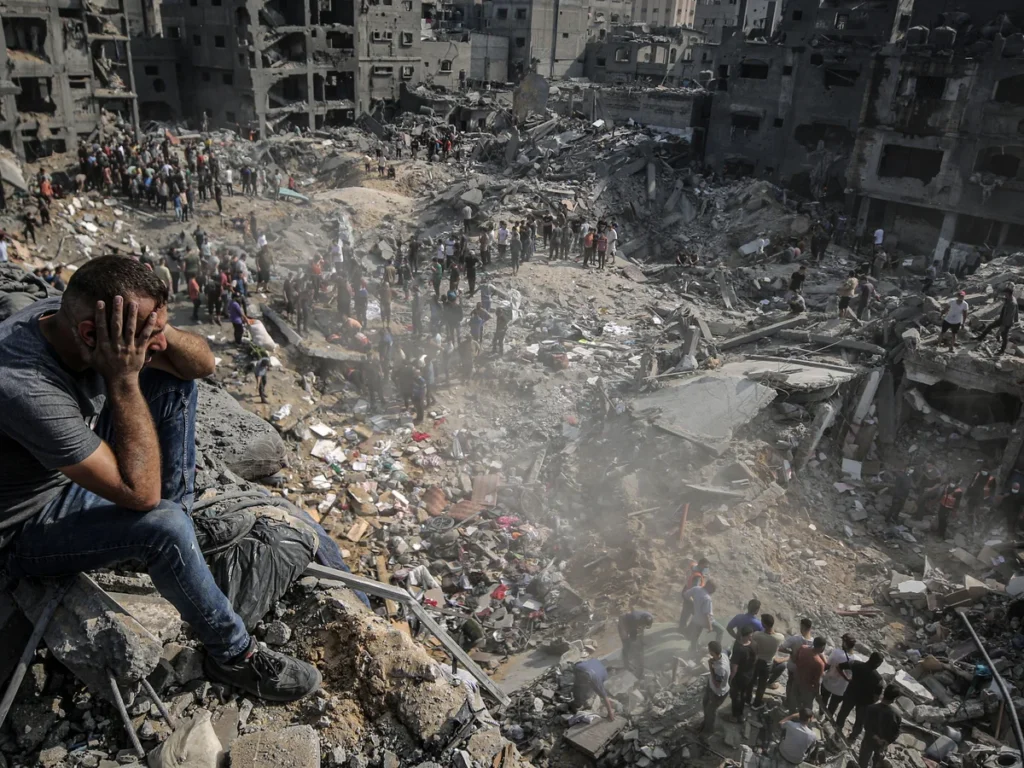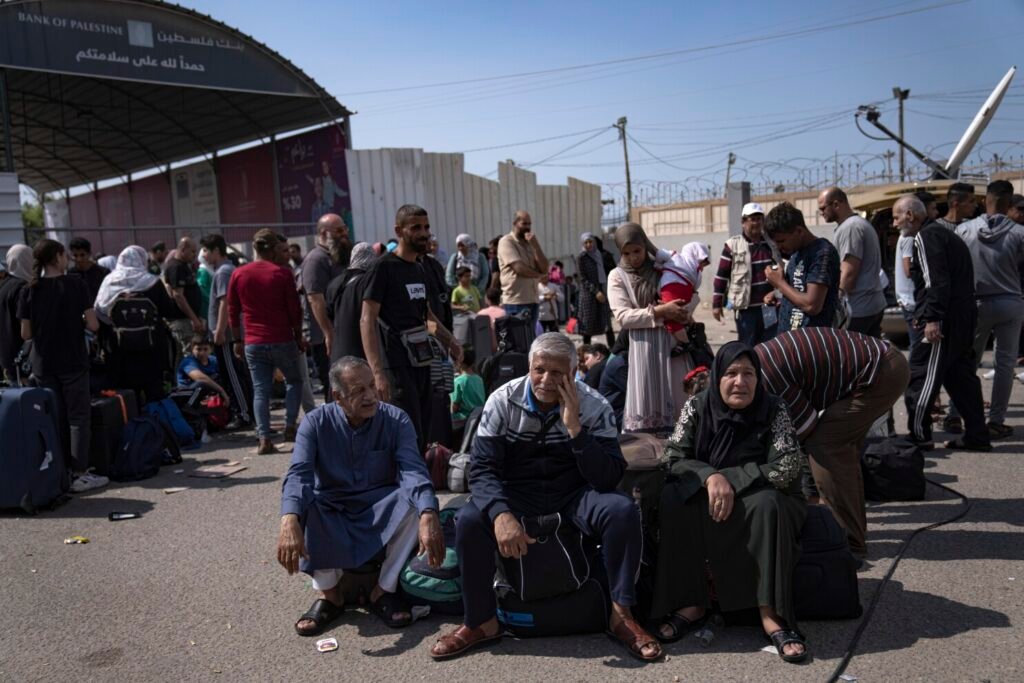
Gaza Herald- The destruction of Gaza did not stop at flattened buildings and shattered neighborhoods. It struck at the heart of the territory’s economic life, dismantling its ability to produce, employ, and sustain its population. What remains is not merely a weakened economy but a system pushed to the brink of total collapse, where survival itself has replaced growth as the central economic reality.
Gaza’s economy has emerged from Israel’s devastating war in a state of near-total paralysis, with damage extending far beyond physical infrastructure into the very foundations of production, employment, income, and financial stability. The crisis is no longer defined by recession or liquidity shortages alone but by a structural breakdown that has disrupted every major component of economic life.
Macroeconomic indicators paint a grim picture. Unemployment has surged to unprecedented levels, poverty has become nearly universal, and economic output has contracted at historic rates. The vast majority of Gaza’s population now relies almost entirely on humanitarian aid to survive.
Production cycles have been halted, infrastructure lies in ruins, and formal markets have largely been displaced by an expanding parallel economy that dominates daily transactions.
Economic analyst Ahmed Abu Qamar, speaking to the Palestinian Information Center, described the collapse as both deep and systemic.
He said unemployment, which stood at around 43 percent before the war, has now climbed to approximately 80 percent, marking an alarming and unprecedented rise. Poverty rates have also worsened dramatically, increasing from 75 percent to roughly 90 percent, leaving the overwhelming majority of Gaza’s population below the poverty line.
Before the war, about 55 percent of residents depended on aid. Today, that number has risen to 95 percent, underscoring the extent of economic devastation.
Abu Qamar emphasized that Gaza’s economy had already been weakened by years of blockade and restrictions imposed by Israel, which limited the entry of raw materials and disrupted industrial and agricultural activity. Over time, many workers shifted toward the service sector, which proved more resilient under siege conditions. However, the recent war devastated even this sector, accelerating the collapse of the entire economic system.
He noted that agriculture has lost more than 90 percent of its productive capacity, despite previously contributing around 13 percent to Gaza’s gross domestic product. Meanwhile, more than 90 percent of productive facilities have been damaged or destroyed, including factories and workshops critical to economic recovery.
As a result, many residents have turned to small-scale survival activities and relief-based work, reflecting a profound structural shift in the economy.
Even if border crossings reopen, Abu Qamar warned that industrial recovery will be slow due to extensive infrastructure destruction.
He estimated direct economic losses from the war at approximately 30 billion dollars, with indirect losses potentially matching or exceeding that figure.
The economic contraction itself has been staggering. Gaza’s economy shrank by 83 percent in 2024 and by more than 90 percent in 2025, compared to contractions of less than 10 percent during previous years of blockade. According to Abu Qamar, this means Gaza has effectively lost more than 50 years of economic development in just two years of war.
The labor market has also undergone a fundamental transformation. Remote workers lost their jobs due to widespread electricity outages and internet disruptions. In response, many residents have shifted to what Abu Qamar described as a “survival economy,” taking on informal jobs such as repairing damaged currency, fixing shoes, sewing clothes, and delivering water.
This shift represents a move away from productive economic activity toward subsistence-level survival.
Income loss has severely weakened purchasing power, while unemployment continues to suppress household earnings. Many public sector employees receive only partial salaries, with some earning about 1,000 shekels every two months, even as the prices of basic goods have increased up to fivefold.
At the same time, the cost of coordinating the entry of a single commercial truck ranges between 300,000 and 900,000 shekels, costs that are ultimately passed on to consumers, widening the gap between income and living expenses.
Abu Qamar described the current situation as a form of “engineered famine,” in which food enters Gaza in limited quantities and at high prices, making it inaccessible to most residents.
He also noted the growing dominance of the black market, as formal banking operations remain largely symbolic and unable to resolve cash shortages. A small group of traders has gained control over liquidity and essential goods through monopolistic practices, further strengthening the shadow economy.
Infrastructure destruction remains one of the greatest obstacles to recovery. Gaza’s electricity sector alone has suffered direct losses estimated at 800 million dollars, while approximately 65 percent of water networks have been damaged.
Without restoring electricity, water systems, and access to raw materials, Abu Qamar stressed that economic recovery will remain impossible.
He concluded that Gaza does not only need physical reconstruction, but a complete economic rebuilding process. Reopening crossings, restoring banking operations, breaking black market monopolies, and enabling the flow of goods and materials are essential steps toward reviving economic life.
Until those conditions are met, Gaza’s economy will remain trapped in a state of prolonged paralysis, leaving its population struggling to survive amid the ruins.