
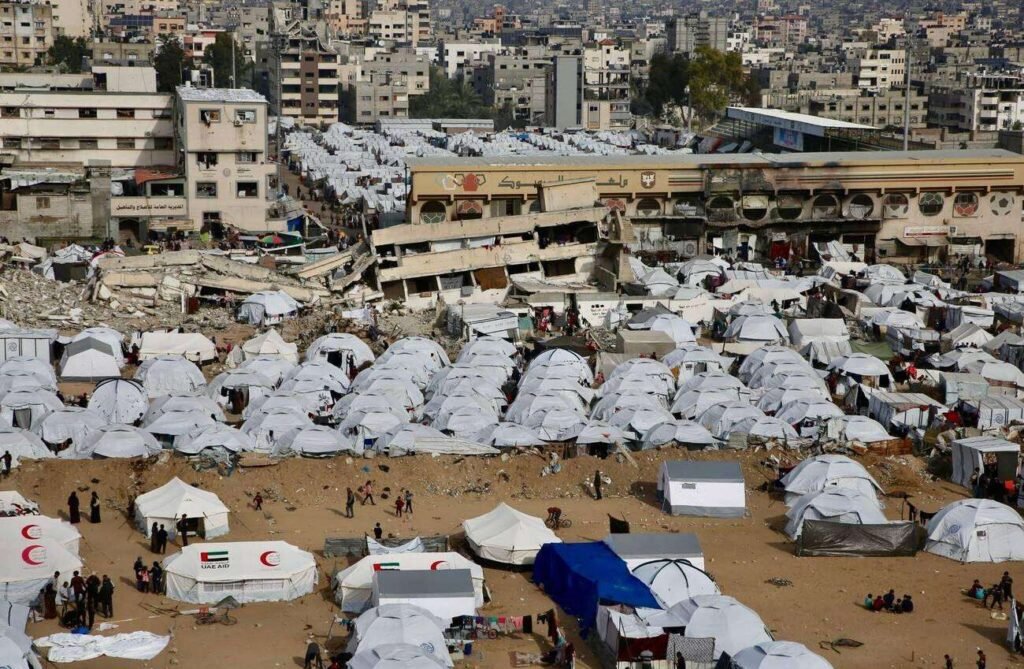
Gaza Herald_ More than a humanitarian catastrophe, the war on Gaza represents a sustained assault on civilian life, dignity, and survival. Entire neighborhoods have been erased, families torn apart, and necessities deliberately denied. Within this context, “Gaza… A Never-Ending Night” exposes the human cost of Israel’s military campaign, revealing how collective punishment and forced displacement have transformed Gaza into a landscape of permanent trauma.
No Palestinian family in Gaza has been spared the devastation of Israel’s war. The documentary film “Gaza… A Never-Ending Night” bears witness to harrowing accounts of families living through loss, forced displacement, hunger, and profound psychological trauma. Through personal testimonies, the film captures the scale of suffering inflicted on civilians and the enduring impact of a war waged primarily against a besieged population.
Hiba Salem’s experience reflects the daily reality faced by countless families. Living with her children in a constant state of fear, she describes how her children repeatedly ask her: “Mama, what will happen to us? How can we stay okay?” For Hiba and her family, survival itself has become an ongoing battle. Early in the war, they lost their home, one she and her husband, Ayman, had spent three years improving to shelter their eight children, leaving them exposed to the violence and uncertainty that now define life in Gaza.
Commenting on the scale of violations, Amnesty International Secretary General Agnès Callamard stated that the number of victims, the imposition of collective punishment, and the systematic denial of humanitarian aid since the early days of the war all constitute grave violations of international humanitarian law and the fundamental right to life. Amnesty International has investigated multiple Israeli airstrikes on Gaza and concluded that many did not target legitimate military objectives, but instead struck civilians and civilian infrastructure.
American Support
Despite the immense civilian toll and successive reports by international human rights organizations documenting serious violations of international law, the United States, Israel’s principal ally, has continued to provide political and military support.
Josh Paul, a former U.S. State Department official, acknowledged this complicity, stating, “I think the United States is aware that war crimes have been committed. The news is full of it every day, and we have other ways of knowing what is happening in Gaza. Yet we continue to supply weapons, which makes us, quite naturally, complicit.” He added that on October 9, 2023, he warned senior colleagues about the urgent need to confront how U.S. weapons were being used against civilians in Gaza.
The documentary returns repeatedly to the suffering endured at night, when fear intensifies and memories of loss resurface. Wissam Hamada describes the darkness as a time of terror and remembrance: “The night is long. The night is terrifying. The night means fear. The night means remembering Hind.”
Among the most devastating stories is that of Abdullah Al-Ghif, who was displaced with his family from northern Gaza and forced to live under extremely harsh conditions. One day, after his young son asked for date biscuits, Abdullah went to the market to buy them. Shortly after he left, the building sheltering his family was bombed. His wife and his two-year-old son, Firas, were killed in the Israeli strike. Abdullah’s grief deepened when his son Mohammed, who had been wounded in the same attack and transferred to Egypt for treatment, later died from his injuries.
By the end of 2023, as Israeli bombardment continued across the south, the number of Palestinian martyrs had surpassed 21,000. Journalists and humanitarian workers were killed in unprecedented numbers, while Israeli restrictions on aid intensified, allowing hunger to spread, particularly in northern Gaza, which by 2024 had become virtually uninhabitable for civilians.
The Story of Hind Rajab
The film also revisits the killing of Palestinian child Hind Rajab, a case that came to symbolize the cruelty of the war. Wissam Hamada returned to northern Gaza with her son, Iyad, and her six-year-old daughter, Hind, staying with relatives, including 15-year-old Layan. Amid freezing temperatures and heavy rain, the family attempted to flee once again. Hind accompanied relatives as they sought safety.
As Israeli gunfire surrounded them, Hind’s relatives managed to contact the Red Crescent in Ramallah, which attempted to coordinate the dispatch of an ambulance from Gaza, requiring approval from Israeli authorities. While Red Crescent staff remained on the phone with Hind, waiting for permission that never came, she was killed by Israeli fire.
“Gaza… A Never-Ending Night” ultimately stands as a testament to the lived reality of Palestinians in Gaza: a population subjected to continuous violence, denied protection, and forced to grieve under the cover of endless nights, where survival itself has become an act of resistance.

