
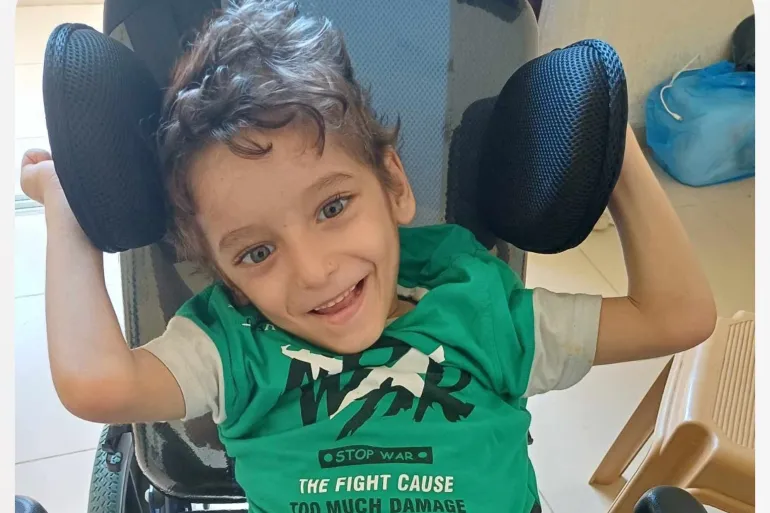
Gaza Herald _Jamal is nine years old. His small body is paralyzed, wracked by relentless and violent spasms that strike without warning. They are so severe that sleep is impossible, not for him, and not for his mother. To control these convulsions, Jamal depends on a medication called baclofen, which relaxes the muscles and prevents the spasms from spiraling out of control. Abruptly stopping this drug can lead to devastating and life-threatening consequences.
A week ago, Jamal’s mother, my cousin Shaima, sent me a message from the family’s tent in the al-Mawasi displacement camp in Gaza. At that point, her son had already gone seven days without the medicine. The neurological attacks gripping Jamal’s limbs come in waves, leaving him screaming in agony, his pain echoing through the camp.
Baclofen cannot be found anywhere in Gaza. It is absent from hospitals, clinics, the Ministry of Health warehouses, and even from humanitarian organizations. Shaima has searched them all. Like countless other essential medications, including pain relief and antibiotics, it is among the drugs blocked by Israel.
Jamal now suffers from dozens of spasms every single day. There is no replacement medication. No alternative treatment. No respite. Only suffering.
If figures like former US Secretary of State Mike Pompeo have their way, Jamal’s story will never be told.
Speaking last month at the MirYam Institute in the United States, a forum dedicated to promoting Israeli narratives, Pompeo declared: “We need to make sure that the story is told properly so that when the history books write this, they don’t write about the victims of Gaza.” His audience applauded.
Pompeo went on to argue that civilian casualties are an inevitable part of war, but insisted that the true victims of this conflict are the Israeli people. His fear, he said, is that October 7 and Israel’s war on Gaza might be remembered “incorrectly.”
What Pompeo is really saying is that Gaza’s people are nothing more than collateral damage, nameless, faceless, disposable. Their suffering, their deaths, and their stories are to be erased from history itself.
These remarks signal the next stage of Israel’s genocide. Having already devastated Gaza’s population, demolished its mosques, flattened its schools and universities, destroyed its cultural institutions, crushed its economy, and seized its land, Israel and its Christian-Zionist allies are now pursuing something more insidious: the erasure of memory, testimony, and martyrdom.
This campaign is unfolding both inside Gaza and far beyond it. The United Nations Relief and Works Agency (UNRWA), an institution that has preserved the legal status of Palestinian refugees and defended their right of return under international law for decades, is being systematically attacked and dismantled. Social media platforms that once allowed Palestinians some space to speak are now restricting, shadow-banning, and silencing pro-Palestinian voices.
Across the United States, the United Kingdom, and other Western states, laws are weaponized against pro-Palestinian youth. Students are detained, careers destroyed, and speech criminalized for expressing solidarity with Gaza. In parts of the US, legislation has even been passed to dictate how Israel and Palestine can be discussed in schools, reshaping history itself through censorship.
Yet what Pompeo and those like him, who distort scripture to sanctify colonial violence, fail to grasp is this: Palestinians have endured erasure before. And we survived it. We will survive this, too.
When reflecting on memory and bearing witness, the concept of the martyr becomes unavoidable. The word “martyr” originates from the Greek martus, meaning witness, and appears throughout biblical texts. In Arabic, shaheed comes from the same root – to witness, to testify. Over time, it also came to embody the idea of suffering for one’s beliefs and standing firm in the face of overwhelming violence.
There is no word more fitting than shaheed to describe Jamal and those like him – living martyrs. Jamal’s fragile body has witnessed unspeakable cruelty. It has absorbed the violence of war, the cruelty of siege, and the silence of the world. Yet he continues, driven by a fierce will to live, just like his mother.
Surrounding Jamal and Shaima’s tent are thousands of others. Day and night, Jamal’s cries cut through the camp. Inside nearby tents, cold, soaked by recent floods, barely standing, are countless others in desperate need of urgent medical evacuation, treatment, and dignity.
The suffering is vast beyond comprehension. Still, men like Pompeo persist in justifying the ongoing, deeply rooted project aimed at the elimination of the Palestinian people.
But Palestinians are also poets. And what those who belittle language, memory, and history will never understand is this: the poet is a witness.
As Mahmoud Darwish wrote:
Those who pass between fleeting words,
Take your names with you and go.
Rid our time of your hours, and go.
Take what you will from the sea and the sands of memory.
Take what images you want, so you might understand
What you will:
How a stone from our land becomes the ceiling of our sky.
The Palestinian people will continue to safeguard memory, just as we have preserved the pain of Beit Daras, Deir Yassin, Jenin, Muhammad al-Durrah, Anas al-Sharif, and every olive tree torn from its soil.
The world witnessed Gaza’s destruction. And in defiance of those who seek to erase it, and in honor of Jamal, the living martyr, we will gather the stones of Gaza and build a new sky.

