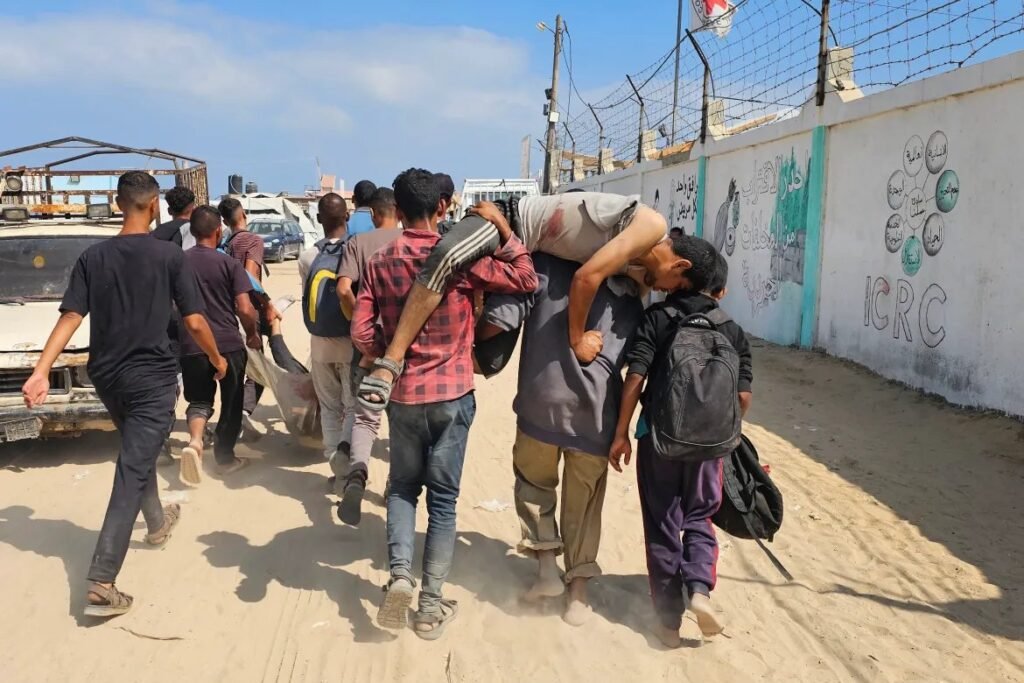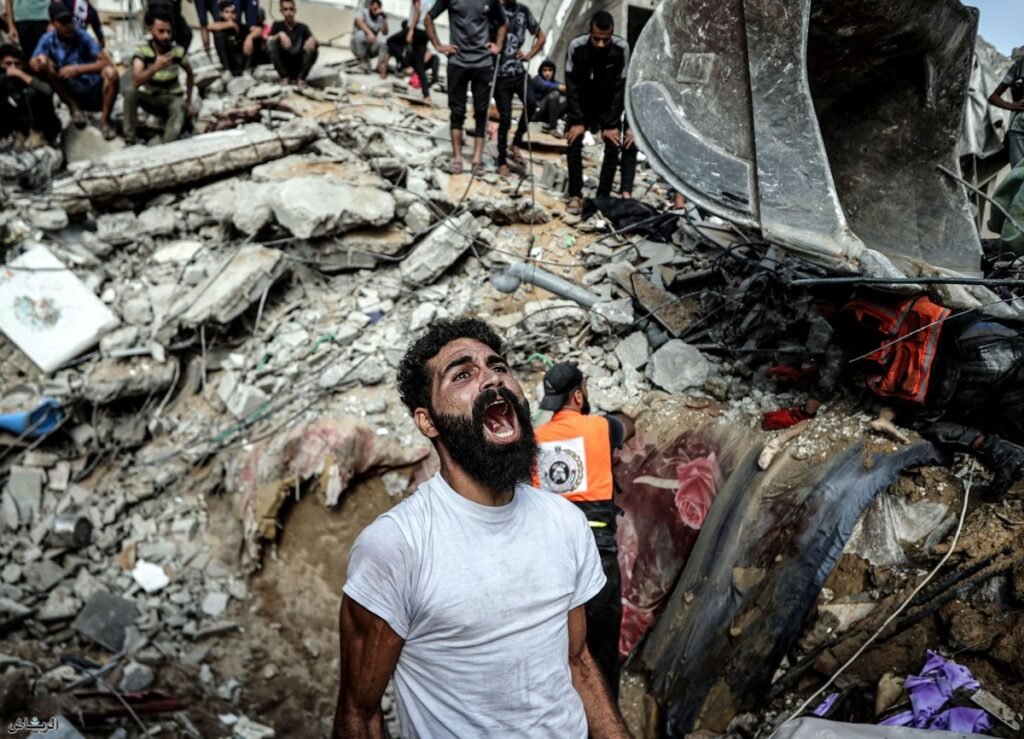
, wGaza Herald _“One soldier shakes the conscience of the world, while thousands of Palestinian bodies buried under rubble stir nothing but dust.” With these devastating words, Gaza’s Director General of the Ministry of Health, Dr. Munir al-Bursh, captured the grotesque moral imbalance governing the treatment of victims in Gaza. While the body of a single Israeli captive becomes a global cause célèbre, thousands of Palestinian remains lie beneath destroyed homes, denied shrouds, graves, and even acknowledgment.
In a deeply emotional statement, al-Bursh asked, “Where are the bodies of our captive martyrs in Israeli prisons? Where is the body of Dr. Adnan al-Burshhere is Dr. Iyad al-Rantisi? Where are the missing, swallowed by bombardment?” Gaza, he said, is no longer only searching for the living but for its dead and for any trace that proves human life once existed here.
One Body Versus Thousands
This anguished appeal coincided with Israel’s announcement that it had recovered the body of captive soldier Ran Ghafili from Gaza in what it described as a “complex military operation.” Israeli media portrayed the mission as an extraordinary achievement. Yet facts on the ground tell a far darker story.
Israeli forces carried out a sweeping operation in Al-Batsh Cemetery in eastern Gaza City, lasting two days and involving the desecration of hundreds of graves. Heavy machinery unearthed bodies, which were transported to Israel’s Abu Kabir forensic institute to identify Ghafili. The operation was accompanied by intense gunfire and aerial cover to secure troop withdrawal.
The scene was harrowing: Palestinian graves were razed, remains were exhumed, and cemeteries were devastated, while more than 10,000 Palestinian bodies remain trapped beneath rubble across Gaza, unreachable and unrecognized. The sanctity of death itself was violated.
The Body as a Political Weapon
Beyond the humanitarian horror lies a deeply cynical political calculus. According to Israeli reports cited by Al Jazeera correspondent Elias Karam, Prime Minister Benjamin Netanyahu deliberately delayed authorizing the recovery operation, despite having precise intelligence weeks earlier. The delay, sources said, was intended to stall political obligations under the ceasefire agreement, including opening the Rafah crossing and allowing humanitarian aid.
In effect, Ghafili’s body became a bargaining chip — a tool of political blackmail — used to justify continued blockade and collective punishment.
Political analyst Yasser al-Zaatra remarked bitterly that the body was exploited to obstruct aid delivery, noting that Israeli outlets confirmed the decision was political, not military. “They retrieved their dead,” he said, “now let them go to hell with it. What excuse remains?”
Military Failure, Diplomatic Success
Netanyahu continues to promote military pressure as the only path to recovering Israeli captives. Yet the figures expose a stark contradiction:
Negotiations succeeded in securing the release of 126 Israeli captives alive.
Military operations recovered only 8 captives alive.
Israeli assaults directly led to the deaths of at least 41 captives, many killed by Israeli fire.
The evidence is unmistakable: diplomacy saved lives, while military force destroyed them.
Even the Dead Are Besieged
While Israel mobilizes its vast military might to retrieve a single body, Gaza endures a far crueler reality: thousands of corpses remain unrecovered, prisoners die under torture without their bodies returned, and entire cities perform funeral prayers in absentia.
“In Gaza,” al-Bursh said, “even the dead are besieged, and even bodies are punished.” This is not a fleeting tragedy, but a permanent moral indictment — one that exposes a system in which Palestinian life, and death, are stripped of dignity and worth.
Resistance Commitment and Narrative Collapse
Hamas stated that the retrieval of the final Israeli body effectively closes the captive file, reaffirming its commitment to the ceasefire terms, even as Israeli violations exceed 1,300 documented breaches. This further dismantles Israel’s narrative that military escalation is necessary, revealing instead a pattern of manipulation and delay.
No Justification for Desecrating the Dead
The Euro-Mediterranean Human Rights Monitor strongly condemned Israel’s mass grave excavations, stressing that no security claim justifies violating the sanctity of the dead. It warned that grave desecration constitutes a serious breach of international humanitarian law and called for immediate cessation, demanding international supervision, transparency, and full accountability.
The organization urged the International Criminal Court and UN investigative bodies to include systematic grave destruction and corpse theft in their war crimes inquiries, emphasizing that impunity only perpetuates atrocity.
A Moral Reckoning
This episode reveals far more than a military operation. It exposes a collapsing ethical order that sanctifies one body while degrading thousands. It demonstrates that what is unfolding in Gaza is not merely war, but a sustained campaign of dehumanization, one that desecrates life, death, memory, and dignity alike, before the silent gaze of a world that moves only when the victim is Israeli.
In the end, this is not merely a story of one recovered body and thousands desecrated; it is a devastating indictment of a world order that has abandoned its most basic moral compass. As long as Palestinian lives and deaths are treated as expendable, justice will remain a hollow slogan, and international law a selective instrument. Gaza today stands as a brutal mirror, reflecting the collapse of conscience, the bankruptcy of political ethics, and the lethal cost of global indifference. Until Palestinian dignity is restored, in life and in death, no claim of humanity, legality, or peace can be taken seriously.