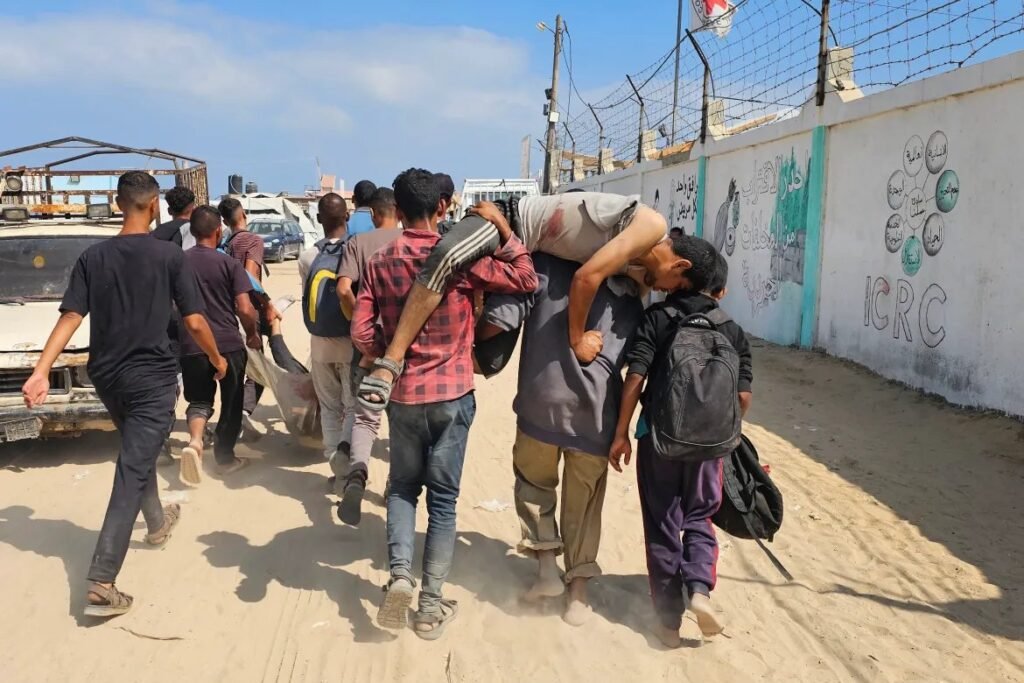
Gaza Herald_ When Donald Trump returned to the White House for a second term, few in Washington or beyond expected a rupture in US policy toward Israel. His first presidency had already cemented a legacy of unprecedented alignment with Israeli priorities, from moving the US embassy to Jerusalem to sidelining Palestinian rights entirely. That approach has not only continued but intensified amid Israel’s ongoing genocidal war on Gaza.
As civilian deaths mount and international condemnation grows louder, Trump’s unwavering support for Israel has begun to generate visible unease, not abroad, but within segments of his own political base. For many of his supporters, the issue is no longer framed solely around foreign policy or ideology but around cost, accountability, and domestic neglect.
Military Aid Without Interruption
US backing for Israel remains vast and multifaceted. Under a 10-year military aid framework initiated during the Obama administration, Washington continues to provide Israel with $3.8 billion annually, primarily earmarked for US-made weapons systems.
Since Trump’s return to office, this support has expanded. In March, Secretary of State Marco Rubio announced an additional $4 billion in emergency military assistance. He also confirmed that the administration had approved more than $12 billion in arms sales to Israel since taking office, portraying this escalation as a decisive break from the policies of the Biden administration, despite Biden’s own record of extensive pro-Israel support.
According to the Cost of War Project, total US assistance to Israel since the start of the Gaza war has now exceeded $21 billion. This figure does not include the political and diplomatic capital expended by Washington to shield Israel from accountability on the international stage.
Diplomatic Protection and Legal Obstruction
US support for Israel has extended far beyond financial and military aid. Washington has repeatedly blocked or diluted resolutions at the United Nations aimed at censuring Israeli actions in Gaza. It has actively worked to undermine efforts to hold Israeli leaders accountable under international law, including imposing sanctions on the International Criminal Court for pursuing investigations related to war crimes.
In doing so, the Trump administration has positioned itself not merely as an ally of Israel but as a guarantor of its impunity. This posture has increasingly conflicted with the rhetoric of “America First” that once defined Trump’s political appeal.
Fractures Inside the MAGA Movement
Contrary to assumptions of uniform loyalty, Trump’s Israel policy has triggered rare dissent within the Make America Great Again movement. Influential conservative figures have publicly challenged the wisdom and cost of unconditional backing for Israel, framing it as reckless and counterproductive.
Tucker Carlson, a key media figure within the movement, broke openly with Trump in June. In a widely circulated statement, Carlson rejected the binary framing of the debate, arguing that the true divide lay between those who encourage endless violence and those seeking restraint. His remarks marked a significant departure from the traditional pro-Israel consensus on the US right.
Steve Bannon, another central MAGA figure and former Trump adviser, has gone further. He accused Israeli Prime Minister Benjamin Netanyahu of betraying US interests by escalating regional tensions, particularly through strikes on Iran, without the capacity to secure decisive outcomes. Bannon later responded sharply after Netanyahu suggested that opposition to Israel was incompatible with MAGA identity, accusing the Israeli leader of deception and warning against dragging the US into future wars.
Open Accusations of Genocide from the US Right
Perhaps the most striking rupture came from Congresswoman Marjorie Taylor Greene, one of Trump’s most outspoken allies. In a rare moment of alignment with global human rights discourse, Greene publicly described Israel’s actions in Gaza as a genocide and highlighted the unfolding humanitarian catastrophe and mass starvation.
Trump responded by publicly attacking her, branding her “Marjorie Traitor Greene.” Despite this, Greene retained considerable support among MAGA voters who viewed her stance as a principled defense of domestic priorities over foreign entanglements. She later announced her decision to leave Congress, but her criticism continues to resonate within right-wing circles, increasingly skeptical of open-ended foreign aid.
Shifting Republican Public Opinion
Polling data suggests these elite fractures reflect broader changes among Republican voters. A recent survey conducted by YouGov in partnership with the Institute for Middle East Understanding Policy Project found that a plurality of Republicans favored allowing the current 10-year military aid agreement with Israel to expire.
Opposition was even more pronounced among younger Republicans. More than half of respondents aged 18 to 44 supported terminating the agreement altogether, signaling a generational shift that challenges decades of bipartisan consensus on Israel.
Academic observers have noted that this trend predates the Gaza war but has accelerated sharply since its onset. Israel’s conduct during the assault on Gaza has further eroded support among young conservatives, including evangelical Christians traditionally viewed as Israel’s most reliable US constituency.
Evangelical Support Under Strain
Even within evangelical circles, long considered a cornerstone of pro-Israel advocacy in the US, support has shown signs of weakening. In response, the Israeli government has invested heavily in targeted public relations efforts aimed at restoring evangelical approval.
This included organizing a high-profile visit to Israel earlier this month involving more than 1,000 US pastors and Christian influencers. The trip, promoted as historic, was organized by evangelical author Mike Evans, a close ally of Trump and a longtime confidant of Netanyahu. Despite these efforts, polling suggests skepticism persists, particularly among younger evangelicals increasingly influenced by humanitarian concerns.
Electoral Implications and Strategic Retreat
As Gaza fades from daily US headlines, Israel’s centrality to domestic political discourse may also diminish. With economic pressures, healthcare costs, and governance crises dominating voter concerns, foreign policy is unlikely to be decisive in the immediate term.
Yet the long-term implications remain unresolved. Should Republicans face electoral setbacks ahead of the 2028 presidential race, party strategists may choose to sideline the Israel issue altogether, viewing it as a liability rather than a unifying cause.
What is increasingly clear is that unconditional support for Israel, once treated as politically cost-free in Washington, is no longer immune from scrutiny, even within the political movement that elevated Donald Trump to power.