
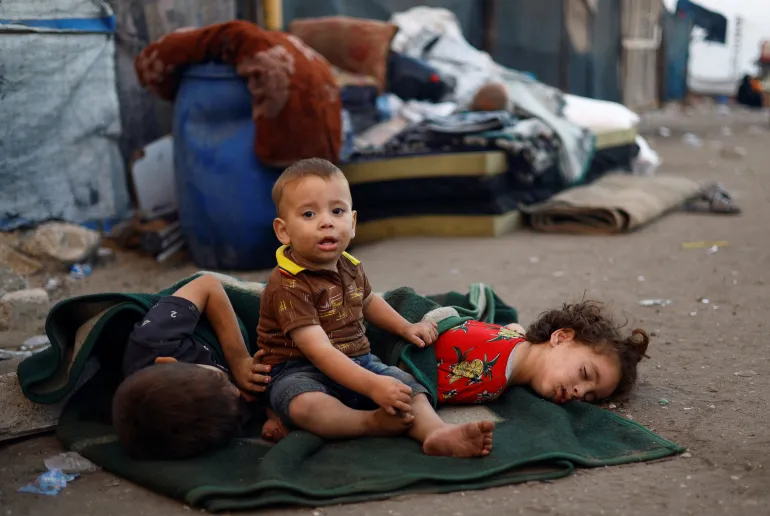
Gaza Herald_In the courtyard of a shattered school in Gaza City’s al-Zaytoun neighborhood, now overtaken by rows of makeshift tents, displaced families wake each morning to cold air and uncertainty. At the entrance of one tent, a four-year-old boy stands quietly, his eyes fixed on the school gate, as if expecting someone to return.
Zain turns to his mother and asks the question that has become part of their daily life.
“When will Baba come back?” he says softly. “He promised me a new bike and sweets.”
For his mother, Nada al-Halawani, each time her son speaks those words feels like a fresh wound. She knows that Zain will grow up without his father, just as she once did.
Before Israel’s genocidal war on Gaza, Nada and her husband Ashraf lived a modest but stable life. They worked tirelessly, dreaming of a better future for their only child. When the war began, their home was destroyed, their income vanished, and the family was forced to flee again and again as Israeli attacks swept across the enclave.
Ashraf did everything he could to keep his family alive. Last September, he was shot dead by an Israeli sniper while attempting to reach an aid distribution point. His body was never recovered.
At just 25 years old, Nada became a widow. Overnight, she was left alone to protect and raise her son amid relentless bombardment, displacement, and deprivation.
“Ashraf was a devoted husband and father,” she says. “Without him, the world became dark and terrifying. I am young, and my child and I now face a frightening future alone.”
According to authorities in Gaza, Israel’s war has left more than 16,000 women widowed and over 44,000 children orphaned. Since October 2023, at least 71,424 Palestinians have been killed.
No Space to Grieve
Even after a ceasefire came into effect in October, widows across Gaza remain trapped in daily survival mode. Food, water, and shelter are still scarce as Israel continues to restrict humanitarian aid.
Rawand Salim, a 27-year-old mother of two, lost her husband, Mohammed, during an Israeli air strike in February 2025, carried out during a previous ceasefire. Since then, every day has been shaped by fear and responsibility.
“Every morning, I wake up wondering how I will keep my children alive,” she says. “Every decision feels like it could mean life or death.”
Her days begin with gathering scraps of wood to cook, followed by hours waiting in water lines and community kitchens for a small portion of soup or rice. Often, she brings her children with her because they panic when she leaves.
To survive what a UN commission has described as Israel’s “policy of starvation,” Rawand sold a treasured piece of jewellery given to her by her husband on their wedding anniversary.
“It carried all my happiest memories,” she says. “But I couldn’t let my children starve.”
Her sons, six-year-old Abdelrahman and three-year-old Subhi, struggle to comprehend their father’s absence. When Rawand once took them to Mohammed’s grave, Abdelrahman began digging with his bare hands, begging his mother to help him bring his father back home.
The trauma has taken a visible toll. Both children suffer anxiety, withdrawal, and constant fear. They cling to their mother, while their bodies show signs of stress—hair loss, skin conditions, weakened immunity, and weight loss.
“They were once full of laughter,” Rawand says. “Seeing them like this breaks my heart.”
Nada sees similar signs in Zain. His grief sometimes emerges as anger or aggression. Finding food and shelter is an ongoing struggle. The family now shares a single tent with two other families, with no privacy or stability.
“I haven’t even had the chance to grieve my husband properly,” Nada says.
As Israel expands its so-called “Yellow Line”, a unilateral military boundary imposed since the ceasefire, Nada and her son face the threat of yet another forced displacement from al-Zaytoun.
A Collapsed Support System
For Gaza’s widows and orphans, loss is compounded by the near-total collapse of support networks.
Before the genocide, limited but vital assistance existed. Small financial stipends, counselling sessions, vocational workshops, and community initiatives helped widows cope. Orphans received educational and psychological support from local and international organisations.
Yomna Salim, a 67-year-old widow, lost two sons and a son-in-law in Israeli attacks over recent years. She now supports her widowed daughter and daughters-in-law, helping raise their children.
“There used to be places where women could talk, learn, and find strength,” she says. “It wasn’t much, but it helped us survive.”
Since October 2023, many of those institutions have been destroyed or forced to shut down. Israel has systematically dismantled Gaza’s education system, described by the UN as being “obliterated.”
More than 80 percent of schools have been damaged or destroyed, including institutions that once provided orphaned children with free education, meals, clothing, and emotional care.
The absence of aid has deepened Nada’s suffering. Because her husband’s body was never found, he is officially listed among Gaza’s more than 11,000 missing. Without a death certificate, she cannot properly register for aid, which is processed under the father’s name.
“I receive nothing,” she says. “Even general aid never reaches us.”
Rawand’s family faces the same exclusion, including the lack of psychological support.
“Widows here need mental and emotional care,” she says. “We need safe spaces to talk, to heal, and to help each other survive.”
Holding On for the Children
Despite everything, widows in Gaza draw strength from their children.
“Zain is my heart,” Nada says. “I stay beside him with patience and love. I calm him when he breaks down. We walk together, learn small things together.”
She dreams of earning a master’s degree in business administration and international trade, hoping one day to secure a dignified life for her son and honour his father’s wishes.
Rawand, meanwhile, focuses on helping her children reconnect with life. She encourages them to play with neighbourhood children under her watch and to express their emotions openly.
“Our children have seen horrors no child should ever witness,” she says. “They are all I have.”
After great difficulty, she managed to enrol Abdelrahman in a nearby learning initiative. Slowly, signs of healing have begun to appear.
“It fills my heart to see them want to play again,” she says. “To hear Abdelrahman come home excited about school, about what he learned, about his teacher and friends.”
She pauses before adding quietly, “They are improving, but the pain is still inside them.”

