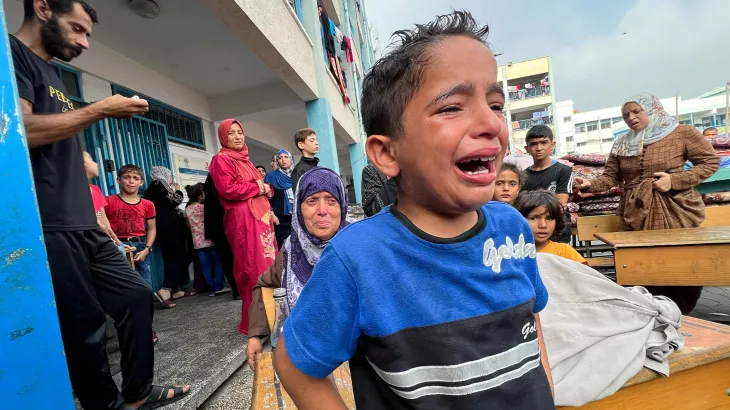
Gaza Herald —Hospitals in Gaza announced the death of a seven-day-old infant due to extreme cold in the city of Deir al-Balah in central Gaza. At the same time, the suffering of displaced families living in tents has sharply worsened with the arrival of a new winter storm, amid warnings of an impending humanitarian catastrophe.
The Gaza Civil Defense confirmed that “every weather depression turns into a humanitarian disaster due to the ban on the entry of construction materials and the obstruction of reconstruction.”
Thousands of Tents Damaged
The Civil Defense warned of a “catastrophe” caused by the storm, noting that it has resulted in severe damage to temporary shelter conditions, with thousands of tents destroyed.
It urged residents to secure their tents to prevent them from being blown away, especially in light of the continued ban on the entry of mobile homes.
Civil Defense spokesperson Mahmoud Basal said in a statement that “what is happening is not a weather crisis, but a direct result of preventing the entry of construction materials and halting reconstruction. People are living in torn tents and cracked homes, without safety or dignity.”
Displacement to the Seashore
Basal added that many Palestinians have been forced to erect tents along the seashore due to the lack of available space inside cities, following their widespread destruction by Israeli attacks.
He stressed that the situation in Gaza “does not meet even the minimum humanitarian standards and constitutes a blatant violation of humanitarian principles and international humanitarian law.”
Strong Winds and Ongoing Attacks
Meanwhile, an Al Jazeera correspondent reported that hundreds of tents were damaged by strong winds, as the Meteorological Department warned that winds would continue and temperatures would further decline.
Israeli airstrikes on the outskirts of Al-Shati refugee camp, northwest of Gaza City, caused additional damage to tents sheltering displaced families, destroying their belongings and forcing them to spend the night out in the open.
Weather Systems Deepen the Crisis
On Friday, a new weather depression hit the Gaza Strip, bringing heavy rain and strong winds. On Saturday, the Palestinian Meteorological Department said conditions remain favorable for scattered rainfall, with strong winds reaching speeds of up to 60 kilometers per hour at times.
Since the ceasefire agreement came into effect on October 10, Israel has failed to meet its obligations under the deal, including allowing the entry of shelter materials such as tents and mobile homes, as well as construction supplies for reconstruction and the rehabilitation of water and sewage networks, according to official data.
During the last storm at the end of December, hundreds of tents set up along the coast of Khan Younis in southern Gaza were flooded by rising sea waves.
In recent months, repeated weather depressions have also caused the collapse of dozens of residential buildings previously damaged by Israeli bombardment, resulting in casualties.
These storms have further deepened the humanitarian crisis in Gaza, which has seen no tangible improvement despite the end of the war, due to Israel’s continued failure to honor its commitments under the agreement.
The ceasefire brought to an end a genocidal war launched by Israel on October 8, 2023, which lasted two years and resulted in more than 71,000 Palestinian deaths, over 171,000 injuries, and massive destruction affecting 90 percent of civilian infrastructure, with reconstruction costs estimated by the United Nations at around $70 billion.