Gaza Herald_ In Gaza, danger does not end with the cessation of airstrikes, nor does it disappear when warplanes leave the sky. More than a year after a devastating war that reshaped both geography and daily life, thousands of families are now fighting a new battle inside what remains of their homes amid cracked walls, fractured pillars, and ceilings suspended over deep fissures, each one threatening to collapse at any moment.
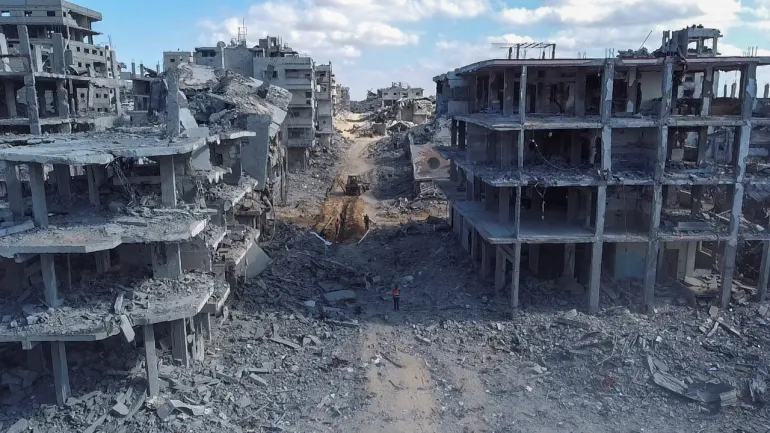
In neighborhoods transformed into fields of rubble, homes are no longer places of refuge. Instead, they have become fragile shells, some missing entire sections, others standing like exhausted bodies leaning on broken supports. Despite the clear danger, these houses remain inhabited, not out of ignorance, but out of necessity. With alternatives nearly nonexistent, leaving often means complete homelessness.
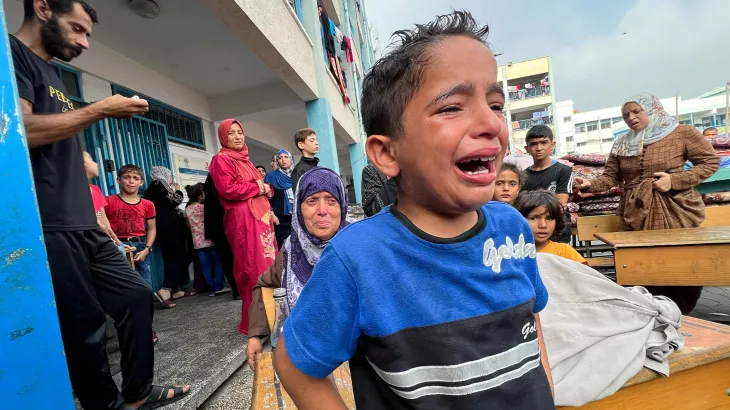
Children no longer sleep peacefully. They lie awake staring at cracks in the ceiling, as if guarding it from falling. Mothers fear the wind more than the night itself, while fathers not only follow the news but also watch the walls, touch them, listen to their silence, and try to calculate how much time remains. In some areas, the explosions have stopped, but fear has not. It has moved from the sky into the heart of the home.
“Where Do We Go?” A Question Without an Answer
Beneath a residential building west of Khan Younis that was previously hit by Israeli airstrikes, the Al-Haddad family, 14 people in total, now lives inside a dilapidated apartment unfit for human habitation. The building lost its upper floors and has been officially classified as structurally unsafe. Still, the family has nowhere else to go.
“We know we are risking our lives,” said Akram Al-Haddad. “But where do we go? There are no alternative homes, no ability to rent a safe place, and all our appeals have gone unanswered.”
Stones fall intermittently from the ceiling. Cold air seeps in from every direction. Rainwater easily finds its way indoors. With every report of a similar home collapsing in another neighborhood, fear tightens its grip on the children, and the weight of waiting grows heavier.
Such stories repeat themselves with every winter storm that reaches Gaza, bringing rain and wind that push hundreds of displaced families out of flooded or wind-torn tents and into homes already on the verge of collapse.
Human rights reports have documented dozens of buildings across the Gaza Strip that were previously damaged by Israeli bombardment and now face imminent collapse. Families remain inside them “despite knowing the extent of their structural weakness,” viewing cracked buildings as a lesser danger than tents that offer no protection from rain or cold.
Half a House, Half a Life
The situation of the Al-Haddad family mirrors that of the Salameh family, whose home was destroyed in two stages, leaving only part of the first floor standing. In this cramped space lives 80-year-old, wheelchair-bound Rowaida Salameh and her daughter, Kholoud. Rubble blocks the entrances, and destroyed rooms surround what remains of the house, constantly reminding them of what was lost.
Kholoud says engineers warned them of the risk of collapse, but she has no alternative. “There are no mobile homes, no shelters, no income. Leaving means homelessness. Staying means danger.”
In Gaza City’s Rimal neighborhood, Sumaya Nabhan says she and her family live inside a dangerously tilted building. “It’s like entering a slippery slope at an amusement park,” she said, adding that she constantly feels the walls could fall at any moment.
That fear recently became reality. In the same neighborhood, a wall from a building sheltering displaced people collapsed during strong winds and heavy rain, killing a 30-year-old Palestinian woman when it fell onto a tent erected next to the damaged structure. Elsewhere across Gaza, tents were flooded or swept away by severe weather.
Before resorting to cracked buildings, thousands of displaced families lived in temporary tents that have repeatedly flooded or been blown away since November, forcing families into the open amid freezing temperatures.
Gaza’s Civil Defense has repeatedly warned residents against sheltering in unsafe buildings, stressing that thousands of housing units have suffered partial but dangerous damage. Yet these warnings collide with a brutal reality: there are no alternatives, no building materials, and no capacity to establish safe temporary housing.
Numbers That Lay Bare the Scale of the Disaster
The Government Media Office in Gaza says the tents spread across displacement camps were never suitable for habitation. Made of worn fabric, they provide no protection from rain or cold and lack sanitation, electricity, or basic services.
Ismail Al-Thawabteh, Director General of the Government Media Office, estimates that Israel has destroyed the homes of approximately 1.5 million people—around 288,000 families.
He added that about 1.371 million people are living in official or informal displacement camps, while roughly 620,000 people, around 120,000 families, are sheltering in homes at risk of collapse, exposing them to serious injury or death, especially during winter storms.
An estimated 48,000 people (9,000 families) are sheltering inside government and public buildings. Since the start of the war 26 months ago, around 135,000 tents have entered Gaza, but approximately 125,000 of them, 93 percent, have deteriorated and are no longer usable. Around 22,000 tents were destroyed by recent storms alone.
Humanitarian Protocols and a Worsening Outlook
Al-Thawabteh said that since the latest ceasefire came into effect, only about 20,000 tents have entered Gaza, “nowhere near enough.” Gaza urgently needs at least 300,000 tents, meaning that what has entered covers just 7 percent of immediate needs.
“When tents deteriorate, displaced families try to repair them, but they remain completely unsuitable for winter,” he said. “What is now required is at least 280,000 new tents.”
He also stressed that Israel continues to block the entry of prefabricated mobile homes, despite their inclusion in the humanitarian protocol attached to the ceasefire agreement. These units could provide tens of thousands of families with dignified shelter, instead of forcing them to survive in tents unfit for human life.
Despite repeated collapses and the victims buried beneath the rubble, thousands of families in Gaza remain trapped in the same cruel equation: a cracked roof is still better than sleeping in a tent that offers no protection from wind or rain.
They ask for nothing more than the basic human right to a safe roof within a reality where survival has become a gamble, steadfastness a risk, and life a constant wait for what may be worse.