Gaza Herald_ Known for his televised addresses and long targeted by Israel, Abu Obeida, the nom de guerre of Huthaifa Samir al-Kahlout, was one of the most prominent figures in the Palestinian resistance movement.
Editor’s note: This profile was first published in May 2024. On 29 December 2025, Hamas announced that Abu Obeida was killed in August during Israel’s genocidal war on Gaza.
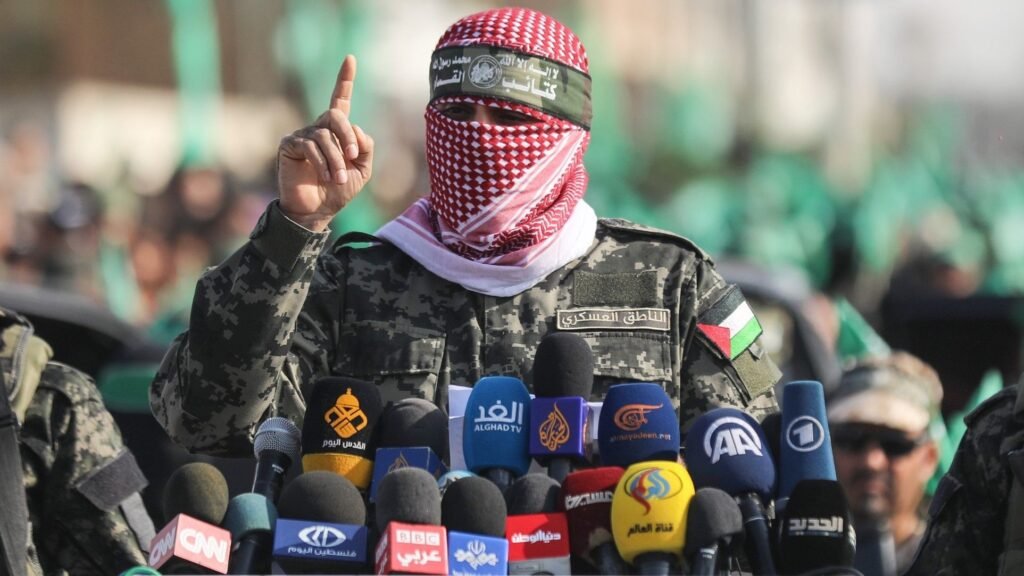
For nearly two decades, Abu Obeida served as the official military spokesman for the Izz al-Din al-Qassam Brigades, the armed wing of Hamas. He became one of the movement’s most recognizable public figures, especially after the Hamas-led attack on Israel in October 2023 and the devastating Israeli assault that followed on the Gaza Strip.
His visibility grew sharply during the war, as he delivered frequent speeches offering battlefield updates, praising resistance operations, and openly challenging Israel, which repeatedly attempted to assassinate him.
To protect his safety, his true identity was kept secret for years. It was only after Hamas announced his death on 29 December that the group revealed his birth name as Huthaifa Samir al-Kahlout.
Across the Arab world, Abu Obeida was widely regarded as a symbol of resistance. His name was chanted at pro-Palestine demonstrations, and songs were written celebrating his defiance.
Due to his senior position in Hamas, which is designated as a terrorist organization by the United States, the United Kingdom, and others, he was placed on U.S. sanctions lists alongside other Palestinian leaders.
Early Life and Background
Very little is known about Abu Obeida’s early years. In a 2005 interview, he said his family was forcibly displaced from historic Palestine during the Nakba in 1948, eventually settling in a village in the Gaza Strip that he did not name.
During that interview, he suggested he was in his early twenties, indicating he was likely born in the early or mid-1980s. As late as 2014, sources within Hamas said that only a small circle knew his true identity.
His chosen name is believed to reference Abu Ubaidah ibn al-Jarrah, a renowned Muslim commander and close companion of the Prophet Muhammad.
When Hamas announced his death, the new spokesman for the al-Qassam Brigades described Abu Obeida as a senior leader who headed the group’s military media office.
“Today we mourn Abu Obeida, whose real name was the great leader Huthaifa Samir al-Kahlout, after two decades of frustrating the enemy,” the spokesman said.
His Role Within Hamas
Abu Obeida first appeared publicly in 2004, when he held a press conference during an Israeli ground invasion of northern Gaza, providing updates on resistance operations.
From that point on, he became the constant military voice of Hamas, delivering interviews and releasing recorded statements through official platforms. He was the first and only figure to hold the title of military spokesman, a role within the media office established in 2004.
His appearances were almost always tied to periods of military escalation with Israel.
Key Statements and Announcements
One of Abu Obeida’s central responsibilities was announcing military operations and achievements.
His first major moment came in 2006, when he confirmed the capture of Israeli soldier Gilad Shalit. In 2014, during Israel’s war on Gaza, he announced the capture of another soldier, Shaul Aron, even publicly stating his identification number.
At the time, Israeli officials initially denied the capture before later admitting Aron had been killed and that his body was held by Hamas.
“How can the enemy hide the disappearance of soldier Shaul Aron, ID number 6092065?” Abu Obeida asked in a recorded statement. “This soldier is now a prisoner held by Hamas.”
That same year, he also confirmed that Mohammed al-Deif, the commander of the al-Qassam Brigades, had survived an Israeli assassination attempt.
Outside times of war, Abu Obeida occasionally addressed political events, including in 2022 when he commented on the re-arrest of six Palestinian prisoners who had escaped from an Israeli jail. He vowed they would be freed in a future prisoner exchange.
His Role After 7 October
Some of Abu Obeida’s most influential speeches came after the events of 7 October and the Israeli war on Gaza that followed.
Two days into the war, he warned that an Israeli captive would be executed for every Israeli bombing of civilian homes, though the threat was never carried out.
Later, he revealed that planning for the October attack began in 2021, following the 11-day war in Gaza that year.
He stated that around 4,500 fighters took part in the operation, with approximately 3,000 involved directly on the ground. He said the primary objective was dismantling Israel’s Gaza Division, part of its Southern Command, along with surrounding military sites and settlements near Gaza.
“The strategic deception, planning, and execution stunned the enemy,” he said, adding that Israel had suffered an unprecedented strategic failure and responded by committing mass crimes against civilians.
One of his most widely shared speeches came on 28 October, when he sharply criticized Arab governments for failing to deliver humanitarian aid to Gaza. His phrase “God forbid” became a popular slogan across the Arab world, symbolizing anger at official inaction.
The Red Keffiyeh and the Mask
In every appearance, Abu Obeida wore a military uniform and concealed his face, earning him the nickname “the masked man.”
His face covering was always a red keffiyeh, a traditional Arab scarf long associated with Hamas fighters. Early commanders of the group, including Yasser al-Namrouti and Emad Akel, wore the same style before being killed by Israeli forces in the 1990s.
Mohammed al-Deif also appeared wearing a red keffiyeh in his last known public video in 2005.
Popularity in the Arab World
Abu Obeida became a powerful symbol of Palestinian resistance across the Arab region, where Hamas enjoys broad popular support.
His commanding voice, confident delivery, and hidden identity amplified his influence. His statements were often accompanied by video footage of resistance operations, reinforcing public trust in his claims.
Across the region, his speeches were events, with weddings paused so guests could listen, and families gathering around screens to hear his words.
Songs praising him circulated widely, including lyrics describing his words as weapons and his resolve as unbreakable.
How Israel Viewed Him
In Israel, Abu Obeida’s speeches were closely followed, and speculation about his identity was constant.
During the 2014 war, an Israeli news outlet published a name and photo it claimed belonged to him, which Hamas denied. Israeli officials later repeated the same claim in October 2023, attempting to strip away what they described as his symbolic power.
Israeli reports also alleged that his home in Jabalia was bombed multiple times and claimed he held an advanced degree in religious studies, though Hamas never confirmed these details.
U.S. Sanctions
In April 2024, the United States imposed sanctions on Abu Obeida, labeling him Hamas’s “information warfare chief.”
The U.S. Treasury accused him of overseeing cyber and media operations for the al-Qassam Brigades, including hosting websites abroad. Hamas did not respond publicly to the allegations or the sanctions.