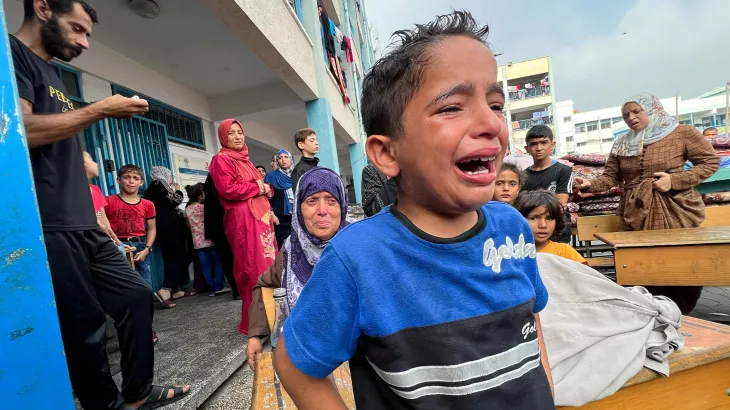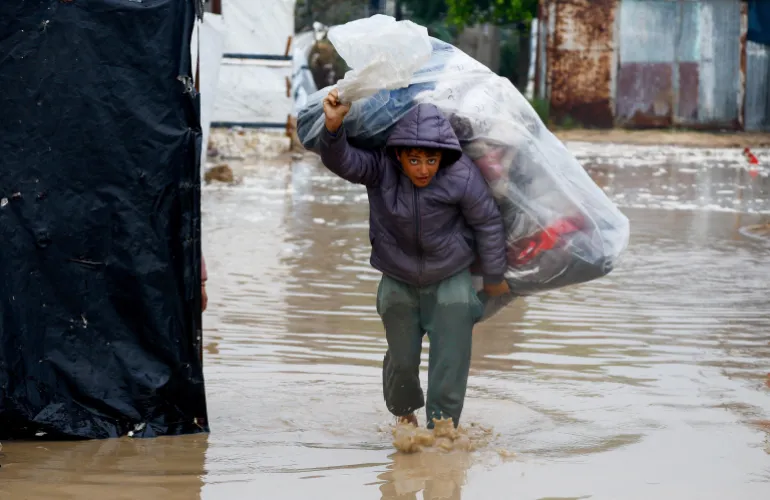
Gaza Herald_ Despite early and repeated warnings issued to displaced people in the Gaza Strip ahead of the winter storm, the fragility of infrastructure and the continued presence of thousands of families in temporary shelters signal the risk of renewed disasters caused by flooding and extreme cold.
The area is currently being affected by a rainy winter depression, the third since the start of winter, with heavy rainfall expected to continue until Monday, according to meteorological forecasts.
Speaking to Safa News Agency, Ismail Al-Thawabta, head of the Government Media Office, said that in light of the severe infrastructure damage resulting from Israel’s ongoing genocide and systematic destruction, the threat of disaster remains highly likely.
He noted that heavy rainfall, strong winds, the potential formation of flash floods in low-lying areas, and the accumulation of water in residential neighborhoods near valleys and drainage channels significantly complicate the situation with the arrival of the storm.
Al-Thawabta explained that relevant government bodies, in coordination with partner institutions, had managed to shelter many families affected by the previous storm, within the limits of available resources.
However, he stressed that these efforts were carried out amid extremely limited capabilities and a severe shortage of resources due to the scale of destruction.
As a result, he said, the conditions of those affected remain difficult and complex, especially given the ongoing Israeli assault and its direct consequences.
According to Al-Thawabta, a very large number of families continue to live in temporary shelters that lack the minimum requirements for a dignified life.
He added, “Infrastructure has been widely damaged, including sewage systems and rainwater drainage networks, while health and environmental risks persist due to overcrowding, humidity, and low temperatures.”
Weak Response Capacity
Al-Thawabta emphasized that all relevant entities cannot mount a comprehensive response due to the siege, the closure of border crossings, and the prohibition on the entry of shelter materials in particular. He warned that this could lead to a repeat of the tragedy caused by Storm Biron, which resulted in collapses, flooding, and the deaths of civilians.
Technical assessments indicate that the areas most vulnerable to flooding include low-lying regions, residential clusters near valleys and drainage routes, and neighborhoods where sewage networks were damaged during the Israeli assault.
Informal displacement areas that lack proper infrastructure are also among the locations most likely to experience renewed flooding disasters.
The Government Media Office called for raising community preparedness levels and fully adhering to safety guidelines issued by relevant authorities.
It also urged stronger coordination among field institutions, municipalities, and humanitarian organizations to reduce risks, as well as immediate support from international institutions and humanitarian organizations to provide shelter and emergency supplies.
Additionally, Al-Thawabta stressed the need for pressure to open border crossings and allow the entry of essential materials required for humanitarian response.
It is worth noting that 19 Palestinians were killed, others were injured, and entire shelters were flooded as a result of Storm Biron, which struck the Gaza Strip approximately two weeks ago.
\