
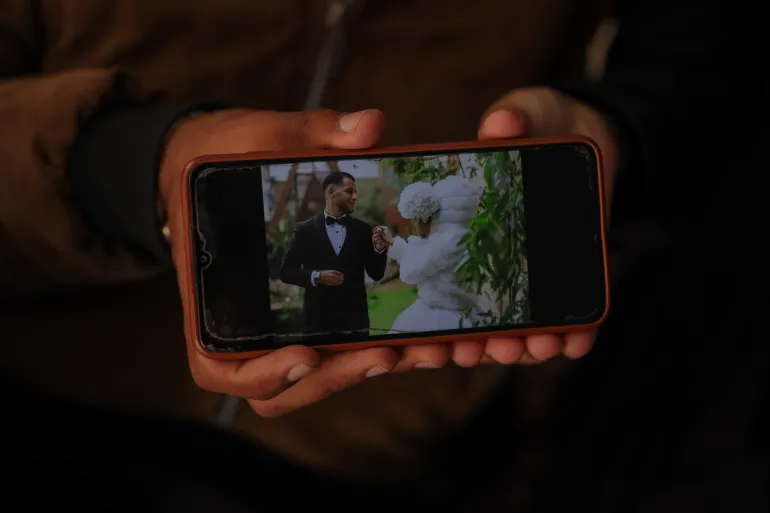
Gaza Herald_ What should have been one of the happiest days of Mustafa and Nesma al-Borsh’s lives unfolded under the shadow of war. In the besieged Gaza Strip, where daily survival has replaced celebration, their wedding was modest by necessity, a quiet attempt to reclaim a fragment of normal life amid devastation.
Nesma visited a beauty salon, rented a simple white dress, and took a handful of photos with her groom, Mustafa. The ceremony was held inside a tent pitched in the Tuffah neighbourhood of eastern Gaza City, with no more than 40 relatives and friends in attendance.
“I can’t say it was the wedding I always dreamed of,” Nesma said softly. “But under these conditions, we tried to steal a few moments of happiness, and for a brief time, we succeeded.”
Those moments did not last.
As the celebration drew to a close last Friday, Israeli shelling struck a building adjacent to the wedding tent. The structure, once a vocational training centre run by Gaza’s Ministry of Education, had been converted into a shelter for displaced families during the war. It was also where the newlyweds planned to live after their marriage.
Within seconds, flames erupted. Smoke, debris, and screams filled the air. What had been a wedding scene transformed into chaos and terror, leaving the couple frozen in disbelief as their long-awaited day collapsed into tragedy.
From Groom to First Responder
“I immediately took my bride’s hand and sent her away with my female relatives,” Mustafa, 29, recalled from the Halawa displacement camp near Tuffah. “Then I removed my suit jacket and ran with the other men toward the building to help those trapped inside.”
The shelling struck the second floor, where Mustafa’s family and other displaced people were sheltering. The classroom prepared for the couple to live in was destroyed, along with everything they had managed to gather for their new life together.
“I helped pull out the wounded and retrieve bodies,” Mustafa said. “I carried my nephew, who was critically injured all over his body.”
Ambulances were called, but Israeli coordination was required for emergency crews to enter the area. For more than two hours, rescue teams were delayed.
“We waited in terror,” Mustafa said. “Shelling continued around us. The fear was beyond words.”
Only after hours were ambulances allowed to evacuate the wounded and the dead. Civil defence teams later ordered families to leave the shelter entirely, forcing them into yet another displacement, abandoning what little they still owned.
A Wedding Suit Stained With Loss
“Since that day, I have been wearing my wedding clothes,” Mustafa said, pointing to his white shirt and trousers. “There is blood on them, the blood of my eight-year-old nephew Mohammad, who died two days later from his injuries.”
The grief is layered atop years of loss. Mustafa and Nesma had become engaged months before Israel’s war on Gaza began in October 2023. Their wedding was first scheduled for that same month.
“My apartment was completely ready,” Mustafa said, showing photos of a home in Jabalia, northern Gaza. “The bedroom, the furniture, the kitchen, everything. We chose every detail together.”
That home was later destroyed.
As the war dragged on, the couple endured bombardment, hunger, and repeated displacement. Marriage became an unthinkable luxury.
“Our families sometimes encouraged us to marry despite the war,” Nesma said. “But we couldn’t imagine celebrating while everything around us was collapsing.”
The pain deepened when Mustafa lost two older brothers, one killed in December 2023 when their family home was bombed, and another in March 2025 during renewed fighting.
“My mother still cries every time she remembers them,” Mustafa said, glancing toward her.
A Fragile Ceasefire, A False Sense of Safety
When a ceasefire was announced in January 2025, the couple briefly believed the war had ended. They began preparing again, hoping to settle in a relative’s apartment in Jabalia. But the fighting resumed in mid-March, forcing them to flee once more, this time to tents in western Gaza City.
A second ceasefire, declared in October 2025, prompted Mustafa’s family to move into the shelter in Tuffah, hoping to escape the harsh winter conditions of tent life, despite concerns about the area’s proximity to Israel’s so-called “yellow line”.
“We knew it was risky,” Mustafa said, “but we were exhausted from living in tents.”
After family discussions, the wedding was scheduled for December 19. Displaced neighbours helped prepare the tent and the classroom. For a moment, life seemed to pause its cruelty.
Mustafa never imagined the shelter would be targeted. The area lay outside the yellow line, Israeli forces had withdrawn from it under the ceasefire agreement, and it housed dozens of displaced families.
Yet despite the truce, hundreds of Israeli violations have been documented in recent months, with more than 400 Palestinians killed.
Eight people were killed in the strike near the wedding tent, all relatives or neighbours sheltering in the building.
Displacement Without End
“Among the dead were a mother, her husband, and their child,” Mustafa said. “And my nephew, who was dancing just moments earlier.”
He paused before asking, “What crime did we commit to deserve this? What justification exists for killing people who were simply trying to survive?”
Today, Mustafa and Nesma are separated once again, living with their respective families, displaced and without a home of their own.
“Every time, I am forced to start from zero,” Mustafa said. “Is there suffering greater than this?”
Nesma’s voice trembled as she spoke.
“We insisted on holding our wedding during the war,” she said. “But the war returned in the blink of an eye, on the very day of our marriage.”
“My joy is shattered. Everything feels dark. There is no room left for happiness here, not even a single step.”

