
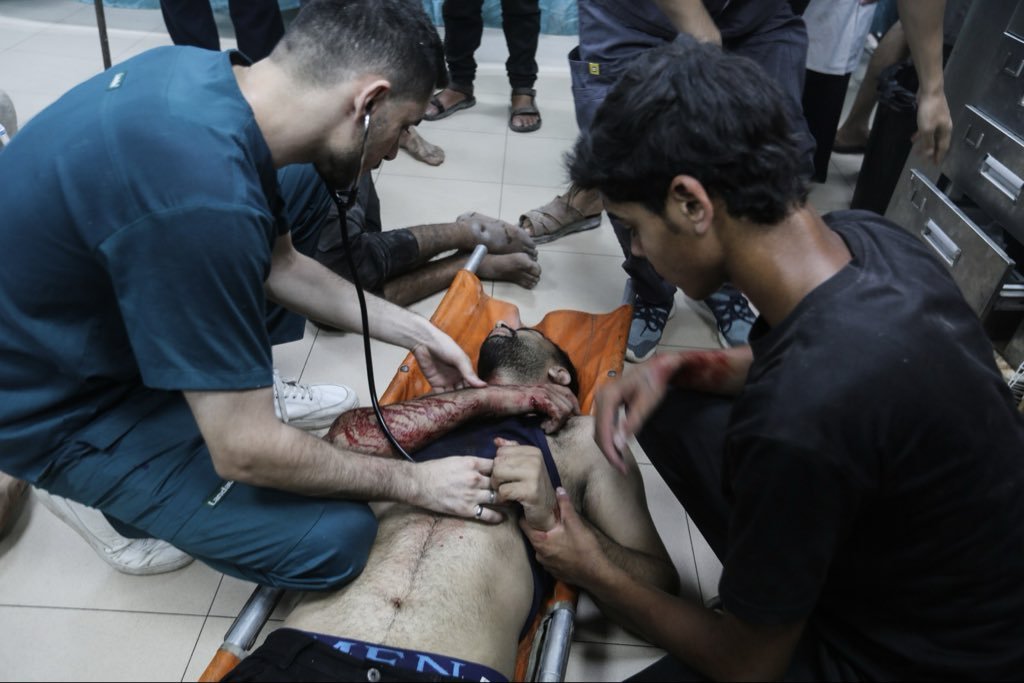
Gaza Herald_ In Gaza, where Israel’s ongoing war has systematically dismantled the health sector, Palestinian doctors are turning to innovation to save lives and limbs. With hospitals damaged, electricity scarce, and medical supplies nearly exhausted, doctors are finding new ways to treat the growing number of patients suffering from severe war-related injuries.
Relentless Israeli bombardment has left thousands with complex fractures and crushed limbs, injuries that would normally require advanced surgical equipment that is now unavailable. In response, Gaza’s medical teams have begun using 3D-printing technology as a last line of defense against amputation.
Solar Power and 3D Printing as Lifelines
Frequent power outages have made conventional medical manufacturing impossible. To overcome this, doctors have begun powering 3D printers with solar energy, allowing them to produce essential orthopedic devices even during total blackouts.
At al-Ahli Arab Hospital in Gaza City, medical staff are producing external fixators, devices used to stabilize shattered bones,using low-cost, recycled materials and open-source designs. These devices, typically imported at high cost, are now being locally manufactured under siege conditions.
Dr. Fadel Naim, consultant orthopedic surgeon and acting director general of the hospital, explained that the nature of war injuries has changed. The fractures arriving at hospitals are increasingly severe and complex, making external fixators the most effective treatment option.
Saving Limbs That Would Have Been Lost
Dr. Naim, working alongside the medical solidarity organization Glia, helped lead the initiative to locally manufacture fixators that would normally cost more than $500 each. By relying on 3D printing and solar power, Gaza doctors eliminated both cost and supply barriers.
One of the patients benefiting from this innovation is Zakaria, a displaced Palestinian from Jabalia refugee camp. He suffered a devastating leg injury caused by shrapnel from an Israeli airstrike and was forced to flee south to Deir al-Balah.
After weeks without proper medical care, Zakaria became the first patient to receive a Gaza-made external fixator. He later learned that the device stabilizing his leg had been produced locally by Palestinian doctors.
Doctors confirmed that the device successfully saved his limb, allowing him to walk without pain or restricted movement.
Healthcare as Resistance
Journalists reporting from Gaza described the use of 3D printing as a vital breakthrough in a collapsing health system. With electricity supplies destroyed and hospitals overwhelmed, the technology has become a rare source of hope.
Medical workers say that every printed component represents resistance against destruction, a refusal to let Gaza’s healthcare system disappear entirely.
According to Glia, at least 12 more patients are currently waiting to receive treatment using the same technology, highlighting both the scale of need and the life-saving impact of local medical production under blockade.
A Model Born From Siege
Glia described the Gaza-led initiative as globally significant, noting that it demonstrates how advanced medical technology can be adapted for extreme conditions. The organization said the project could serve as a model for other conflict zones, disaster-stricken areas, and communities facing infrastructure collapse.
Despite the near-total devastation of Gaza’s health sector—where nearly two-thirds of hospitals remain out of service—Palestinian doctors continue to innovate, using minimal resources to save lives.
A Health System Under Attack
Israeli military operations have left Gaza’s medical infrastructure in ruins. As of early December, the majority of hospitals were no longer functioning. Housing destruction has displaced over 1.5 million Palestinians, many of whom are living in tents with little access to medical care.
More than 70,000 Palestinians have been killed since the war began, and countless others have suffered permanent injuries. In this environment, Gaza’s doctors are not just treating patients, they are rebuilding medicine from the ground up.
Through solar-powered 3D printers and sheer determination, Gaza’s medical teams are proving that even under siege, life-saving innovation is possible.

