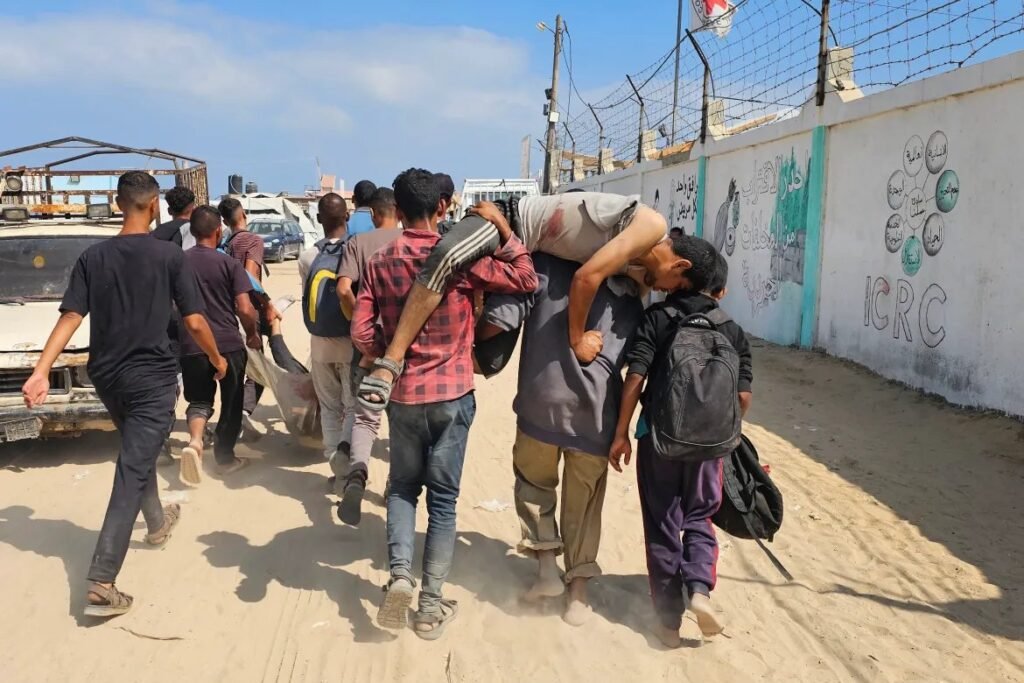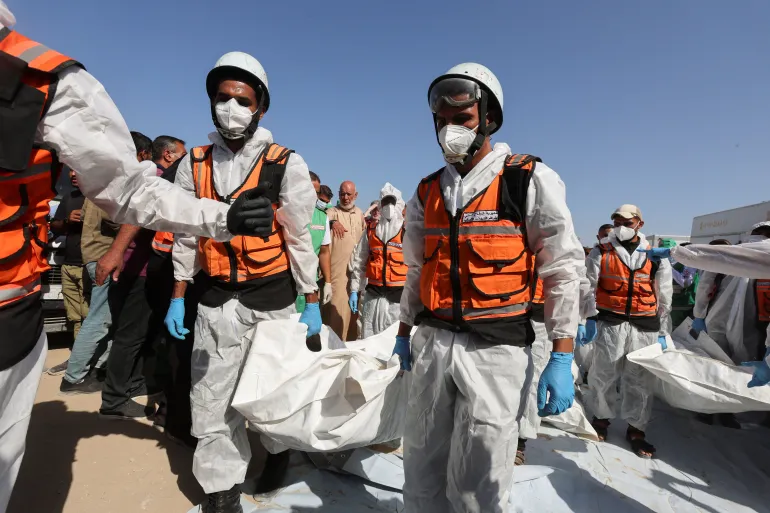
Gaza Herald_ Bodies returned to Gaza from Israeli custody have brought renewed anguish to families who had hoped for closure after nearly two years of uncertainty. The remains, delivered frozen and marked only with numbers, offered long-awaited answers about missing relatives, yet raised disturbing new questions about what happened to their bodies while detained.
Many of the corpses that arrived at Nasser Hospital in Khan Younis were difficult to identify. Several showed severed fingers or toes, and others bore long stitched incisions across their torsos, leading families to suspect that organs or body parts may have been removed. Forensic doctors in Gaza, however, say they cannot confirm or deny these concerns due to a severe lack of medical equipment.
Muhammed Ayesh Ramadan searched for days before recognizing his brother Ahmed, who disappeared on the first day of the war. The body was burned, riddled with bullets, stiff from freezing, and missing part of a toe , a pattern seen on almost all bodies returned, according to doctors, who say such amputations are usually linked to DNA procedures performed by Israeli authorities.
Gaza’s forensic teams report extreme limitations in their ability to conduct proper examinations. Director of Forensic Medicine Khalil Hamada explained that bodies arrive frozen solid or partially decomposed, and that the department lacks DNA-testing capability and advanced scanning tools needed to determine whether organs are missing. As a result, many bodies remain unidentified and are buried in mass graves. Out of 345 bodies returned so far, only 99 have been identified.
Israel provides no names, medical reports, or explanations with the handovers. Families are instead shown photographs on a large screen at Nasser Hospital and asked to identify their relatives based on visible features, injuries, or clothing. For those unable to attend, an online archive displays images and basic information in hopes someone will recognize a loved one.
For many families, the discoveries are devastating. When Zeinab Ismail Shabat found her brother Mahmoud, she saw that his hands and feet were bound, one finger severed, his clothes removed, and his body bearing signs of violence, including fractures and bruises. Medical workers say numerous bodies retrieved from Israeli custody show indications of torture, restraints, and injuries that appear to have occurred before death.
Nagah Ismail al-Jabari identified her brother and son mainly from their clothing, as decomposition and missing body parts made the process difficult. Like most others, both bodies were returned with severed extremities, typically a thumb or toe , believed to be removed for DNA sampling.
Despite the relief of finally locating their loved ones, families remain haunted by what they saw, left with more uncertainty than closure.