
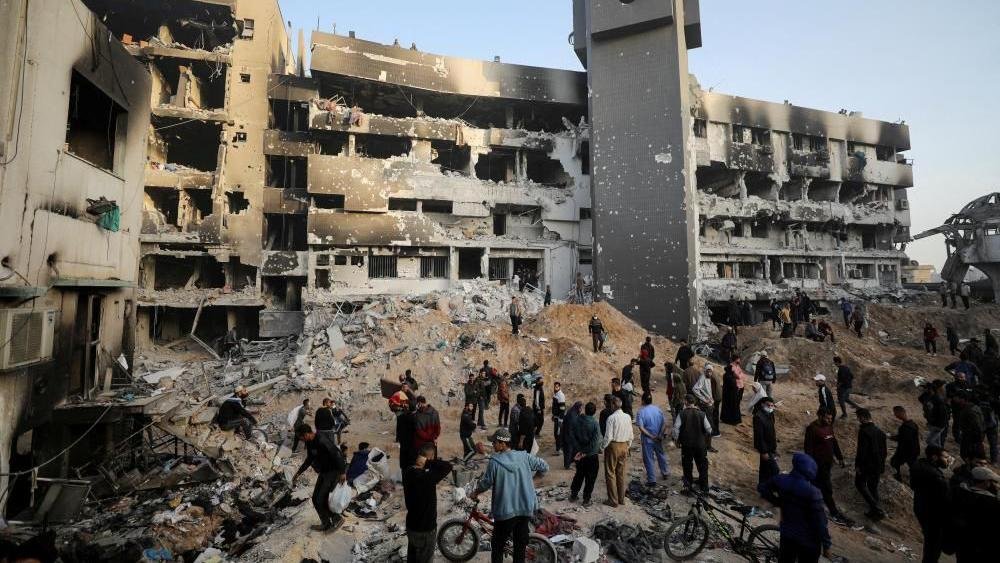
Gaza Herald_In Gaza, the search for the missing has become a daily ritual of grief, with families digging through mountains of shattered concrete in the hope of finding a trace of those they love. Beneath the ruins of entire neighborhoods lie thousands of Palestinians whose stories ended in silence; their bodies buried under the rubble created by relentless Israeli bombardment.
For many, closure has become a distant dream, replaced instead by the agonizing question of whether the people they lost are still somewhere beneath the broken earth.
As soon as Mohammed al-Banna heard that Israeli forces had withdrawn from eastern Gaza City in early August, he rushed to the area. His father, Jehad, was last seen heading back toward their home in Shuja’iyya, a neighborhood declared a “dangerous zone,” where residents were expelled, and anything that moved was targeted.
Jehad had been sheltering temporarily elsewhere in the city, but on 3 July, he insisted on returning home, driven by an attachment too deep to overcome. Mohammed and his family tried to stop him. He left anyway and never returned.
Mohammed, still a teenager, called his father repeatedly. Each unanswered call tightened the knot of dread in his chest. The fear became real when a neighbor informed him that their house had been bombed.
“That was when the terror set in,” he recalled. “I felt he had been inside the house when it was struck.”
The family pleaded for civil defense teams and international agencies to reach the area, but they were denied access. They turned to online appeals, waiting desperately for any sign of hope. No message came.
“For weeks, my family lived in torment, wondering whether my father was alive or dead,” Mohammed said.
When Israeli military vehicles finally pulled back on 3 August, residents were allowed to enter for the first time in weeks. People began searching for loved ones with a mixture of dread and fading hope.
“Along the way, there were bodies on the streets,” Mohammed said. “Those who arrived earlier had moved them aside, because that was all they could do.”
‘I searched for my father among the ruins.’
When Mohammed reached what was once their home, he froze. The house was gone, crushed into a mound of broken concrete and dust.
“I looked for my father among the ruins and found nothing,” he said. He kept searching the neighborhood, checking every corner, every collapsed room, every destroyed home.
Then, inside a neighboring wrecked house, he encountered a scene that would stay with him forever.
“I found my father thrown by the force of the explosion into the neighbors’ home,” he said. “His dear body had decomposed… nothing was left except his clothes and shoes. My beloved father stayed here alone for more than a month.”
Despite the devastation, Mohammed said he felt a painful relief at finally finding him. He was able to bury his father, something thousands in Gaza have been denied.
His neighbors told him he was lucky. Many families have found only scattered remains of their loved ones, sometimes hundreds of meters from where they lived. Others have found nothing at all.
Mohammed’s grief does not end with his father. His sister and her entire family were also killed in an Israeli strike. Civil Defense retrieved some of their bodies, but her eldest son Mohammed’s closest friend remains trapped deep under the rubble. With no machinery allowed into the Strip, bringing him out is impossible.
“He was like a brother to me,” Mohammed said. “We shared everything. Now he is still under the rubble, and I can’t bury him.”
“I’m only 15, but I feel like I’ve lived a lifetime of pain,” he added.
A slow, painful recovery
Authorities in Gaza estimate that around 10,000 people remain trapped beneath the rubble across the devastated territory.
Many hoped that the recent ceasefire would allow recovery teams to finally begin their work, but Israeli restrictions and repeated violations have prevented any meaningful progress.
According to Mahmoud Basal, the spokesperson for Gaza’s Civil Defence, the process of recovering bodies has become “tragic, complex, and nearly impossible.”
“We receive countless appeals every day,” he said. “But our reality prevents us from doing our work.”
Civil Defense teams face overwhelming obstacles: entire districts razed to the ground, massive volumes of debris, and the near-total absence of heavy equipment.
“Without machines, most operations cannot even begin,” Basal explained.
Around 600 bodies have been recovered since the ceasefire began, according to the Palestinian health ministry, a tiny fraction of the true number. A UN Development Program report estimates that Gaza now contains 61 million tonnes of rubble, calling it an unprecedented global challenge.
Basal said the crisis began long ago in November 2023 when Civil Defense teams were forced to suspend most body-recovery missions due to the intensity of the bombing. They focused only on rescuing survivors or retrieving bodies that were within reach.
“Crews often had to apologize to families and withdraw,” he said. “The bombing was too intense.”
Today, recovery teams still work with basic tools: shovels, pickaxes, wheelbarrows, and their own hands.
With official capacity crippled, many families have taken on the work themselves, digging through ruins in search of loved ones.
A new joint effort with the Red Cross hopes to begin using a single backhoe, a pilot attempt to see whether more organised operations can start.
“The longer calm continues, the fewer the missing will be,” Basal said.
But every renewed Israeli attack resets the clock.
“Each escalation keeps the number the same or makes it rise,” he warned.
Beneath Gaza’s shattered skyline lies an unspoken history, thousands of stories that ended unseen, unheard, and unfinished. Everybody trapped under the rubble represents a family left without closure, a childhood stolen, a generation erased. Until the living are allowed to recover the dead, Gaza remains suspended between grief and paralysis.
The rubble that covers the Strip is not just the remains of destroyed buildings, it is the physical weight of a people denied even the dignity of mourning. In Gaza, the struggle for life now includes the struggle to honour the dead, and both battles continue under the shadow of a world that has yet to demand justice.

