
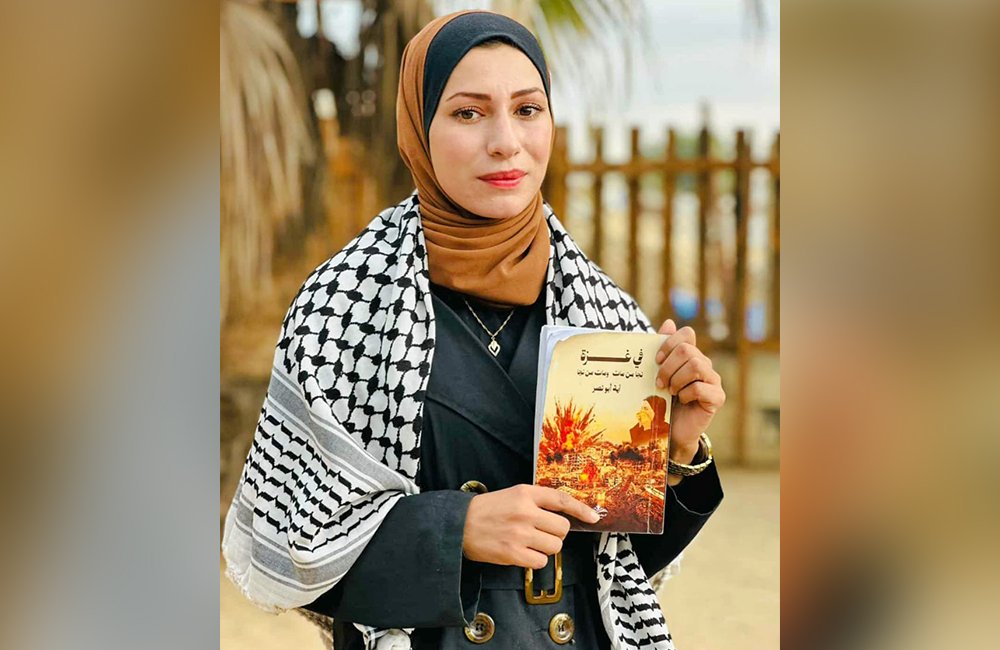
Gaza Herald—From beneath the shattered remains of Beit Lahia in northern Gaza, the story of twenty-nine-year-old Aya Abu Nasr emerged carrying a weight far heavier than her age. She did not document her experience with pen and paper but through pain loss and the persistence of memory capturing one of the harshest realities civilians in Gaza faced throughout the war. Aya lost one hundred and fifty members of her extended family when an airstrike leveled a five-story residential building on October 29 2024. She describes that moment as the instant when her entire world went dark a feeling she later encapsulated in the title of her book which reads In Gaza the dead survived and the survivors died.
Loss, Displacement, and Life Under Fire
Aya speaks of a war that forced itself into her life without warning describing it as a sudden night swallowing a lit home. She recalls how it stripped her of her family her house her work and the sense of safety that once anchored her. She ignored repeated warnings urging residents to flee south choosing to stay in northern Gaza for as long as possible. When the offensive intensified she eventually found herself pushed into displacement walking under the sight of tanks and circling aircraft. She remembers those hours as terrifying with tanks rolling beside the displaced people soldiers confronting civilians and her mother weeping over the sons she had left behind in the north. From that moment Aya felt that her role was to preserve the truth and deliver the reality of Gaza’s suffering to the world.
Despite the enormity of her loss Aya refused to allow grief to define her. Instead she joined humanitarian efforts offering psychological support and essential assistance to displaced women transforming her personal tragedy into a source of strength. She insists that the occupation will not silence her nor break her resolve. In a section of her book titled The First Encounter she reflects on her gradual return to life and how she became a pillar of comfort for others enduring pain similar to her own.
Women’s Voices From the Heart of the Fire
Aya’s book gathers dozens of firsthand accounts from women who endured bombing starvation and displacement. She writes about a mother crying over the bodies of her nine children about men standing in aid lines under the threat of shelling and about holidays that passed stripped of homes gatherings and joy. She also details life inside tents where privacy barely exists medicine is scarce and patients wait endlessly for treatment that may never come.
Carrying Gaza’s Memory to the World
Aya’s book eventually found a home beyond Gaza. It was adopted and published in the Sultanate of Oman and later distributed in several international bookstores. Aya emphasizes that her work is not merely a literary project but a human record a testimony of what Gaza lived through exactly as she saw and experienced it. She explains that she wrote to ensure the names of her loved ones would not be erased and that Gaza would not die twice once under the rubble and once in silence.
From the ruins Aya Abu Nasr did not rise as a figure of despair but as a witness determined to speak. Through her writing she fights to preserve memory and to remind the world that every statistic hides a life every story traces back to a home and every soul lost had once filled a space with laughter.

