
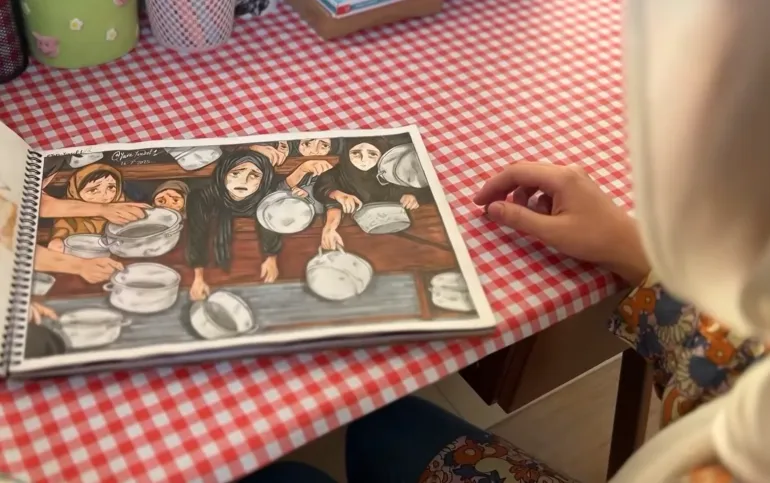
Gaza Herald_ In Gaza, where every child has become both a survivor and a witness, the language of grief has taken on new forms. Some cry in silence, some write their pain in the dust of destroyed classrooms, and a few, like 16-year-old Yara Youssef Abu Kweik, paint their suffering into existence.
More than two years of Israel’s genocidal war have shattered childhood in Gaza beyond recognition. Streets that once echoed with laughter now lie under rubble; schools have turned into shelters, hospitals into morgues. For Gaza’s youth wounded in body, displaced from their homes, robbed of safety and certainty, the struggle is not just for survival, but for meaning in the ruins.
Painting What Words Cannot Express
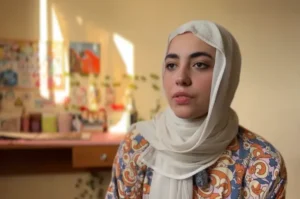 “I used to draw ordinary, spontaneous, colorful things,” Yara says softly, her fingers still stained with charcoal. “But as the war went on, I felt that I needed to show the world how we are living.”
Yara’s artwork has become her form of testimony, a visual diary of life under siege. Her drawings, both delicate and haunting, capture scenes that many outside Gaza cannot imagine: children reaching for handfuls of water, families huddled beneath torn tents, mothers clutching lifeless bodies.
“I drew a picture of children struggling to grab water,” she explains. “The famine we have endured, the tents, the endless displacement, it all takes a toll on the soul.”
When she draws, she says she feels a brief release, but the relief never lasts. “Sometimes I get flashbacks,” she admits. “The pain comes back while I’m painting. But I have to keep doing it because I want people to see.”
A Generation Marked by Trauma
Psychologists in Gaza say that more than 80 percent of children now show signs of severe trauma symptoms ranging from headaches and stomachaches to depression, hair loss, and weakened immunity. For many, the suffering runs deeper than physical pain.
“The second time I was displaced,” Yara recalls, “I began painting the things that changed all of us. The people who have no shelter, not even tents… I drew children and parents sleeping on the road, exposed to fire and shells.”
Even before this war, Gaza’s children lived on the edge of despair. A Save the Children report from 2022 found that four out of five suffered from depression, grief, and fear, while more than half reported suicidal thoughts.
Now, after two years of nonstop bombing and siege, the trauma has grown into an epidemic of invisible wounds.
According to UNICEF, more than 64,000 children have been killed or injured since October 2023. Gaza’s Ministry of Health places the broader death toll at nearly 69,000 Palestinians, most of them women and children, and more than 170,000 wounded.
A Ceasefire Without Peace
Even the much-publicized ceasefire, brokered by the United States and declared on October 10, has brought little relief. Israeli forces continue to carry out strikes, and humanitarian aid remains choked by severe restrictions.
In the weeks since the ceasefire, more than 200 Palestinians have been killed and over 500 injured, according to the Ministry of Health in Gaza.
“The war didn’t end,” says Yara. “It just changed shape.”
“We Want to Live”
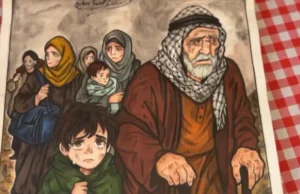 In her small corner of Gaza City, surrounded by fragments of destroyed walls and the hum of generators, Yara continues to draw. Her dream, she says, is to one day hold an exhibition that will “show the world Gaza through the eyes of its children.”
“Despite everything, I will keep painting,” she says firmly. “My message is simple: I represent all Palestinian children, and on their behalf, I say: Enough is enough. We want to live.”
Her paintings, vibrant strokes born of heartbreak, speak louder than words. They are the colors of defiance, the lines of survival, and the shadows of a stolen childhood still daring to dream.

