
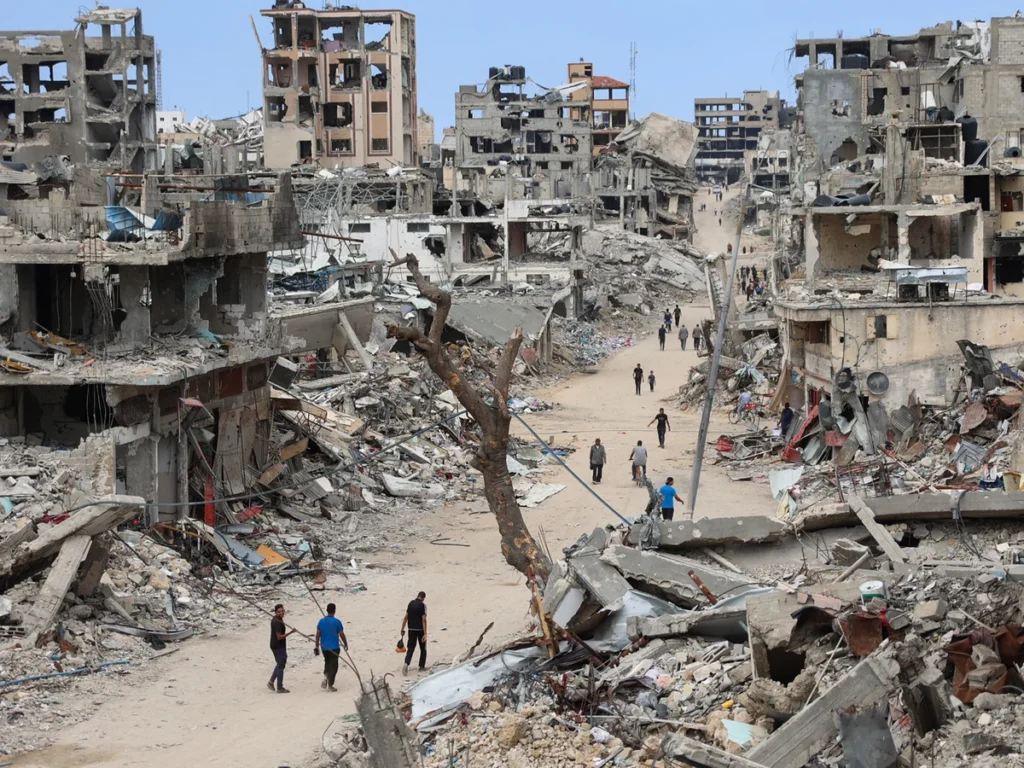
Gaza Herald — After two years of relentless war, thousands of Palestinian bodies remain buried under mountains of rubble across the Gaza Strip, silent victims of an assault that erased entire families and neighborhoods. Palestinian families are still desperately hoping to recover the remains of their loved ones, clinging to the smallest fragments of memory and faith.
Emergency crews say they lack the proper equipment to recover and identify victims on such a massive scale. With most heavy machinery destroyed or barred from entering Gaza, recovery teams continue to dig by hand, working through collapsed buildings, decomposed remains, and fading hope.
Amid this devastation and a suffocating global silence, Gaza’s Civil Defense warns that more than 10,000 bodies are still trapped beneath the ruins of homes and schools. Each represents a story, a family, and a right denied the right to a final farewell.
A Farewell Denied
Beneath the rubble of demolished homes, thousands of Palestinian martyrs lie waiting not for burial rites, but simply to be found. As grieving mothers sit before the ruins of what once were homes, the world looks away. Meanwhile, international search teams rush to recover the bodies of Israeli soldiers, their efforts amplified by global media coverage and political urgency.
Since the ceasefire agreement on October 10, international intervention in Gaza has focused not on civilians, but on assisting Israel in recovering its soldiers’ remains. In contrast, more than ten thousand Palestinian victims remain entombed under destroyed buildings, many since 2023, while the world’s conscience remains unmoved.
In Gaza’s Yarmouk refugee camp, Rowa Omar still waits to recover the remains of her sister, who has been trapped beneath the collapsed Al-Taj Mall tower for two years, along with a dozen others.
“My sister was martyred on October 16, 2023, inside the Al-Taj Tower. We couldn’t bury her, we couldn’t even say goodbye. The rubble is still there, the means are nonexistent, and no one has moved to recover those still trapped beneath it.”
Her grief carries the weight of betrayal.
“The world sends machinery and expert teams to Gaza to recover Israeli bodies as part of exchange deals, but no one hears our calls. It’s as if we’re not human,” she says.
She adds:
“We only ask for a dignified burial to recover our dead and know their fate. That’s the least of human rights. Don’t let the silence bury our loved ones twice. The world’s indifference kills just like the rubble does.”
Neighborhoods Turned to Graves
On November 16, 2023, Gaza’s Zaytoun neighborhood was bombarded in one of the deadliest attacks of the war. Nearly seventy people were killed, including forty children. Dozens of displaced families who had sought refuge there were crushed as their temporary shelter collapsed upon them.
“We’ve lived three years of unending suffering,” says Mahmoud Malka. “During a brief truce, we managed to bury about twenty martyrs, but more than fifty bodies remain trapped under the rubble. The buildings here are destroyed, floor upon floor collapsed. We know where some of them are, even beside my brother’s house, but no one has come to help.”
He adds bitterly:
“Israel was assisted with advanced machinery to recover its soldiers, while we were left to suffer. My family alone has over fifty missing martyrs. There are thousands more across Gaza. This is injustice in its purest form.”
The Waiting Never Ends
In the devastated district of Shuja’iyya, Aya Jundiya carries an unbearable grief. She lost two of her brothers in the latest offensive. One’s body was recovered; the other’s fate is still unknown.
“When countries sent machines to recover the Israeli soldiers, no one thought to dig out our sons,” she says. “We just want to bury them. We want our mother to have a grave to visit, to know her boys are at peace.”
She recalls the moment her mother learned of her first son’s death:
“When she found out, she went herself to the site and started searching with her bare hands. She couldn’t find him, and since that day, she’s been waiting for any word about the other.”
For Aya’s family and thousands like hers, every pile of rubble is a grave without a name, a memory without closure.
A Double Standard of Humanity
Dr. Salah Abdul Ati, head of the International Commission to Support Palestinian Rights (HIMAM), confirms that more than 10,000 bodies remain trapped under the rubble, while Israel continues to block the entry of essential rescue equipment.
“Civil defense crews are forced to recover bodies with primitive tools,” he explains. “Meanwhile, the international community expresses readiness to send machinery to recover Israeli soldiers’ remains, but not to rescue Palestinian civilians.”
He highlights the moral and humanitarian hypocrisy at play:
“This is a blatant double standard. The world must open Gaza’s crossings to allow heavy machinery, civil defense teams, and humanitarian aid in. We must recover the bodies of the martyrs and help Gaza heal from two years of genocidal war.”
An Unfinished Mourning
As Gaza’s sky fills once more with dust and silence, the grief beneath the ruins remains untouched. Thousands of families continue to wait — not for aid, not for justice, but for the simplest human right: to say goodbye.
For the people of Gaza, the war did not end when the bombs stopped. It continues in every mound of debris, in every name unspoken, and in every soul still buried under the rubble awaiting a delayed farewell.

