
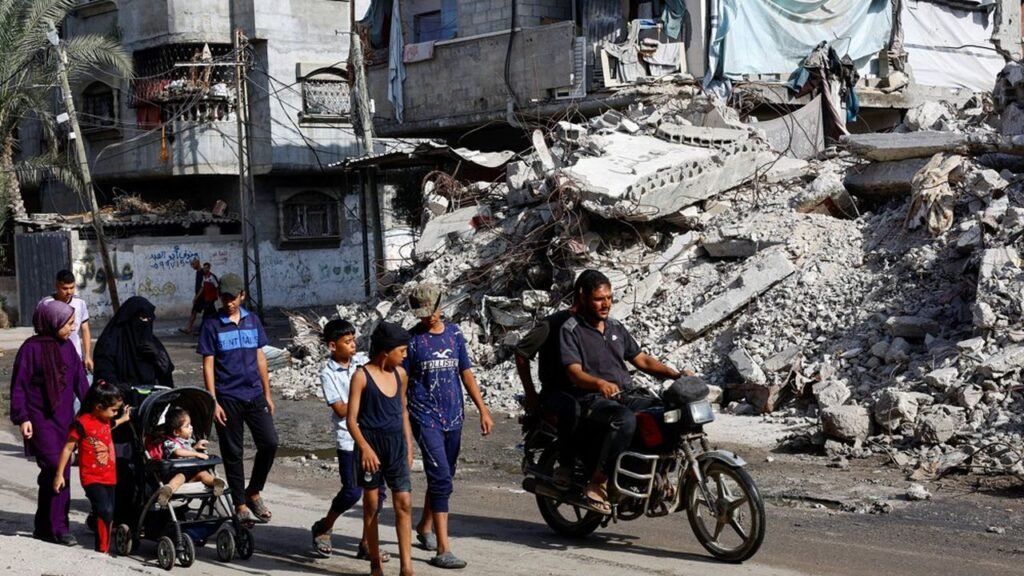
Gaza Herald _When silence falls after the storm, the real story begins. In Gaza, the bombs have gone quiet, but the sound of the rubble is louder than ever. The city breathes dust instead of air; its streets, once alive with children’s laughter and market chatter, have turned into narrow corridors between crumbling walls. People move carefully through them, carrying both their losses and the faint glow of a dream to live again.
Returning to Nothing
In al-Shati Camp, west of Gaza City, Salah Abu Ghoneima stands before a horizon of ruin. The outlines of his home are gone, erased by months of relentless bombardment. He stares into the void, tracing invisible lines with his finger as if redrawing his life from memory.
“Here was our door… and over there, my mother used to plant mint,” he says softly, before his voice breaks. “Now there’s nothing but rubble.”
Salah has come back not to rebuild, but to remember. Yet he refuses to surrender to despair. Lifting a small pickaxe, he begins clearing what was once his courtyard. “Even if nothing remains,” he says, managing a weary smile, “I’ll start from here, from this corner.”
The Waste of War: Bombs of Another Kind
Farther south, in the overcrowded displacement zones, a new kind of devastation spreads, silent but deadly. The smell of rotting waste and stagnant water fills the air. Piles of plastic, scraps of metal, and the bodies of stray animals surround the tents of the displaced, forming mountains of decay.
“The insects have become part of our daily life,” says Umm Bilal, a mother of five, her eyes hollow from exhaustion. “We close the tent, but they crawl through every hole. My youngest got sick three times last month… and we still haven’t seen a doctor.”
The United Nations warns that Gaza is facing an unprecedented environmental catastrophe, with millions of tons of debris and garbage choking the land. Water sources are polluted, sewage systems have collapsed, and what remains of hospitals are “conditions unfit for human life.”
The Battle After the War
Rebuilding Gaza will take more than concrete and cranes. It will take endurance.
“The cleanup is harder than reconstruction itself,” says Jaco Cilliers, representative of the UN Development Program. “Before rebuilding, we must clear the ruins, open the roads, remove the waste, and let life move again.”
Gaza’s war destroyed not only homes but the entire ecosystem of living: machinery, infrastructure, schools, hospitals, and even the small green spaces that once offered children a place to play. Every step now begins with rubble.
Cities Searching for Their Features
In Khan Yunis, a lone bulldozer crawls through a sea of debris, its engine coughing dust. Beside it, Thaer al-Astal, a 30-year-old man with a torn mask and a rusty shovel, digs by hand.
“We don’t have equipment,” he says, pausing to catch his breath. “But we have willpower. Every stone we lift feels like a step toward life.”
He looks toward the horizon. “Maybe under this rubble, there are bodies. Or maybe, a new beginning. We don’t know, but we have to keep going.”
Hope Rising from the Dust
Despite everything, the hunger, the grief, the endless loss, Gaza still writes its story on the walls that remain. Children have begun to draw again: small houses, suns, flags, and a single repeated phrase, ‘We want to live.’
Those shattered walls have become Gaza’s notebooks of hope. Every brushstroke, every word, is an act of defiance against annihilation.
The statistics speak only of destruction: 100,000 buildings erased, 300,000 homes damaged, but what cannot be measured is the pulse of life that still beats beneath the dust. Gaza, wounded and weary, rises once more from her ashes not because the world has rebuilt her, but because her people refuse to stop living.

