
Gaza Herald_ For Palestinian prisoners held in Israeli jails, captivity is not only a battle of the body but a relentless assault on the mind. Psychological warfare is waged daily through deception, uncertainty, and cruel manipulation.
Families reported dead, news of homes destroyed, and the constant fear of never seeing loved ones again. Freed journalist Shadi Abu Sidu’s shocking reunion with his wife and children, who he was told had been killed, exposes the cruel mental torment that detainees endure in a war within a war, where hope and despair are wielded as weapons.
Gaza journalist Shadi Abu Siddo feared he would never see his wife and children again. While imprisoned by Israeli forces, he was told by guards that his wife and children had been killed in Gaza.
But last Monday, after being released under a ceasefire agreement following a two-year genocidal war, he discovered that his life partner and his children were alive.
Alive Amid Death
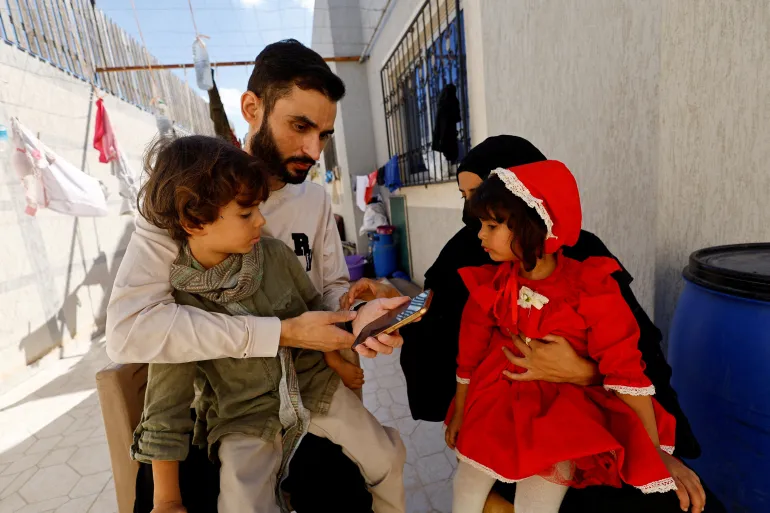
His wife, Hanaa Bahloul, ran down the hallway of their home in Khan Yunis and threw herself into his arms. They spun around holding onto each other as Abu Siddo pressed kisses onto the cheeks of his children, whispering, “My loves,” embracing the son and daughter he thought he would never see again.
“I only heard her voice, I heard my children’s voices, and I was stunned. It’s indescribable… alive. I saw my wife and children alive imagine, alive in the midst of death,” Abu Siddo told Reuters.
He was first detained at Al-Shifa Hospital in northern Gaza on March 18, 2024. His wife explained that he was initially held at the notorious Sde Teyman camp, then transferred to Ofer prison in the occupied West Bank, and finally to Ketziot prison inside Israel. She noted that he had been arrested solely because he was “a journalist working for a Palestinian organization.”
Beatings and Torture
Abu Siddo said, “I was brutally beaten, my hands were bound, and my eyes were blindfolded during detention.” His wrists bore clear marks from handcuffs and restraints.
He described the prison as a “cemetery for the living. They took the soul out of my body. But when I returned to Gaza, my soul came back. And then I saw the massive destruction… how do I even begin again? This is a story… a whole saga.”
Abu Siddo, a photojournalist, was among 1,700 Palestinians arrested by Israeli forces during the war in Gaza.
His wife said that a lawyer from Al-Dameer Human Rights Organization informed her that her husband was being held under Israel’s “Unlawful Combatants Law,” a form of administrative detention. Al-Dameer confirms that 2,673 Gazans are currently detained under this law.
Prisoner Exchanges Amid Ceasefire
On Monday, Hamas released 20 Israeli prisoners in its custody. In exchange, Israel freed 250 Palestinian prisoners serving life sentences, along with 1,718 detainees from Gaza since October 2023, and returned 90 bodies of Palestinian martyrs.
Earlier on Wednesday, the Izz al-Din al-Qassam Brigades, Hamas’s military wing, announced its need for equipment to recover the remaining bodies of Israeli prisoners in Gaza, following the handover of living prisoners and available bodies under the ceasefire agreement that took effect on October 10.
The ordeal of prisoners like Abu Sidu highlights a hidden front in Israel’s campaign against Gaza: the systematic infliction of psychological suffering. Beyond physical abuse, the manipulation of truth, the spreading of false news, and the deliberate withholding of information leave detainees trapped in a state of constant fear and grief. For those behind bars, survival is measured not only in days but in the ability to withstand a psychological siege that can scar the mind long after their release.

