
Gaza Herald— The bodies of at least 135 Palestinians have been recovered from beneath the rubble across the Gaza Strip, as rescue teams finally reached devastated neighborhoods following Israel’s ceasefire-mandated halt in its two-year genocidal war.
Palestinian officials confirmed that the remains of dozens of men, women, and children were retrieved on Saturday from multiple sites across Gaza, including 43 bodies taken to al-Shifa Hospital and 60 to al-Ahli Arab Hospital in Gaza City. Additional victims arrived at hospitals in Nuseirat, Deir el-Balah, and Khan Younis.
Medical authorities also reported that 19 more Palestinians were killed in Israeli airstrikes on Friday, while one person succumbed to previous injuries. Sixteen members of the Ghaboun family were killed when their home south of Gaza City was bombed in the early hours. Another resident was killed in Sheik Radwan, and two more died in attacks near Khan Younis.
It remains unclear whether any of these assaults occurred after the ceasefire took effect at noon local time (09:00 GMT).
The Return to Ruins
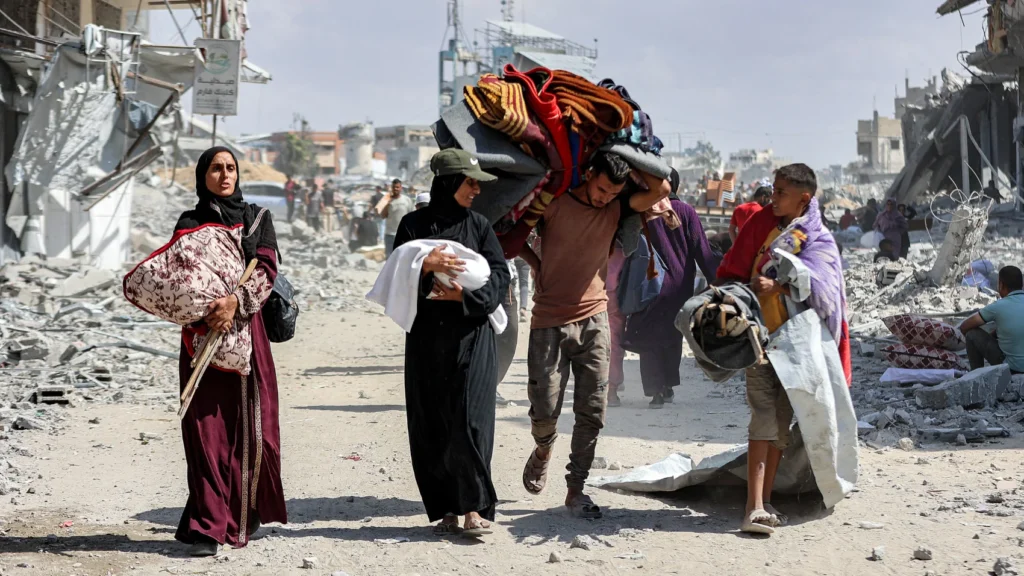
As Israeli forces withdrew from parts of the shattered enclave, the reopening of al-Rashid Street, Gaza’s coastal road, signaled the beginning of a painful return. Tens of thousands of displaced Palestinians began the long journey back to what once were their homes, now nothing but rubble.
Entire families could be seen walking, driving, or riding donkey carts northward, carrying what little they owned. Some dismantled their makeshift tents in southern camps to rebuild them over the ruins of their former homes.
For many, this return represents not only a desperate act of survival but also a quiet act of defiance, a refusal to abandon their homeland, even when everything has been destroyed.
“Almost nothing remains of Gaza City,” said one civil defense worker. “There is no clean water, no electricity, no functioning infrastructure. Only the bones of buildings and the memories of the people who lived in them.”
Life Amid the Ashes
Among the returning families was Naim Irheem, who packed a few belongings into his car before heading to Gaza City.
“I’m going back even though there are no conditions for life there — no infrastructure, no water,” he said. “My son was killed, my daughters were wounded, but I still want to return. We’ll live in a tent if we have to. It’s our land.”
For many, the homecoming is both heartbreaking and hopeful. Aisha Shamakh, another survivor, described her return as “a journey to see what’s left of our lives.”
“We want to see our homes or what’s left of them,” she said. “Floors collapsed on our children. Still, after everything, there’s joy in being able to come back.”
Faces of Resilience
In Gaza City, exhausted faces revealed both grief and a sense of relief. Some residents arrived to find their homes flattened; others dared to hope theirs might still be standing.
Ahmed Abu Shanab, who made the difficult journey north, said: “We suffered endlessly. We barely slept, we barely ate. Now we return to uncertainty, but we had to come back.”
Another woman, Maryam Abu Jabal, echoed the same fear: “We don’t know if our home still exists. But we prayed to God to see it again.”
In the obliterated Sheik Radwan neighborhood, Mohammed Sharaf looked over the ruins and said, “Everything has changed. We thought we’d be gone for a few days. Now we return to nothing but ashes.”
Hope That Refuses to Die
Even amid death, mourning, and ruin, Gaza’s people continue to return driven not by comfort, but by identity, memory, and hope.
Each step across the rubble is a declaration: that they will not be erased, not displaced, not forgotten.
The ceasefire may have silenced the skies for now, but the cost of survival is measured in the faces of those digging for loved ones — and in the determination of a people who, despite everything, still call Gaza home.

