
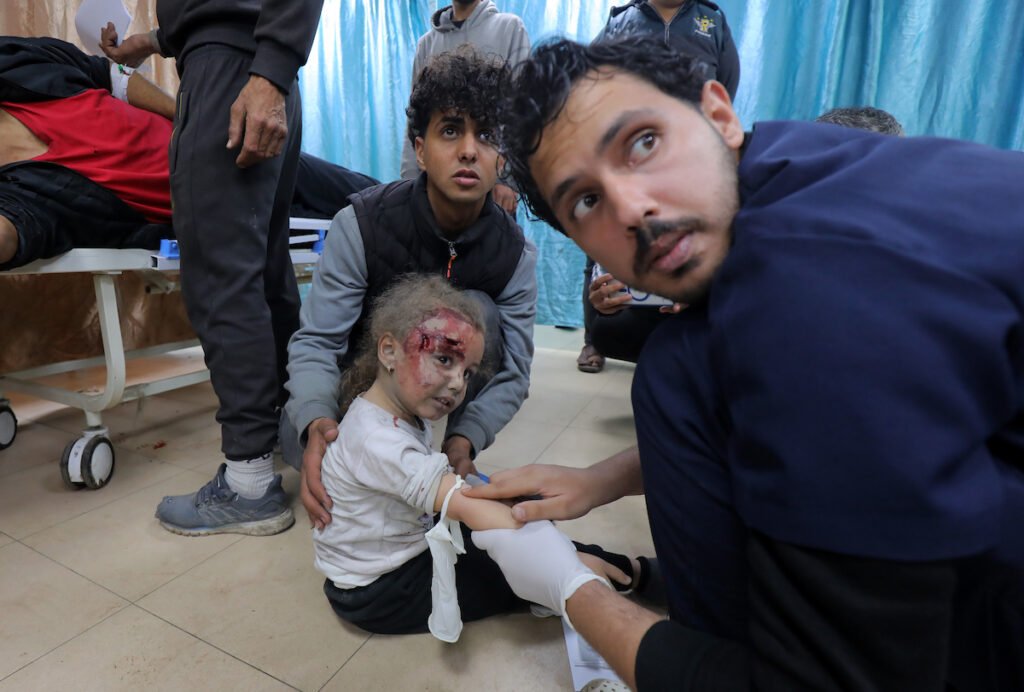
Gaza Herald- In a harrowing and urgent compilation, Displaced in Gaza presents 27 deeply personal testimonies from Palestinians who have been internally displaced following Israel’s latest invasion of the besieged Gaza Strip. The narrators, children, parents, teachers, and elders offer firsthand accounts of life under an unfolding genocidal assault.
Published by Haymarket Books in partnership with the American Friends Service Committee and the Hashim Sani Center for Palestine Studies, this anthology presents voices that emerge directly from Gaza’s ongoing devastation, unfiltered, immediate, and piercing in their honesty.
This collection does not simply document suffering; it serves as an archive of perseverance, dignity, and unwavering attachment to land and identity. What might first appear to be a book about destruction is, in fact, a defiant portrait of human resilience. The testimonies shake the reader with their raw emotion, but also lift them with an enduring spirit of hope, resistance, and refusal to be erased.
From the outset, the reader is not merely informed about atrocities; they are immersed in the lived experience of survivors who refuse to be reduced to headlines or numbers. These narratives do not repeat what international observers have long noted about the history or politics of Gaza. Instead, they offer a direct connection to the heartbeat of a people enduring the unimaginable—yet still dreaming of return, justice, and liberation.
A Symphony of Defiant Testimonies
The strength of Displaced in Gaza lies in its inclusivity: voices of all generations and backgrounds are woven together in a collective call for acknowledgment. These aren’t abstract tragediesthey are lived realities.
Among them is an 80-year-old grandmother, twice displaced in her lifetime, who now shelters her grandchildren in a tent after her home was levelled. Despite her circumstances, she still dreams of the liberation of her homeland and a return to the life that was stolen from her.
Her resilience echoes that of a 12-year-old boy who operates a humble trampoline at an Unrwa shelter to bring moments of joy to other displaced children, even as he fears Israeli bombs with every breath.
Equally heart-wrenching is the account of a young father who loses both of his daughters in a single air strike, one of them on her third birthday. He describes how he dug through rubble with his bare hands to retrieve their bodies, only to find them thrown far from their home by the blast.
“I spoke to them, but they didn’t respond,” he recalls, turning a reader’s heart to ash.
Yet, there are also stories of survival and renewal. A young teacher, after losing her home and her private tutoring centre to Israeli bombs, begins teaching over 200 children in a displacement tent.
Her act is not just one of necessity, but a declaration that education remains Gaza’s most potent weapon of resistance.
There is also the pharmacist who, after his two pharmacies were flattened, opens a makeshift clinic in a displacement camp to treat those with nothing. He dreams not only of rebuilding his businesses but of completing his advanced studies, seeing healing as both his duty and his future.
Across these pages, we meet newly widowed mothers raising children alone, siblings who are the sole survivors of entire families, and even Nakba survivors forced to relive the horrors of 1948.
One 91-year-old contributor, after surviving multiple Israeli wars and occupations, insists that this onslaught is the worst of all. Yet, he vows never to leave Gaza.
“We cannot migrate again,” he writes. “We will stay on our land until death.”
Each of these stories stands alone in its power, yet together they form a collective voice one that refuses to be silenced.
Clinging to Dignity Amid the Ruins
Reading Displaced in Gaza is a deeply emotional experience. The trauma recounted here is immense families wiped out in seconds, children disfigured, entire neighborhoods turned to dust. The testimonies don’t soften the horrorthey confront the reader with it.
We witness scenes that imprint themselves on the reader’s mind: a mother screaming at soldiers to stop as they nearly run over a terrified child during an evacuation; families huddling together under shellfire; a parent describing how “we indescribably shared pain” as war came to their doorstep.
There are moments of pure horror, such as when a father, Tareq, finds the tiny bodies of his daughters and later wraps them in blankets because the morgue had run out of space.
These aren’t faceless statistics—they are voices that demand to be remembered. The book does not allow the reader to remain emotionally distant; it requires empathy and recognition.
What emerges most profoundly is the sumud the steadfastness of Palestinians who insist on remaining rooted despite every attempt to uproot them.
“Our love for our homeland Palestine… and our refusal to emigrate from it have pushed us to stand firm,” declares one elderly contributor.
“We are the owners of this land… and we will never leave it.”
That sentiment is echoed by a 61-year-old man who, after losing everything, spends his days organising games for children in displacement camps.
“If the resistance defends us with weapons, we must also resist by standing firm on our land,” he explains.
Even a child, like 12-year-old Said, continues to tend his trampoline despite witnessing carnage and living in fear.
“I was happy to bring joy to the faces of displaced children,” he says.
These expressions of refusal to break off or continue life, play, and education are, in themselves, revolutionary.
Testimony as Resistance
What sets this book apart is not literary polish, but truth. The power of Displaced in Gaza lies in the urgency of its accounts. Many pieces were written under fire, by phone light, in displacement camps, amid air raids. This immediacy lends them a visceral, irrefutable force.
The editors have succeeded in preserving the unique voice of each storyteller while crafting a work that reads as both a documentary and a collective diary. These are not simply stories; they are declarations of being. The contributors are not just survivors; they are authors of their history, asserting agency through words.
As Ahmad Alnaouq notes in the foreword:
“Storytelling becomes an act of resistance, a declaration of our humanity. Through our words, we reclaim our narrative.”
These stories break through the wall of media narratives that often dehumanize Palestinians. They offer a counterbalance truth-telling through lived experience. Each account is a brick in the foundation of future justice and memory.
As Tareq Baconi describes it:
“[This is] an archive of enormous importance.”
A Testament of Survival and a Call to Act
Despite the scale of suffering documented here, the effect of the displacement in Gaza is not to paralyze the reader but to move them. These voices are not mourning in isolation; they are reaching out to the world, demanding solidarity, accountability, and remembrance.
The testimonies are filled with pain, yes—but also with strength, love, and resolve. We see a father mourn his daughters, then teach children in a tent. A teacher loses her classroom but builds a new one from tarpaulin and determination. A boy dodges bombs but repairs his trampoline for others to smile.
As one contributor bluntly states: “We write so that others cannot say they did not know.”
This book is a monumental living testament to Gaza’s spirit. It is a collective cry for dignity and recognition in a world that too often turns away.
In the final pages, one of the editors expresses gratitude to the storytellers for their courage and notes that through their words, “you are contributing to a legacy of resilience and hope.”
Now, that legacy passes to remember us, to speak out, and never forget.

