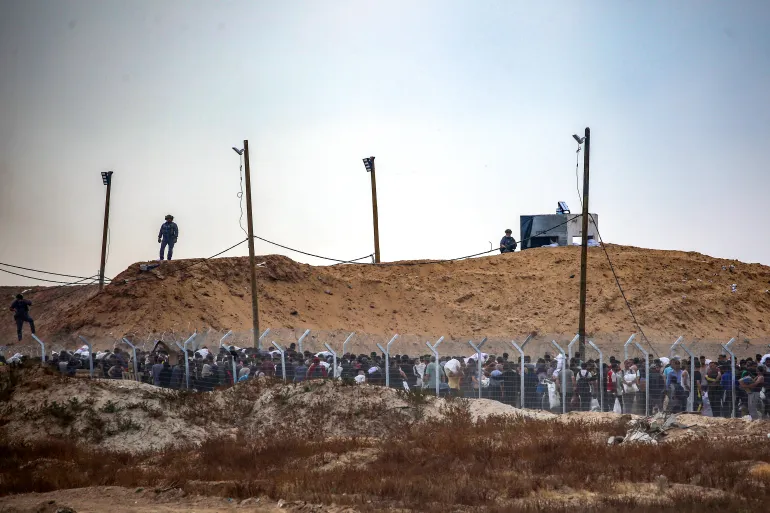
GazaHerald – On a dusty Sunday morning in northwestern Gaza, tens of thousands of desperate Palestinians gathered in the al-Sudaniya area, clutching onto a fading hope that a truckload of flour might offer some relief from months of starvation.
Instead, many walked into a massacre.
Eighteen-year-old Mohammad al-Ewadi was among the crowd. Like thousands of others, he had heard that aid trucks would be arriving, and he set out early, hoping to bring something, anything, back to his family of fifteen.
What he witnessed instead was horror.
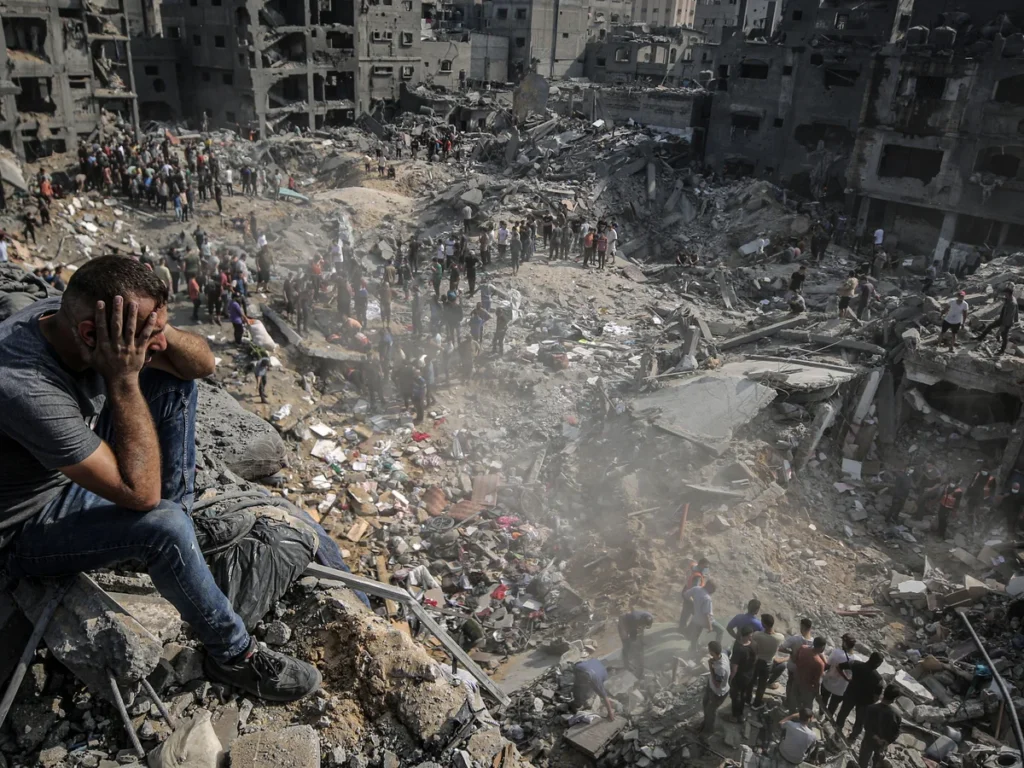
“They fired heavily at us from the tanks,” he said, still shaken. “There are now piles of martyrs. It was chaos. The scenes were grotesque, truly grotesque.”
According to survivors, Israeli forces encircled the crowds before opening fire with bullets and tank shells, sending people fleeing in all directions or collapsing where they stood. Health officials later confirmed that at least 99 people were killed and over 650 wounded.
“It was like something out of a nightmare,” al-Ewadi said. “You’re just trying to survive. If the person next to you gets hit, you can’t help. You freeze. You hide, you run.”
Among the wounded was his brother, Abdullah.
Nearby, Farah Hisham al-Sheesh arrived around 10 a.m., lured by rumors of a flour delivery. Moments later, he was struck in the head by shrapnel.
“God is sufficient,” he murmured from a hospital bed. “That’s all we can say now.”
Another survivor, Nafez Hana al-Najjar, described being hit in the ear and arm. “We were surrounded,” he said, his voice trembling. “I saw men martyred in front of me. Wounded people all around.”
He had never gone to an aid point before. His first time ended in bloodshed, and tragedy. His cousin, trying to rescue him, was shot through the heart and died instantly.
“It was all indiscriminate,” he said, his eyes wet. “And without warning.”
The Price of Flour in a Starving Land
Since March, Gaza has been under a total blockade. No humanitarian aid or commercial goods are allowed in. The once-flourishing markets are bare. Children are skeletal. Hunger is a permanent fixture.
For the rare few who manage to grab a sack of flour, their ordeal doesn’t end. Armed gangs often lie in wait along the roads home, ready to rob them of their precious lifeline. Al-Sheesh said he once lost a bag of flour to a group of young looters. Al-Ewadi has been to the same aid point eight times; only twice did he come back with food.
“This time, thank God, I got 11 kilograms of flour,” he said. “It might last us four days.”
His voice tightened when asked when he last ate bread. “Two months ago,” he replied.
Sheesh, who supports a family of eight and says they survive mostly on lentils and rice when they can find them. A kilo of flour, when available, costs 140 shekels, more than $40. His young children, Mohammad and Nouriddeen, are already showing signs of severe malnutrition.
“I lost five kilos,” he said. “My son looks like a skeleton.”
‘We Run Toward Death Just for a Kilo of Flour’
Ehab al-Zein, another survivor of the Sunday massacre, said it had been more than a week, maybe two, since he last had access to flour.
“What can we do?” he asked bitterly. “We’re running toward death just to get a kilo of flour. And even then, we often come back empty-handed. We die, and return home with nothing.”
“I saw death with my own two eyes,” he said. “And somehow, I came back alive.”
Zein, who is responsible for 20 relatives, parents, sisters, orphans, his wife, and children, said this would be his last attempt. He doesn’t plan on returning to the aid site.
“I will die from hunger,” he said. “But I’m not going back to be killed like that. Let the children die of hunger, it’s better than watching them die like this.”
He described crouching for an hour and a half under Israeli fire, bullets whizzing over his head, shells pounding the ground nearby.
“Only God knows how I made it out. It took a hundred miracles.”