
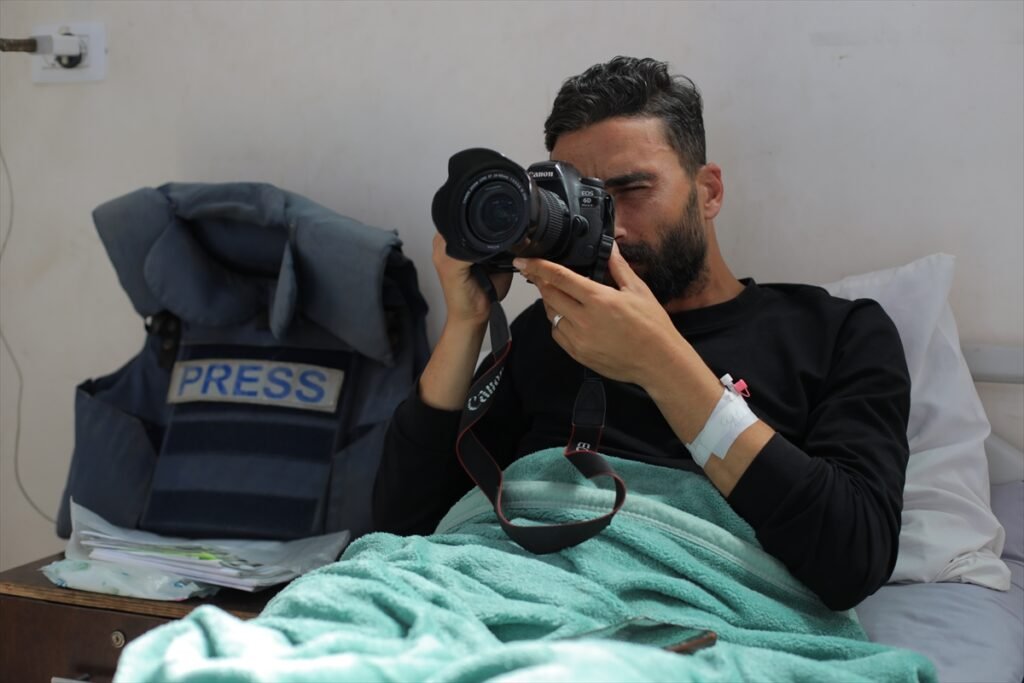
Gaza Herald – For years, Palestinian photojournalist Moataz Al-Salhi was the eye documenting death across the Gaza Strip. Today, the camera has slipped from his exhausted shoulder, replaced by an IV line in his arm, as illness forces him away from the field.
Al-Salhi is now fighting a painful battle with Crohn’s disease amid a severe shortage of medicine and Israel’s continued blockade, transforming him from a witness to suffering into one of its victims.
A Dangerous Illness
 Lying on a hospital bed inside Al-Aqsa Martyrs Hospital in central Gaza, the Palestinian journalist appears physically drained by both war and disease, barely able to move after years spent behind his lens documenting the suffering of others. Today, he finds himself inside the very scene he once photographed.
Al-Salhi, a freelance photojournalist who worked with Anadolu Agency, spent the years of war moving between rubble, hospitals, and displacement camps, documenting destruction, hunger, and killing in Gaza while quietly battling a serious illness consuming his body day after day.
In 2022, doctors diagnosed him with severe Crohn’s disease, a chronic inflammatory condition affecting the digestive system that requires continuous biological treatment unavailable inside the besieged Gaza Strip.
He was supposed to receive his first doses of treatment inside Israeli hospitals in October 2023, but the outbreak of war prevented his travel, beginning a long journey of pain and worsening health.
Despite his condition, he continued working throughout the war, moving between bombed areas, hospitals, and shelters while carrying both camera equipment and medication bags at the same time.
“Now I Am the Story”
 Recalling those days, he said: “I was covering events while the IV line was attached to my hand for treatment. I was extremely exhausted, but I wanted to deliver the people’s message and suffering.”
Then, speaking with visible fatigue, he added: “Today, I have become the story. I am the one who needs treatment.”
The effects of the illness are evident on his frail body after he lost significant weight and became unable to live normally amid the absence of proper treatment and the continued closure of crossings for thousands of patients and wounded civilians.
Al-Salhi confirmed that his condition worsens daily inside the hospital, where he spends long hours between pain and waiting without access to the biological medication he urgently needs.
The Palestinian Ministry of Health in Gaza warned that the medicine and laboratory crisis inside hospitals is rapidly deteriorating, announcing shortages of 47% of essential medicines and 59% of medical supplies.
During more than two years of nonstop coverage, Al-Salhi documented the wounded, the sick, and famine victims. Today, he finds himself in the same place he once captured through his lens, a patient waiting for treatment.
Journalists Under Fire
Journalists in Gaza are living through what the Government Media Office described as an “unprecedented and catastrophic reality,” as the war has turned journalism into a profession shadowed by death and direct targeting.
According to the office, around 262 journalists have been killed since the beginning of the genocide, while more than 420 others have been injured. Dozens have also been detained, and others remain missing.
Dying Slowly
Al-Salhi’s suffering extends beyond illness itself. He also fears for his small family. He is the father of two children, while his wife is expecting another baby, and he fears dying before he can hold the child in his arms.
“I am not asking for anything except a chance for treatment,” he said. “I want to return to my normal life as a father, husband, and journalist.”
He believes his story is not an isolated case, but a reflection of the reality facing thousands of patients in Gaza waiting for a chance to travel abroad for treatment amid the collapse of the healthcare system and the severe shortage of medicine and medical supplies.
Concluding his message, he said: “I used to deliver people’s voices to the world. Today, I am delivering my own voice, save me, I want treatment abroad.”
Thousands Waiting for Medical Evacuation
More than 18,000 patients and wounded civilians are estimated to be waiting for medical evacuation from Gaza, while only a few hundred have managed to leave the Strip for treatment abroad amid strict travel restrictions and the continuing collapse of the healthcare sector.
Israel was supposed to reopen the crossing during the first phase of the ceasefire agreement that came into effect on October 10, 2025, but it later backed away from doing so.

