
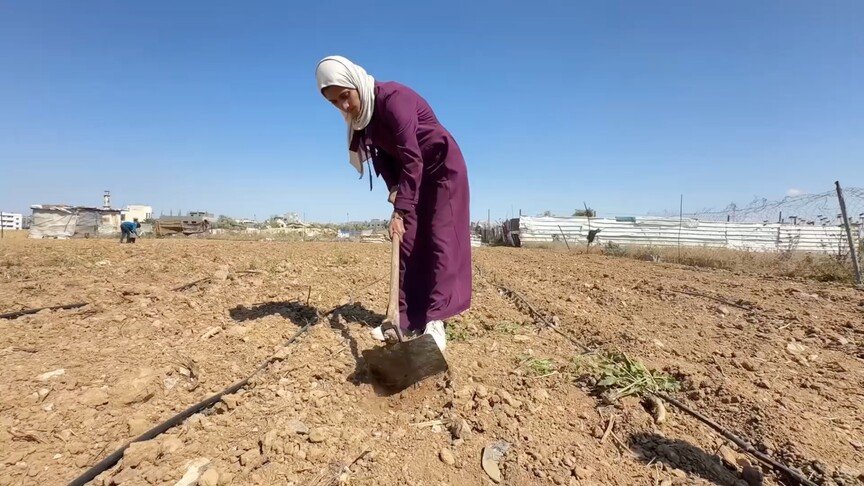
Gaza Herald – On the soil of her family’s farmland on the outskirts of Bureij refugee camp in central Gaza, a young Palestinian woman, Rowan Salama Al-Qarnawi, stands trying to bring life back to what remains of her father’s legacy after losing him during Israel’s genocidal war on Gaza.
For Al-Qarnawi, who once lived in the eastern areas of Bureij camp, returning to farming was not merely an economic choice. It became a harsh necessity imposed by the genocide that erupted on October 8, 2023, after the family home was bombarded and all sources of income were lost.
Leaving Her Education Behind
Al-Qarnawi, who was forced to leave her studies, said: “After everything was destroyed and our home was ruined, we returned to farming again to continue what my father used to do before he was killed.”
Rowan’s father, Salama Al-Qarnawi, was killed several months ago while returning from work on his farmland in Bureij camp after being hit in an Israeli strike.
According to data from Gaza’s Government Media Office, Israel destroyed more than 94% of Gaza’s agricultural land out of 178,000 dunams, causing agricultural production to collapse from 405,000 tons to around 28,000 tons.
Reports by the United Nations Food and Agriculture Organization (FAO) also confirmed that the amount of land available for cultivation dropped to less than 5% following the genocidal war.
Enormous Challenges
With extremely limited resources, the young Palestinian woman began rebuilding her connection to the land from scratch, plowing, planting, and irrigating, amid conditions lacking even the most basic necessities because of Israel’s ongoing blockade on Gaza.
Israel has imposed a strict blockade on the Gaza Strip since June 2007, isolating it from the occupied West Bank and the outside world.
The blockade has continued ever since, while the genocide and its aftermath have dramatically worsened the humanitarian crisis.
Al-Qarnawi explained that water scarcity remains the biggest challenge she faces after water sources were damaged and the pump her family relied on for irrigation stopped functioning.
“Land without water has no life, and everything we planted is at risk of being destroyed,” she said.
The difficulties have also intensified because agricultural tools were lost during the war, forcing her to repurchase supplies at soaring prices amid severe economic collapse.
Despite all of this, Al-Qarnawi managed to plant wheat across the land in an attempt to preserve her family’s only source of income.
But fear continues to haunt her, as the crop that struggled to grow now faces an uncertain fate due to the lack of equipment needed for harvesting and milling.
“We planted wheat, but we do not know how we will harvest it or grind it. When you have a goal and cannot achieve it, that is extremely painful,” she said.
Her suffering is not limited to agricultural hardships. The land lies near areas exposed to Israeli occupation fire, yet she continues her daily work while holding onto hope to save whatever can still be saved.
On October 17, 2025, the UN agency for Palestinian refugees (UNRWA) stated that nearly all agricultural land in Gaza had become either “destroyed or inaccessible,” depriving families of their primary livelihoods and driving food prices to unprecedented levels after two years of genocide.
A Legacy and a Dream
Al-Qarnawi’s bond with the land goes far beyond work. Every corner of it carries memories of her father. Speaking with a voice filled with grief and longing, she said: “I lost my father while he was returning from the land, and every time I come here, I feel he is still with us.”
She stressed that what she is doing is not simply a struggle for survival but rather a matter of loyalty to her father’s dream of planting the entire land with wheat.
“We planted the land the way he wished, and we will continue no matter the circumstances,” she said.
According to a statistical report published by Gaza’s Government Media Office on October 6, 2025, Gaza’s agricultural sector suffered losses estimated at nearly $2.8 billion after two years of genocide.
The Israeli occupation also destroyed 1,233 agricultural wells and rendered them unusable, in addition to demolishing more than 85 percent of Gaza’s greenhouses, according to the same report.

