
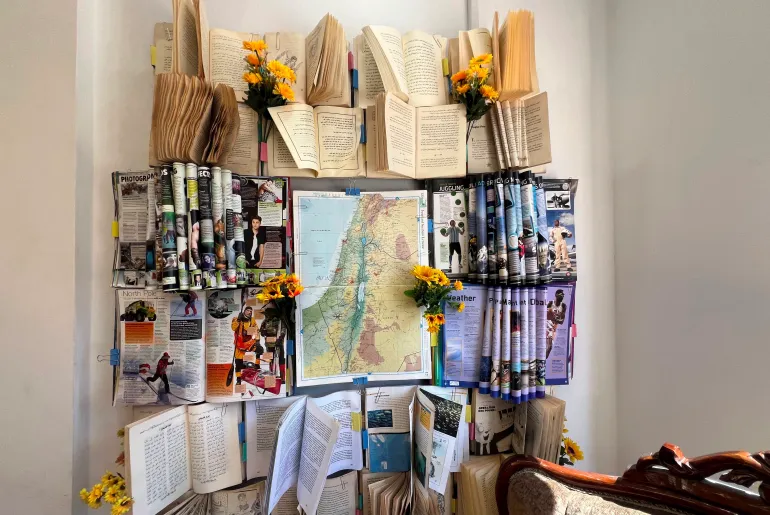
Hera Herald – In a city where displacement has become routine, and survival is measured in repetition rather than stability, a small cultural space has emerged as a symbol of endurance. The “Phoenix Library” in Gaza City opened this week, carrying an extraordinary history behind its shelves: its founder says the collection has been displaced 13 times before finally finding a place to settle.
The library, located on Omar Al-Mukhtar Street, opened its doors with roughly 6,000 books spanning literature, science, education, religion, and social studies in Arabic and English, alongside translated works from multiple languages, including Spanish, French, Russian, and Japanese. Despite the ongoing destruction across the enclave, the opening drew students, writers, and young readers seeking what many described as a rare moment of normalcy.
For its founder, Omar Hamad, the library is more than an academic project. It is a personal archive of survival. He described the books as “part of identity and memory,” noting that they had been repeatedly displaced alongside him during years of genocide and forced movement.
The idea of rebuilding a library in the middle of widespread devastation has been widely interpreted locally as an act of cultural resistance. In Gaza, where printed books have at times been sold by weight for fuel and paper, preserving written knowledge has become increasingly difficult.
Co-founders and volunteers involved in the project said many of the volumes were salvaged from destroyed homes and damaged private collections, while others were donated by families who lost relatives in the Israeli genocide. The result, they say, is a collection shaped as much by loss as by preservation.
Beyond its symbolic value, the library also functions as a community space. It offers free lending services, intended to remove financial barriers in an economy severely weakened by prolonged genocide and restrictions. Organizers say the goal is to restore access to reading for students and residents who have been cut off from educational resources.
Visitors to the library describe it as a psychological refuge. One university student said the space creates “a pause from everything outside,” adding that reading restores a sense of continuity that daily life has lost.
Others emphasize its social role, noting that it brings together people who share a desire for learning in a setting that feels unusually calm compared to surrounding conditions. For many young visitors, the library represents not just access to books, but a rare environment where focus and reflection are still possible.
Despite its modest scale, the Phoenix Library has quickly gained attention as a cultural milestone amid ongoing hardship. Its founders say they intend to expand the collection and continue restoring damaged works, even as resources remain limited.
In a place where buildings are frequently reduced to rubble, the library’s name reflects its ambition: to be rebuilt again and again if necessary. As one visitor put it, “When everything else collapses, the page is still something you can hold.”

