
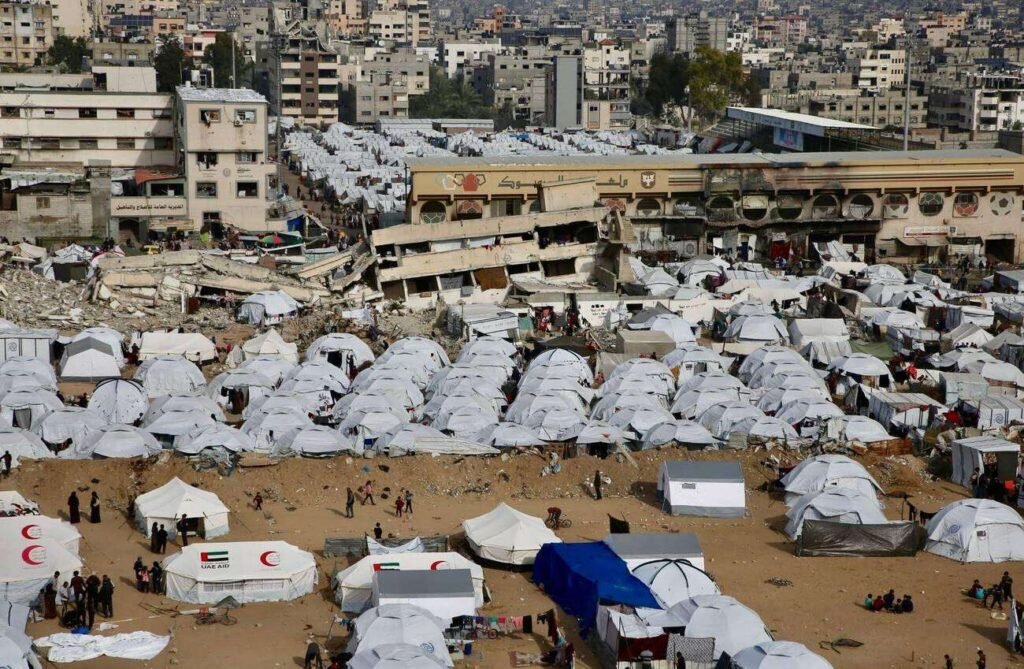
Gaza Herald – In the far north of the Gaza Strip, where the boundaries between fear and frontline violence blur, hundreds of displaced Palestinians in Halawa camp are enduring conditions that defy ordinary measures of hardship.
Here, time is not marked by days or weeks, but by the number of hours that pass without injury or death. What was meant to be a temporary refuge has instead become an exposed and precarious space, where daily life unfolds under the persistent sound of gunfire and shelling.
Halawa camp lies just a few hundred meters from a high-risk military zone, often referred to locally as the “yellow line,” placing it within near-constant range of fire. This proximity has effectively turned the camp into an unspoken danger zone, where Israeli attacks can erupt without warning.
Residents describe a state of continuous alert. Even inside tents, there is no sense of protection. Bullets, they say, do not distinguish between open ground and shelter.
For families, maintaining even a fragment of normal life has become an exhausting struggle. Parents attempt to shield their children from the reality around them, but fear seeps into every detail of daily existence. Simple routines, cooking, sleeping, gathering water, are carried out quickly and cautiously, often under the cover of darkness.
Children, in particular, are bearing the invisible weight of this environment. Play has nearly disappeared. Open spaces are considered too dangerous, and even the act of running or laughing outdoors carries risk. What should be a space for recovery has instead deepened the trauma of displacement.
Recent incidents underscore the fragility of life in the camp. A 13-year-old boy was fatally shot while collecting water at night, an ordinary task turned deadly. Days earlier, a young man lost his life under similar circumstances. Such losses are mourned quietly and quickly, as prolonged grieving itself can feel unsafe.
Humanitarian conditions continue to deteriorate. According to international estimates, the majority of Gaza’s population remains displaced, facing severe shortages of food, clean water, and medical care. In camps like Halawa, these challenges are compounded by immediate Israeli threats and the complete absence of safe zones.
For those living there, expectations have narrowed to the most basic of hopes: survival. As one displaced resident put it, the goal is no longer to rebuild a life, but simply to remain alive long enough to imagine one again.

