
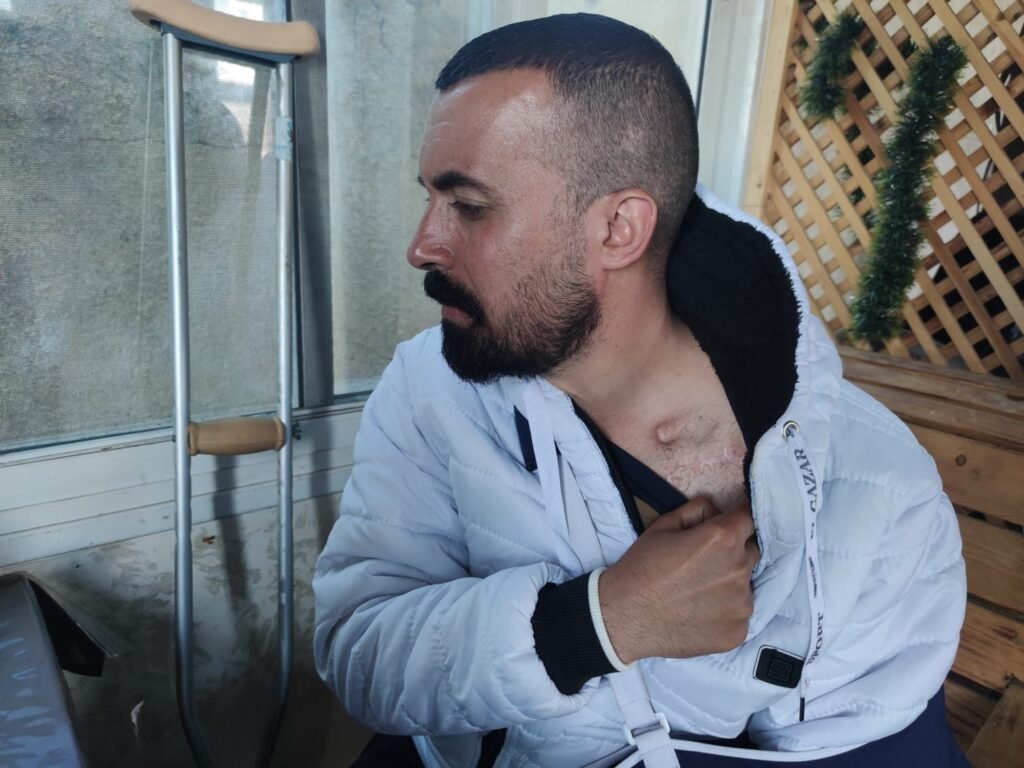
Gaza Herald – Abdul Qader Tafesh, 34, never expected that he would go from being a volunteer paramedic treating the wounded inside Kamal Adwan Hospital to becoming a detainee and witness to one of the harshest chapters of detention experienced by Palestinian civilians during the Israeli war on Gaza in October 2023.
Abdul Qader, a civilian from Jabalia camp, says he took shelter in the hospital after his home was bombarded, like hundreds of civilians who sought refuge within hospital walls. There, he volunteered to assist the injured amid a severe shortage of medical staff. However, the place he had turned to for safety became a direct target.
Storming of the hospital
One day before the hospital was stormed, an Israeli shell hit the first floor, killing five people. Abdul Qader says: “We did not know this shelling was a prelude to the raid, especially with hundreds of civilians, including women and children, inside the hospital.”
On the morning of December 12, 2023, Israeli occupation forces destroyed the hospital’s outer wall as tanks surrounded the area and snipers took positions on nearby buildings. Soldiers then ordered all men between the ages of 15 and 70 to leave, including the wounded, medical staff, and paramedics.
“I walked out with more than 500 civilians. Even the injured were forced to move on foot,” he recalls.
Outside, they were ordered to strip, then taken to a military site where they were screened using an eye-scanning camera.
“Anyone the army wanted was separated and taken away. I was among those detained,” he adds.
Beaten directly on the metal implants
Tafesh describes one of the most painful moments: “I had previously been injured and had metal plates in my hand and shoulder. I told them I couldn’t tie my hands behind my back, but they ignored me.”
He continues in a strained voice: “One of the soldiers asked where the metal plates were, then started hitting me directly on them until they were forced out of my body. I lost sensation in my hand.”
He reports that detainees were subjected to a series of abuses, including severe beatings, binding, blindfolding, and transfer to unknown locations under harsh conditions.
Recalling that night, Tafesh says: “It was an extremely difficult night I will never forget. We were naked in cold, rainy weather. Because of the metal plates, I suffered from breathing difficulties and severe pain from the cold. I lost consciousness and was woken up by soldiers, and the torture continued for an hour in the heavy rain.”
40 days of suffering
Tafesh was later transferred to detention centers inside Israel, where he endured more than 40 days of suffering. There, physical pain was compounded by hunger, cold, and fear.
“Forty days of beatings, insults, being suspended by the hands, forced to kneel for hours, and allowed only four hours of sleep in freezing conditions without blankets.”
“We were barely allowed to sleep. We woke up at dawn to the sound of banging on metal sheets, which caused constant fear. The food was not enough even for a small child—just a quarter loaf of bread for breakfast, and the same for lunch and dinner,” he says.
He adds: “We were not allowed to speak. Silence dominated. Around 100 detainees in one room, and not a single voice could be heard because of the fear and intimidation.”
Dogs were reportedly used to intimidate detainees under the pretext of searches, and access to toilets was used as a form of humiliation, with some detainees denied access until they were forced to relieve themselves where they stood, particularly the elderly.
Shortly before his release, Tafesh says he was told he would be taken for surgery. “On the way, they beat and insulted me. My hands and legs were shackled. They said I needed surgery due to a new fracture, but the doctor later said my condition did not require any operation. I was returned to the detention ward, it seemed like psychological pressure.”
Physical and psychological trauma
Recalling the night of his release in January 2024, Tafesh says: “They forced us to run in freezing weather. There were women, elderly civilians, and the sick with us. They ordered us to chant ‘Long live Israel,’ and when we took the wrong way, they fired at us.”
“When I arrived, I collapsed. I could not stand any more. I kept losing consciousness. My body was extremely weak. Some youth carried me into a UNRWA bus.”
They were later handed over at Kerem Shalom crossing to Red Cross ambulances, where he received his first medical assistance before being transferred to Abu Youssef Al-Najjar Hospital.
After his release, Tafesh learned that his father, who had been detained with him, was freed after a month, while his brother’s fate remains unknown.
Today, Abdul Qader suffers from severe physical and psychological trauma. He struggles to walk and uses crutches, experiences constant pain and tremors, and requires urgent surgery to remove damaged metal implants from his shoulder and replace them. He also suffers from knee injuries from being forced to kneel for extended periods.
“We wished to remain under bombardment rather than be humiliated like this,” he says.
Tafesh’s story is one of hundreds of testimonies emerging from detention, shedding light on what Palestinian detainees endure in Israeli jails. The number of detainees has surpassed 9,600, including 84 women and around 350 children.

