
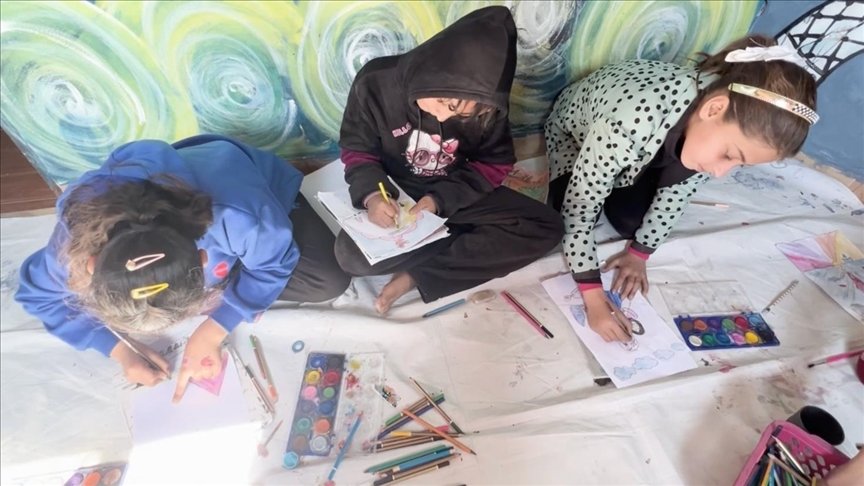
Gaza Herald- Amid the devastation of war and ongoing displacement in the Gaza Strip, a small art studio in Deir al-Balah has become a refuge for dozens of children seeking to process trauma and reclaim fragments of their lost childhood.
Inside the modest space known as “Atelier Mays,” children sit on the ground, around simple tables, or even atop stones from bombed buildings, painting scenes that stand in sharp contrast to the violence they have endured since the war began in October 2023.
Through brushes and color, the children attempt to transform fear, loss, and displacement into vivid expressions of life and hope. For many, art has become more than a pastime; it is a coping mechanism.
According to the United Nations, children have paid the heaviest price in Gaza, with more than 20,000 reported killed and tens of thousands losing one or both parents.
Nearly 47 percent of Gaza’s 2.4 million residents are children, underscoring the profound impact of the conflict on this generation.
Fourteen-year-old Abeer Shubair, who was displaced twice from Khan Younis before settling temporarily in Deir al-Balah, says the studio has given her space to express emotions she struggled to put into words.
“I started by drawing sadness and destruction, but over time, my drawings became more positive. I feel like I’m getting better,” she explained.
A similar transformation is described by 11-year-old Rafif al-Attar, whose early drawings reflected tents, ruins, and hardship. Gradually, her artwork shifted toward nature, flowers, and children playing, images of a life she hopes to regain.
Beyond emotional healing, the studio has helped children reconnect socially. Rafif noted that she has become more open and interactive after previously withdrawing from others.
Palestinian artist Mays Youssef founded the initiative after she lost her home and studio during the Israeli genocide.
Determined to help displaced children, she began organizing art workshops for those who had experienced severe trauma, including the loss of family members or survival from under rubble.
Youssef says art has proven to be an effective form of psychological support, allowing children to express painful memories without fear or hesitation.
“Some children began telling their stories through drawings when they couldn’t speak about them,” she said.
As part of the initiative, she launched a project titled “Messages to the Sky,” where children channel their experiences into artwork.
These pieces have been exhibited internationally, including in the Netherlands and Italy, where children of similar ages have engaged with their stories.
Youssef is also preparing a book documenting the children’s experiences during the war, aiming to amplify their voices globally.
“They are not just numbers, they are human stories that must be told,” she said.
Despite a reduction in active fighting, the humanitarian situation in Gaza remains dire. Children continue to face disrupted education, limited access to safe spaces, and a lack of basic opportunities for play and normal development.
Approximately 1.9 million people out of Gaza’s 2.4 million population remain displaced, living in overcrowded tents with minimal access to essential services following widespread destruction of homes and infrastructure.
The war has left more than 72,000 people dead and over 171,000 injured, with around 90 percent of civilian infrastructure damaged or destroyed.
Ongoing ceasefire violations continue to raise fears of renewed escalation.
In the midst of these hardships, the small studio in Deir al-Balah stands as a rare space where children can momentarily escape the realities of war, using color not only to remember what was lost, but to imagine what could still be rebuilt.

