
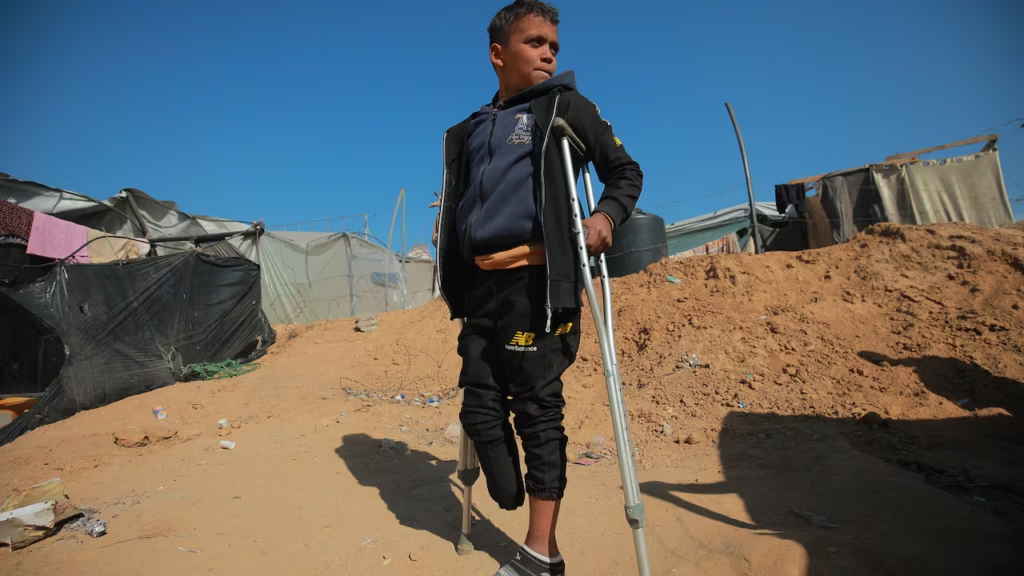
Gaza Herald _ What is happening to Gaza’s children is not collateral damage; it is the steady erosion of an entire generation’s future. Beyond the visible destruction of homes and schools lies a quieter devastation: the psychological collapse of childhood itself. In a territory where reconstruction is delayed, borders are sealed, and uncertainty governs daily life, children are being pushed into survival roles long before they are ready. This is not simply a humanitarian crisis. It is a generational emergency shaped by war, blockade, and prolonged instability.
Child Trauma Beyond Child Labour
“What we are witnessing in Gaza is not merely child labour,” said Yaqeen Jamal, an educational psychologist who has provided psychological support to children during the war. “It is the systematic destruction of an entire generation’s future.”
Jamal explained that children are losing their fundamental sense of security and stability. “They are stripped of their childhood and burdened with responsibilities that exceed their cognitive, emotional, and physical abilities,” she said.
With schools destroyed, families displaced, and breadwinners injured or killed, many children have been forced into work simply to help their families survive. But Jamal warns that the damage goes far beyond economics.
“The long-term consequences will be catastrophic,” she said. “We are facing a generation at risk of illiteracy and serious mental health deterioration. This will create a societal gap that will be extremely difficult to repair.”
According to Jamal, rebuilding schools and restoring education must be prioritised above all else. “Education is the last line of defence for a people’s identity and future,” she stressed. “Without it, recovery becomes nearly impossible.”
Yet reconstruction in Gaza is expected to take years. Israel continues to obstruct the entry of essential materials, and the threat of renewed military escalation looms. In this climate of uncertainty, children remain trapped between trauma and economic necessity.
Layla’s Story: A Childhood Buried in Pink Rubble
Among those children is 11-year-old Layla.
Her father lives with a physical disability that prevents him from working. With no stable source of income, Layla has taken on the responsibility of helping support the family. Every day, she walks the streets of Khan Younis selling tea.
Along al-Bahr Street, the city’s main road, her small voice rises repeatedly: “Hot tea, hot tea, one shekel.”
She carries a tray holding eight cardboard cups, each two-thirds full and covered carefully with aluminium foil to keep them warm. Her movements are focused and deliberate, far older than her years.
When asked about her favourite colour, Layla answered without hesitation: pink.
She remembered her pink bedroom, once filled with toys. She spoke of her favourite doll, also pink, now buried beneath the rubble of the room destroyed during Israel’s war on Gaza.
“I wish the colour pink would return to my life,” she said quietly. “I wish my room would come back. I wish our happy life before the war would return.”
Moments later, she hurried back into the street, resuming her calls to passing strangers, her childhood suspended between memory and survival.
Rebuilding More Than Walls
The destruction of Gaza’s schools and homes can, one day, be rebuilt. But the psychological wounds inflicted on a generation of children cannot be repaired with cement alone. Without immediate action to restore education, lift restrictions, and provide sustained psychological support, the damage risks becoming permanent.
If childhood is the foundation of any nation’s future, then Gaza’s future is being systematically undermined. Rebuilding Gaza must mean more than reconstruction; it must mean restoring safety, dignity, and the right of children to simply be children again.

