
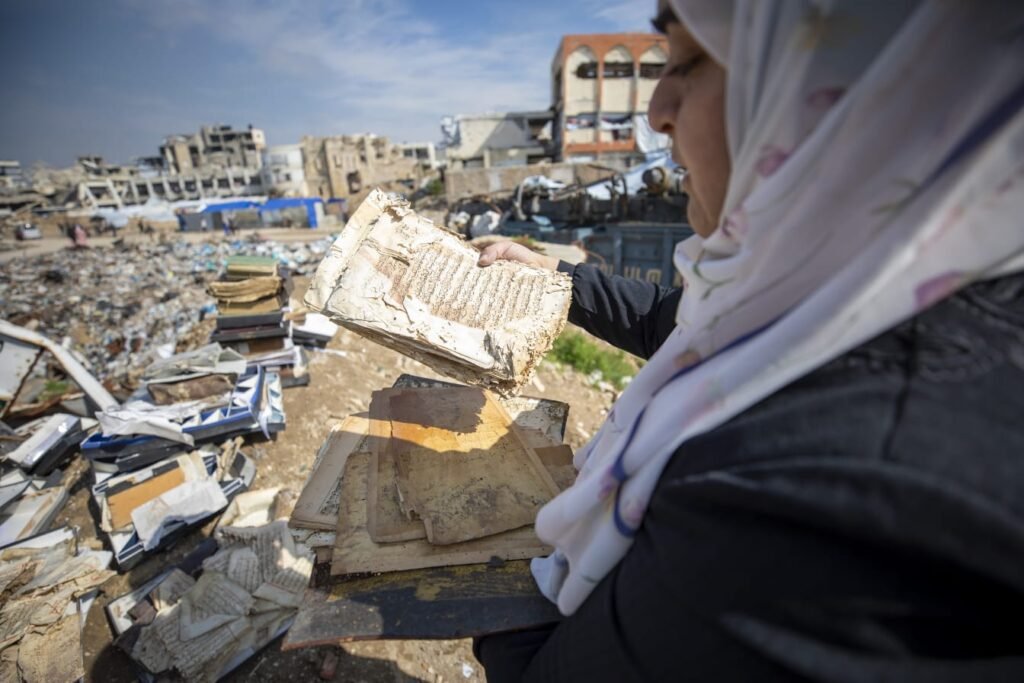
Gaza Herald Exclusive- Beneath the shattered streets and collapsed buildings of Gaza City, Palestinians are not only searching for the bodies of loved ones. They are also digging through the ruins for fragments of their collective memory. In Gaza, it is not just human lives that are being buried under rubble, but centuries of history, knowledge, and cultural identity. Books, manuscripts, and irreplaceable archives have been reduced to dust, erasing a living record of Palestinian heritage.
As Israel’s genocidal war on Gaza continues, mounting evidence reveals the systematic destruction of cultural institutions, libraries, manuscript collections, and archival centers. The scale of the loss is beyond comprehension. What is unfolding is not merely collateral damage, but a deliberate campaign aimed at dismantling Palestinian historical memory itself.
A Calculated Assault on History and Identity
 When memory is shattered and witnesses are silenced, it becomes clear that the occupation is targeting more than the present. It is methodically crushing the past. Dozens of cultural, academic, and heritage institutions have been obliterated, reflecting a calculated effort to erase Palestinian identity and deny an entire people the right to preserve and narrate their own history. All of this has unfolded amid deafening international silence and an alarming failure to protect Palestinian cultural heritage.
Historian Abdul Latif Abu Hashim, former director of the Manuscripts and Antiquities Department at Gaza’s Ministry of Religious Affairs, describes the destruction of Gaza’s archives as a direct assault on the foundations of Palestinian identity. Cultural heritage, he explains, forms the core of any nation’s historical continuity, and its annihilation constitutes a permanent loss that can never be repaired.
A Policy Rooted in the Nakba
Speaking to Gaza Herald, Abu Hashim stressed that Israel’s targeting of Palestinian archives is not new, but part of a long-standing policy dating back to the Nakba of 1948. He pointed to extensive documentation of organized looting and confiscation of Palestinian libraries and archives over decades. He cited an Israeli doctoral dissertation titled Ownership Card, which meticulously records the systematic theft of Palestinian archival materials, as well as Israel’s seizure of the Palestinian Research Center in Beirut during the 1970s, when vast collections of documents and manuscripts were confiscated.
During the current war, Israeli attacks have destroyed at least 208 archaeological and heritage sites out of 325 across Gaza, according to the Government Media Office. Rare artifacts were also reportedly stolen, as evidenced in footage released by Israeli soldiers themselves. Abu Hashim explained that the manuscripts lost in Gaza held immense scientific, historical, and cultural value. Authored by scholars from Gaza and southern Palestine, these works spanned theology and law, medicine, literature, and astronomy, documenting Gaza’s deep contributions to Arab and Islamic civilization.
Lost Manuscripts, Lost Civilizations
 The magnitude of this loss, Abu Hashim emphasized, cannot be measured in financial terms. It is a devastating blow that rivals the scale of human destruction inflicted on Gaza. In his assessment, the eradication of archives amounts to cultural genocide, severing future generations from their roots and reshaping history through erasure.
He warned that recovering even fragments of this lost heritage will require extraordinary collective effort and international commitment. Israel, he said, fully understands the symbolic power of archives and deliberately targets them to undermine Palestinian historical legitimacy and portray Palestinians as a people without culture or continuity.
More Than 80 Percent of Gaza’s Archives Destroyed
Human rights advocate and cultural preservation expert Haneen Al-Omassi, executive director of Eyes on Heritage, described the devastation as “beyond description.” According to her organization’s estimates, more than 80 percent of Gaza’s archival infrastructure has been destroyed, and the true figure may be far higher due to the absence of comprehensive field documentation.
She explained that Israeli attacks have deliberately targeted cultural memory through the systematic destruction of museums, libraries, archives, universities, and heritage centers. Her own institution, which housed some of the rarest historical collections in Palestine, remains buried under the ruins of Al-Ghafri Tower in western Gaza. The fate of its priceless manuscripts remains unknown.
 The library preserved rare collections belonging to Gaza’s most prominent scholars and historians, including the libraries of the Bseiso family, Sheikh Othman Al-Taba’, Nahid Munir Al-Rayyes, and Sheikh Mohammad Awad, former head of Al-Azhar institutes in Gaza. These collections documented Gaza’s history from the late Ottoman period until the Nakba of 1948, offering unparalleled insight into Palestinian intellectual life before displacement.
Many of these materials had never been digitized. Entire collections of Ottoman-era records and detailed archives of Palestinian villages destroyed in 1948 were incinerated, leaving no surviving copies. Al-Omassi compared the scale of destruction to the catastrophic cultural losses of World War I, warning that this erasure will create a deep historical void affecting scholarship, education, and identity for generations.
She stressed that the destruction of archives does not simply eliminate documents. It severs the link between past, present, and future, dismantling the collective memory of an entire people. It also creates an irreversible rupture in academic research, historical documentation, and cultural continuity.
The targeting of cultural heritage extended to private homes, government institutions, and religious sites, leaving no safe space for preservation. Al-Omassi noted that only a fraction of manuscripts were rescued, including 147 volumes salvaged from the historic Great Omari Mosque library. The overwhelming majority, however, was lost forever.
Human rights organizations have affirmed that these acts constitute war crimes under international law. The Euro-Mediterranean Human Rights Monitor has stated that the deliberate destruction of cultural and historical sites violates the Rome Statute of the International Criminal Court and breaches the Hague Convention for the Protection of Cultural Property in Armed Conflict. It further asserts that this cultural annihilation represents a core dimension of Israel’s genocidal campaign, aimed at obliterating Palestinian identity, memory, and historical existence.
In Gaza today, the ruins speak not only of shattered buildings and lost lives, but of erased stories, burned manuscripts, and silenced generations. The destruction of archives is not an unintended consequence of war. It is a calculated assault on memory itself, an attempt to ensure that the Palestinian narrative disappears beneath the rubble.
Yet even amid this devastation, Palestinians continue to search, document, and remember, refusing to let their history vanish. In their struggle to reclaim fragments of their cultural inheritance, they affirm a simple truth: a people without memory cannot survive, and Gaza’s memory, though wounded, still lives.

