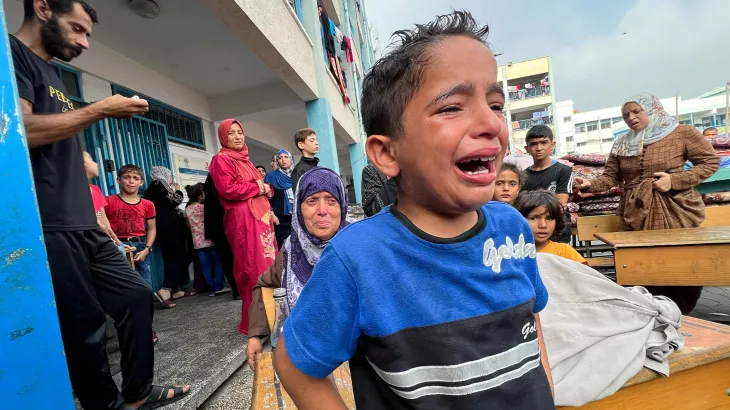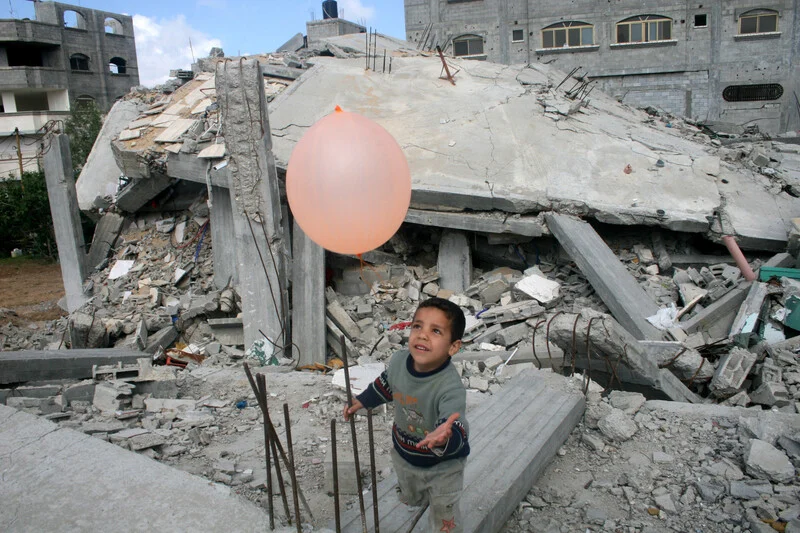
Gaza Herald _ For the third consecutive year, Gaza’s Christian community is deprived of celebrating Christmas, as Israel’s ongoing war and siege continue to strip the enclave of safety, joy, and basic human dignity. What was once a season of light, family gatherings, and spiritual renewal has been reduced to quiet prayers held amid ruins, grief, and unhealed trauma.
“The hardest thing for me this Christmas is that I will remain alone inside the church,” says Faten Al-Salfiti, her voice breaking with grief. “I lost the dearest people in my life during the war—my husband and my son. We have no life anymore. We lost life itself. The rituals will be limited only to prayer.”
As Christmas Eve approaches according to the Western calendar, Faten explains that although Christmas had always been the most beautiful day of her year, the devastation caused by relentless bombardment has erased any sense of celebration. Her pain reflects the collective reality of Gaza’s Christian minority, now marking the holiday for a third year under catastrophic humanitarian conditions.
A Community Caught in a Prolonged War
Gaza’s Christians are enduring this Christmas more than two years after the October 7, 2023, events and the Israeli military assault that followed, a war that has engulfed every corner of the Gaza Strip. Entire neighborhoods have been flattened, families displaced, and social life dismantled, leaving no space for celebration, only survival.
The impact of the war has been indiscriminate. Homes, schools, churches, businesses, and cultural landmarks have all been destroyed, forcing Christians, like the rest of Gaza’s population, into displacement, poverty, and profound psychological distress.
Religious Observance Without Public Celebration
Father George Anton, Director of Operations at the Latin Patriarchate in Gaza, confirms that all public manifestations of Christmas have been cancelled this year.
“There will be no public celebrations,” he told BBC Arabic. “The religious celebration will remain, as it always does. There will be a full Christmas Mass and complete religious rites, but public displays such as lighting the Christmas tree and family festivities have been cancelled.”
Father Anton explained that Gaza’s residents are still living under the heavy psychological weight of war. “People have not yet moved beyond feelings of despair, depression, and deep sorrow,” he said, emphasizing that the wounds of war remain open and unresolved.
Churches Turned Into Shelters
Several Christian places of worship in Gaza have been severely damaged by Israeli bombardment, including Saint Porphyrius Greek Orthodox Church, the Holy Family Church (Latin Catholic), and the Baptist Evangelical Church. These attacks destroyed large sections of the buildings and caused the killing and injury of worshippers, including women, children, and elderly civilians.
Despite the dangers, both the Greek Orthodox Patriarchate of Jerusalem and the Latin Patriarchate decided to keep priests and nuns in Gaza. Churches were transformed into shelters, offering refuge to hundreds of displaced families who sought safety behind their walls when no other shelter remained.
Hilda Ayad, a Christian resident of Gaza City, says the sounds of explosions and shelling are still heard almost daily. Yet, she insists the community is trying to preserve the meaning of Christmas in whatever way it can.
“We will try to celebrate through prayer and religious rituals,” she said. “The celebrations will not be as large as before the war, but we are trying to bring some happiness to ourselves and to the children, who hardly know what Christmas is anymore.”
Ayad explained that even placing a small Christmas tree with a few lights has become an act of resistance. “We try to decorate it so people can feel a little joy. We celebrate this year with minimal means. We hope for peace and for the return of real celebrations one day. I dream of being able to visit Bethlehem, the birthplace of Jesus Christ.”
Children Carrying Loss Instead of Gifts
For Gaza’s children, Christmas is marked not by presents, but by memories of loss and grief. Young Maria Anton says she felt happy seeing a Christmas tree, but her joy was incomplete. She lost her grandmother and aunt during the war.
“After the truce, the situation became a little better because we could move and go outside,” Maria said. “Before that, there was fear, bombing, and terror. Shrapnel used to reach us.”
She recalled the most painful day of her life—the day her relatives were killed. “We were under siege. Everyone in my family was injured, including my father and siblings. We had to live inside the church,” she said.
A Small Community Facing Erasure
Christians make up a tiny minority in the Gaza Strip. Before the war, their number was estimated at around 1,000 people, less than half of one percent of Gaza’s population. They belong mainly to the Greek Orthodox and Catholic denominations and live primarily in neighborhoods such as Rimal, Tel al-Hawa, and the southern harbor area.
Today, their presence, like much of Gaza’s social fabric, is under existential threat. War, displacement, and destruction are accelerating the erosion of a community that has existed in Gaza for centuries.
Faith as the Last Refuge
As Gaza’s Christians observe Christmas without celebration, their faith has become their final refuge. With no lights, no gatherings, and no public joy, prayer remains the only constant.
For this besieged community, Christmas is no longer a feast; it is a quiet act of endurance, a refusal to surrender hope, and a testimony to life persisting amid devastation, loss, and an unrelenting war that has stolen even the most sacred moments of peace.