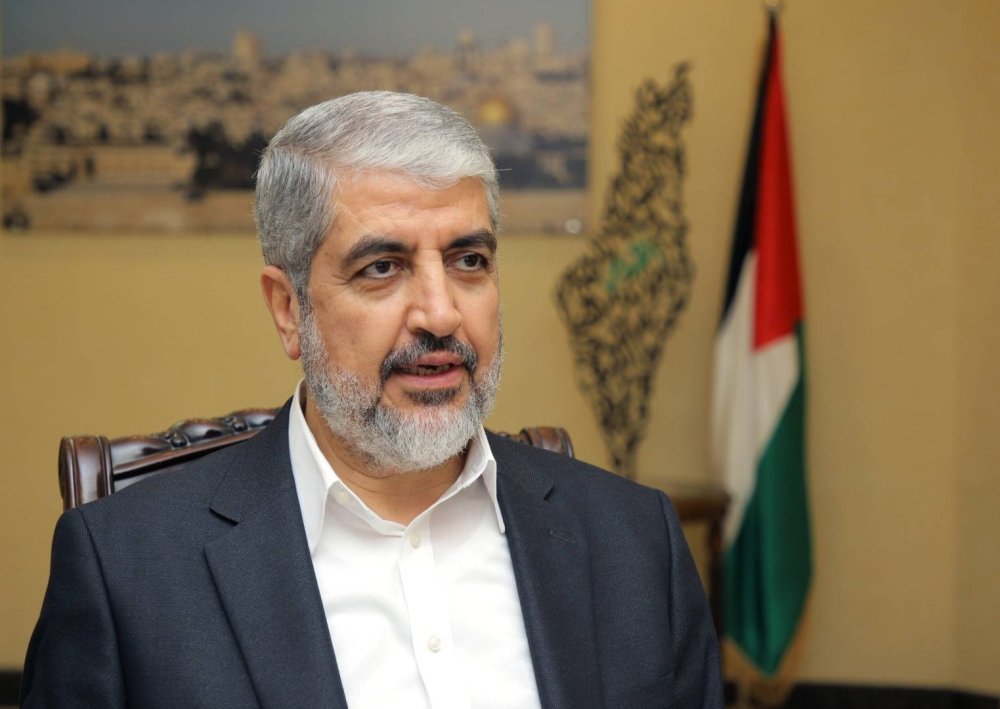
Gaza Herald — Senior Hamas leader Khaled Meshaal has called on U.S. President Donald Trump to fundamentally reassess Washington’s long-standing alignment with Israel, arguing that Israeli interference in American policy toward Palestine has distorted U.S. decision-making, undermined regional stability, and damaged America’s own interests. Speaking in an extensive, in-person interview with Drop Site in Doha, Meshaal urged the Trump administration to engage directly with Hamas and other Palestinian political forces through serious negotiations aimed at establishing respectful and balanced relations.
Meshaal argued that U.S. policy toward Palestine has long been shaped by Israeli priorities rather than an independent evaluation of American interests. He said that this imbalance has become increasingly visible, even within Trump’s own political base, where voices inside the MAGA movement are beginning to question the political, moral, and strategic costs of unconditional support for Israel.
“Unfortunately, one of the core problems with the U.S. administration is that it prioritizes Israel’s interests over America’s interests,” Meshaal said. “Even Trump’s own supporters have begun to realize that Israel is a burden, one that restricts and harms U.S. interests. I am simply calling on the American people and their leadership to judge matters based on America’s interests, not Israel’s.”
He added that if Washington were to view Palestinians through a fair and impartial lens, it would recognize that they are a people living under military occupation with an internationally recognized right to resist. “If America intervenes to force Israel to withdraw, we would thank America,” Meshaal said. “But when the world abandons you, resistance becomes the only remaining choice.”
A Veteran Figure in the Palestinian National Movement
Meshaal is currently the head of Hamas outside Palestine and is widely regarded as one of the movement’s most experienced and internationally recognized leaders. In the decade preceding Hamas’s formal launch in 1987, Meshaal played a central role in developing the intellectual and organizational framework for a new Islamic political liberation movement in Palestine. That process culminated in the creation of the Islamic Resistance Movement, commonly known by its Arabic acronym, Hamas.
Following Israel’s assassination of Hamas’s spiritual leader, Sheikh Ahmed Yassin, in 2004, Meshaal emerged as the movement’s political leader. He served as head of Hamas’s political bureau from 1996 until 2017, guiding the movement through years of exile, armed confrontation, electoral participation, and regional upheaval.
Throughout his political career, Meshaal has sought to balance resistance with political engagement, arguing that Palestinians must retain the right to defend themselves while remaining open to negotiated solutions that restore their rights and sovereignty.
A Call for Direct U.S. Engagement
Rather than continuing policies of isolation and sanctions, Meshaal called on the United States to open direct channels of communication with Hamas and other Palestinian factions. He argued that excluding major political actors only entrenches instability and prolongs conflict.
“The Palestinian people are not hostile to the United States,” Meshaal said. “We are hostile to policies that support occupation, siege, and aggression. If America adopts a fair approach, it will find Palestinians ready for dialogue.”
Meshaal stressed that meaningful American engagement, particularly pressure on Israel to withdraw from occupied territories, would dramatically reshape the political landscape. Such pressure, he argued, could create the conditions for long-term stability rather than endless cycles of violence.
Hamas and the Question of a Long-Term Ceasefire
Addressing international concerns, Meshaal reiterated that Hamas is prepared to enter into a long-term ceasefire agreement with Israel. This would include a commitment to halt military operations and place its weapons in storage under mutually agreed conditions. He emphasized that these steps would occur within a broader political framework aimed at stabilizing Gaza, enabling reconstruction, preparing for democratic elections, and addressing the future of a Palestinian state.
“The pragmatic American mindset, and President Trump’s stated desire to prevent Gaza from remaining a bleeding wound that shocks the human conscience, can create a real opportunity,” Meshaal said. “Hamas provides this opportunity with guarantees and a record of commitment.”
He framed Hamas’s approach as political realism rather than ideological rigidity, arguing that stability cannot be achieved through imposed solutions or military coercion.
Gaza Governance and Political Legitimacy
Meshaal emphasized that Hamas remains a deeply rooted political force within Palestinian society and has served as Gaza’s governing authority for nearly two decades. This reality, he said, cannot be erased through legal decrees or external pressure.
While Hamas has offered to relinquish administrative control of Gaza in favor of a technocratic committee of non-partisan Palestinians, Meshaal warned against efforts to exclude Hamas-affiliated individuals from Gaza’s reconstruction or political future.
“Any attempt to impose a non-Palestinian authority in Gaza is unacceptable and doomed to fail,” he said. “Foreign forces or foreign administrators would be treated as occupiers. Palestinians would not reject Israeli occupation only to accept another form of foreign domination.”
Western Double Standards and the South Africa Parallel
Meshaal argued that the current moment represents a rare opportunity for the United States and Europe to reassess their approach to Palestine. He drew a parallel to the eventual Western shift away from supporting apartheid in South Africa, arguing that continued backing of Israel’s policies places Western governments on the wrong side of history.
“The Palestinian people are not opposed to American or European interests,” Meshaal said. “We oppose occupation and those who support it. We reject guardianship, domination, and the protection of an occupier.”
He questioned why Washington has shown flexibility toward former armed actors in other regional conflicts while refusing similar engagement with Palestinian leaders, including those who have expressed readiness for political compromise. This double standard, he said, undermines Western credibility and fuels resentment.
Surviving an Israeli Assassination Attempt
A former physics teacher, Meshaal has spent most of his life in exile since 1967. In 1997, shortly after being named head of Hamas’s political bureau, he survived an Israeli assassination attempt in Amman, Jordan. Mossad agents, posing as Canadian tourists, sprayed poison into his ear as he exited his car.
The operatives were captured with the assistance of Jordanian police, prompting a major diplomatic crisis. King Hussein threatened to put the agents on trial and potentially execute them if Meshaal died, while also warning Israel that Jordan would annul its peace treaty. Israel ultimately sent the antidote and agreed to release Sheikh Ahmed Yassin as part of the deal.
Elections, Popular Support, and Democratic Exclusion
Meshaal has been widely credited as one of the architects of Hamas’s victory in the 2006 Palestinian legislative elections. In 2012, he made a highly symbolic visit to Gaza, his first return to Palestine since 1967, where he was greeted by massive crowds.
His final act as Hamas’s political leader came in 2017, when he presided over the release of a new political document stating that Hamas was willing to accept a Palestinian state along the pre-1967 borders, without relinquishing Palestinian rights or recognizing Israel’s legitimacy.
While the document did not replace Hamas’s 1988 charter, it was widely viewed as a significant overture to the international community.
Israel’s Continued Violations After the Ceasefire
After Israel assassinated Yahya Sinwar and Ismail Haniyeh in 2024, Meshaal largely receded from public view. That changed following Trump’s Gaza ceasefire initiative, as Meshaal reemerged to articulate Hamas’s positions.
He condemned Israel’s continued violations of the ceasefire, noting that despite the halt in large-scale bombardment, Israeli attacks, restrictions, and killings have persisted. Since October 10, Israel has killed nearly 400 Palestinians and wounded more than 1,000, while continuing to block essential supplies.
“Some believe the first phase was fully implemented; it was not,” Meshaal said. “Violations continue, and Israel must be held accountable before moving to the second phase.”
Disarmament, Resistance, and Security
Meshaal reiterated that while Hamas is open to freezing or storing its defensive weapons, it will not agree to full disarmament unless it occurs within the framework of a recognized Palestinian state with a national army capable of protecting its people.
“The issue is not protecting the occupier,” he said. “The issue is protecting a nearly defenseless people.”
He warned that attempts to disarm Palestinian resistance forcibly would sabotage negotiations rather than secure peace.
International Forces and Rejected Solutions
Meshaal criticized proposals to deploy an international force to Gaza with a mandate to disarm Palestinian factions. He warned that such forces would be perceived as instruments of occupation rather than peacekeeping.
“Hamas negotiators never agreed to disarmament,” he said, adding that their mandate during negotiations was limited to a ceasefire and prisoner exchange.
Arab States, U.S. Pressure, and Responsibility
While acknowledging frustration with Arab and Islamic states, Meshaal said the ultimate responsibility lies with Washington. He noted that many regional governments face economic and political pressures that limit their ability to confront Israel.
“The United States is the only actor capable of compelling Israel,” Meshaal said. “Power is responsibility.”
“Power Is Responsibility”
In closing, Meshaal placed responsibility squarely on the Trump administration, arguing that history will judge whether Washington chooses justice or continued impunity for Israel.
“For Palestinians, the path forward depends on recognition, political inclusion, and an end to occupation,” he said. “That choice now rests largely in Washington’s hands.”