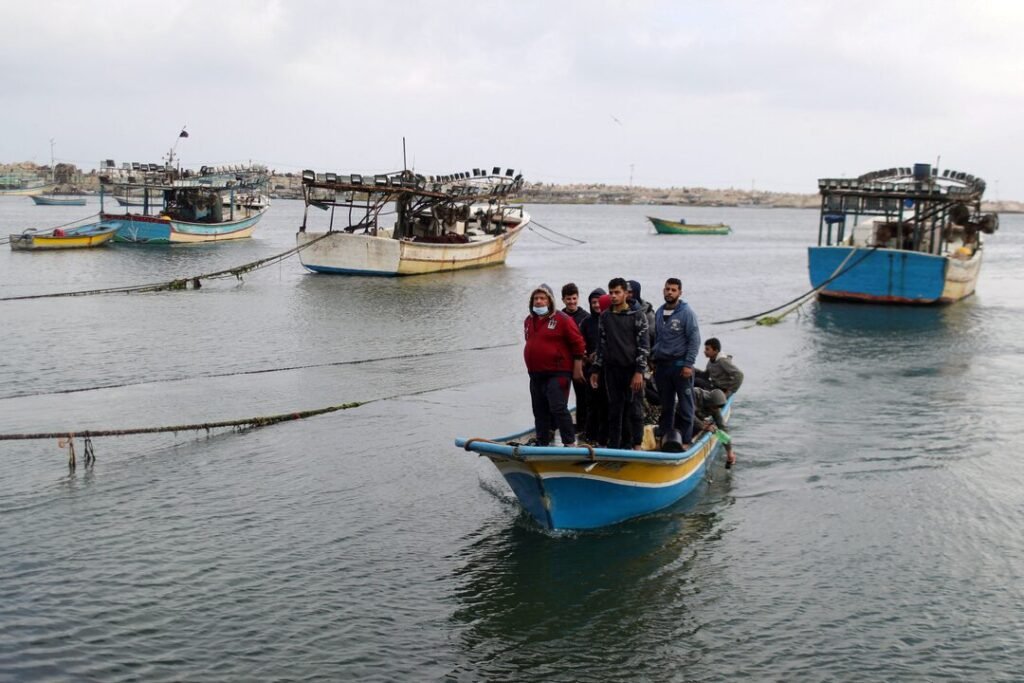
Gaza Herald- Israeli naval forces detained four Palestinian fishermen on Thursday morning off the western coast of Gaza City, in yet another violation of the ceasefire agreement.
According to Zakaria Bakr, head of the Fishermen’s Committees in Gaza, Israeli naval vessels intercepted the fishermen while they were working in Gaza’s waters and arrested Hamza Abdulwahab Katoo, Abdel-Latif Zaki Taroush, Roshdi Abdullah Al-Attar, and Arafat Malik Taroush.
Bakr said the fishermen managed to recover one of the boats belonging to the detainees, while the Israeli navy prevented them from retrieving the second. He added that Israeli naval forces continue to target fishing boats and detain crews as part of ongoing violations in Gaza’s maritime zone.
The attacks have persisted despite the ceasefire that came into effect on 11 October, with at least 23 fishermen detained so far.
A similar incident occurred on 19 November, when Israeli naval forces detained three fishermen after intercepting their boat off Gaza’s coast.
At the time, Bakr said Israeli gunboats opened heavy fire on fishing boats only meters from Gaza’s fishing port before detaining Khaled Yousef Shemla, Hassan Jamal Al-Nu’man, and Mahmoud Saeed Al-Sa’idi, who were taken to an undisclosed location.
Restricted access to Gaza’s sea
Under the 1993 Oslo Accords, Palestinian fishermen were theoretically permitted to access up to 20 nautical miles off Gaza’s coast.
In practice, this has never been implemented. Over the past three decades, Israel has repeatedly reduced the fishing zone, limiting it at various periods to between 3 and 12 nautical miles before the current war.
Since the genocide in Gaza, and even after the ceasefire came into force, the situation has deteriorated further.
Testimonies from fishermen and recent field reports indicate that the Israeli navy now effectively prevents Gaza’s fishermen from sailing beyond roughly one kilometer from the shore. Any attempt to go further often results in live fire, the confiscation of boats, or arrest.
As a result, Gaza’s fishing sector remains effectively paralyzed, with fishermen facing life-threatening risks even within the extremely limited area that remains theoretically accessible to them.