
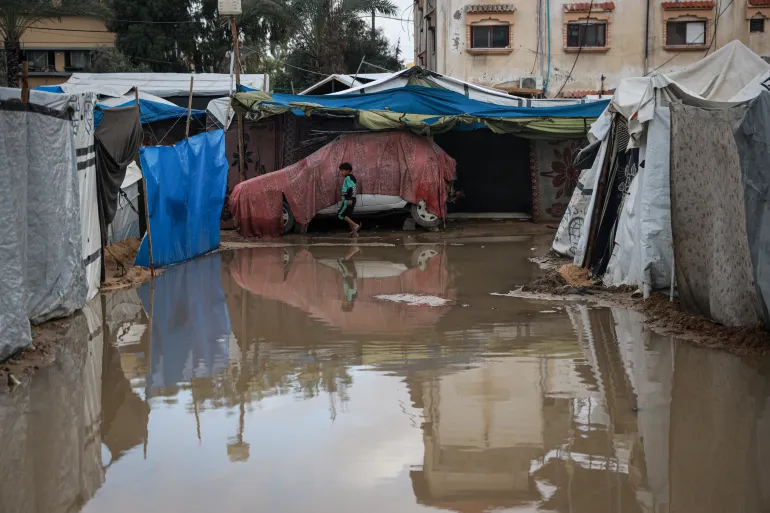
Gaza Herald — The first winter rain did not bring relief to Samar al-Salmi; it brought disaster.
Before sunrise, freezing water burst through the thin walls of the family’s worn-out tent in a displacement camp in Deir el-Balah. Within minutes, the floor turned into a muddy swamp. Around them, displaced families scrambled to shovel sand, drag out drenched mattresses, and rescue what little they still owned.
For 35-year-old Samar, due to deliver her baby girl any day now, the timing was unbearable.
“All the baby’s clothes were soaked in mud,” she says, holding tiny garments caked in brown stains. “Everything I prepared, even the diapers and formula, is ruined.”
Samar, her husband Abdulrahman, and their three young children have lived in this deteriorating tent since Israeli forces destroyed their home in Tal al-Hawa in Gaza City during what Palestinians widely describe as Israel’s genocidal war. Her mother and siblings live in nearby tents, also flooded.
“There are no words,” she says, voice trembling. “How am I supposed to welcome my daughter like this?”
While Samar tries to save what she can, her husband and brothers struggle to stop the incoming water, shoveling sand into deep puddles and dragging soaked belongings into the weak sun.
“I thought my mother’s tent would be safer, so I left the baby’s hospital bag there,” she says. “But the rain entered her tent first. Everything was destroyed.”
She pauses, overwhelmed. “Do I clean my kids? Do I dry the mattresses? Do I prepare for delivery? I don’t even know where to begin.”
For two years, aid groups have warned that displaced families, banned by Israel from receiving caravans, wood, or construction materials, would face catastrophe each winter. Samar’s reality is exactly that.
“A tent is not a home,” she says. “In summer we burn, and in winter we drown. This is not a life.”
A Father at His Breaking Point
Abdulrahman, exhausted and heartbroken, initially refuses to speak. But eventually, the weight he carries spills out.
“I’m a father, and I feel completely helpless,” the 39-year-old says. “Whatever I try to fix collapses again. That’s been our life during this war, and after it.”
He recalls receiving Samar’s panicked phone call earlier that morning while heading to his first day of work at a small barbershop.
“She was screaming, everyone was screaming,” he says. “‘Come quickly, the rain is pouring into the tent from everywhere.’”
He ran back through the storm.
“The tent was a swimming pool,” he says, tears forming. “My wife and mother-in-law were crying, my kids were outside shaking from the cold. People were scooping water out with buckets. It was unbearable.”
Everything for the baby, diapers, bottles, and formula, is now ruined, and prices have become impossible.
“A pack of diapers that cost 13 shekels is now 85,” he says. “Milk is 70. Even a pacifier is expensive. And now it’s all drenched.”
The couple cannot stop thinking about the home they once had, a warm, clean apartment where they lived with dignity. That entire neighborhood is now rubble.
A Terrifying Birth Ahead
Samar is scheduled for a C-section. She will give birth in a devastated healthcare system and then return, with a newborn, to a flooded tent.
“I never imagined welcoming my daughter like this,” she whispers. She admits she sometimes feels guilty for becoming pregnant during the war.
“Before, I returned from the hospital to my home, to my bed, to safety. Now look at this.”
Their children, Mohammad, 7; Kinan, 5; and Yaman, 3, are constantly sick from cold, insect bites, and damp conditions.
“They’re shivering all the time,” Samar says. “Nothing stays dry. Even the clean clothes are covered in mud again.”
To her, talk of a “ceasefire” means nothing.
“They say it’s calm. Where?” she asks. “Bombing continues. People still die. And now we drown in rain. This is not peace — this is another kind of war.”
A Plea for Dignity
More than anything, the couple wants shelter, not charity, but dignity.
“We’re human beings,” Samar says. “We had homes. We want our homes rebuilt. Tents are plastic sheets, not a life.”
She appeals to humanitarian agencies:
“We need clothes, blankets, mattresses, everything is gone. We need shelter. No one can live like this.”
As Abdulrahman spreads another layer of sand in a desperate attempt to reclaim the floor of their tent, he sums up their reality in one exhausted confession:
“Honestly… we’ve become bodies without souls.”

