
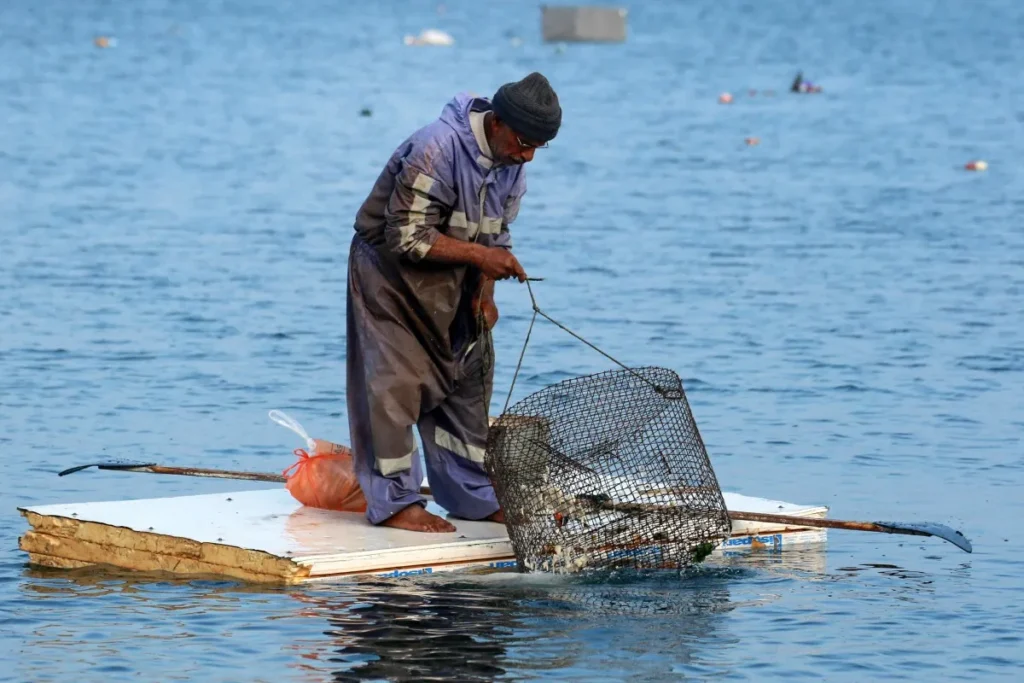
Gaza Herald_ For two years, Gaza’s land has been swallowed by dust and death. With its borders sealed and its streets turned to rubble, the sea remains the only horizon still open to the besieged, a thin, trembling line between survival and despair. For Gaza’s fishermen, the Mediterranean is not just a source of livelihood; it is the last lifeline, the last space left where a man can breathe freely and taste the salt of resistance.
Generations of Palestinians have drawn sustenance from these waters, feeding their families and their communities even as Israel’s siege tightened its grip. Today, those same waters, once a refuge and a promise, have become perilous. Patrol boats, naval gunfire, and strict bans have turned the sea into yet another battlefield, where fishermen risk their lives for a few fish and a flicker of dignity.
The Beast of Gaza
Targeting a meal for his family, Salem Abu Amira, known to locals as “The Beast,” dives deep beneath the waves, his body slicing through the cold water like a shadow. “People here call me ‘The Beast’ because I once caught a fish that was more than a metre and a half long,” he recalls with a faint smile. “It’s rare, but I’ve caught many big fish.”
For Abu Amira, free diving is not merely a profession. It’s a legacy. He learned it from his father, who learned it from his own chain of salt, sweat, and memory stretching back through generations. “This is what we know. This is who we are,” he says.
Before Israel’s war, Gaza’s fishermen could sail out far enough to fill their nets with sardines, mackerel, and bream. The sea was alive, and so was Gaza’s coastal life. In 2020, the World Bank estimated that about 18,000 Gazans directly depended on fishing for their livelihoods, supporting more than 110,000 family members in total. It was one of the few sectors that survived the years of blockade until the war erased it all.
A Profession Under Fire
“We can no longer reach the places we used to,” Abu Amira says. “Now we can only fish close to the shore where there are no big fish.”
The restrictions began the moment Israel launched its genocidal war. Since then, the blockade has been absolute, the coastline patrolled by Israeli gunboats that fire at anyone daring to venture too far. “I can’t just sit at home waiting for someone to support me,” Abu Amira says, shaking his head. “Fishing is my only way to live.”
Before the war, Gaza’s fishermen hauled in around 4,600 tonnes of fish each year, despite facing constant harassment, their boats being seized, their nets slashed, their lives perpetually at risk. Now, nearly all of those boats lie in pieces, destroyed in Israeli airstrikes or left to rot in the sand.
According to Gaza’s Ministry of Agriculture, by December 2024, at least 200 fishermen and their associates had been killed by the Israeli military, out of roughly 6,000 people engaged in the profession. The loss is both personal and collective, a whole heritage drowned in the sea that once sustained it.
“No-Go Zone”
In January 2025, Israel declared Gaza’s waters a “no-go zone,” banning fishing, swimming, and any form of access to the sea. The impact was devastating: Gaza lost 94 percent of its fish catch, cutting off one of its last remaining food sources.
“Fishermen are the most exposed to danger,” says Zakaria Bakr, head of the Fishermen’s Committees in Gaza. “Often, the occupation forbids them from going to the sea, and free divers cannot get their diving gear. It affects their ability to work for days, even weeks.”
The few who still venture out must stay close to shore, casting their nets just meters from the coastline. Even then, they risk being shot at or detained. Many of them return empty-handed or not at all.
The Sea as Salvation
After months of displacement, Salem Abu Amira has returned to Gaza City, restless but undeterred. His small wooden boat, patched and scarred, waits by the shore. “The Beast” will dive again, searching for fish he can sell in the market for a few shekels to feed his children, a reminder that life continues, however fragile.
“I am determined to pass on my profession to my children,” he says, tightening the straps of his diving mask. “It is a pleasure and a hobby. Fishing relieves stress and provides a source of income. It reminds me that I am still alive.”
After hours underwater, Salem surfaces with several fish and a single octopus enough to feed his family and maybe trade for a bit of bread or fruit. The sea has given once more, though sparingly.
Beyond Survival
For Gaza’s fishermen, the struggle is not only against hunger or economic ruin. It is about holding on to something deeper, their identity, their freedom, their bond with the sea that has defined their existence for centuries.
They know that every dive, every cast of the net, is an act of defiance against a system that seeks to strip them of even the right to live. In a land surrounded by walls, the sea remains the last open horizon, one that Israel cannot fully close, no matter how many boats it destroys.
As the sun sets over the Mediterranean, turning the waves to gold, the fishermen of Gaza prepare for another night tired, hungry, but unbroken. For them, the sea is not just water. It is home, history, and hope, the last pulse of life in a land under siege.

