
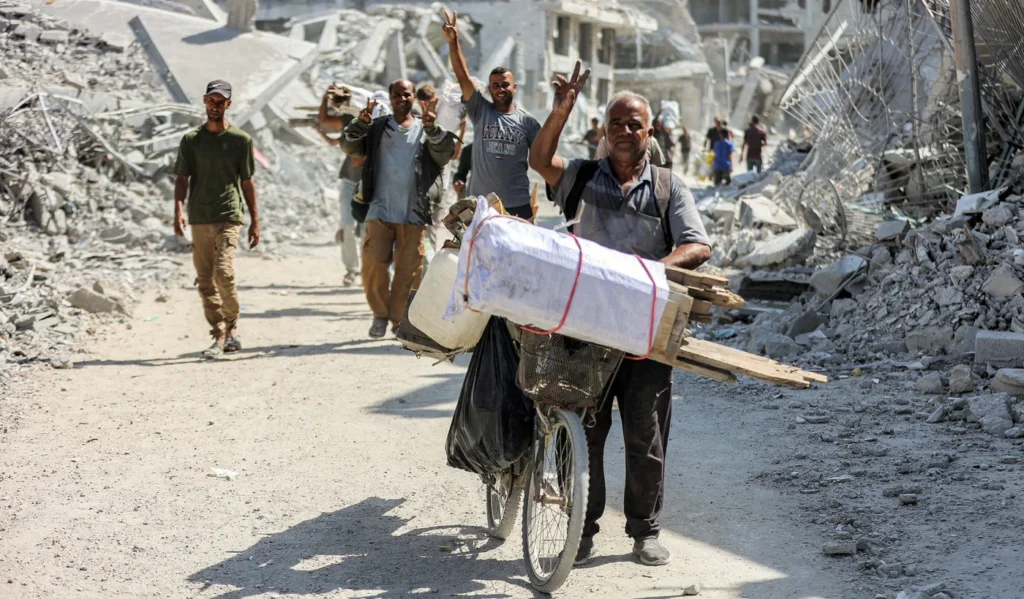
Gaza Herald — Two years after Israel’s genocidal assault on Gaza began, the so-called “ceasefire” has done little to ease the suffering of Palestinians. While Western headlines speak of “peace” and “reconstruction,” the reality across the shattered enclave remains one of hunger, loss, and ruin.
The people of Gaza are not experiencing peace; they are struggling to survive. Beneath the illusion of calm, families live in the wreckage of bombed-out homes, facing hunger, disease, and the oncoming winter with almost nothing left.
“A Race Against Time” to Deliver Food
Aid agencies are warning that they are in “a race against time” to deliver food and necessities to Gaza. The United Nations World Food Programme (WFP) said that Israeli restrictions continue to block humanitarian access, despite the truce with Hamas.
Abeer Etefa, WFP spokesperson, said that although aid deliveries have slightly increased since the ceasefire took effect last month, they remain far below what is needed. “We need full access. We need everything to move quickly. People are still suffering from hunger, and the needs are overwhelming,” she said.
Currently, only two border crossings are open, both tightly controlled by Israel, and aid convoys must follow long, dangerous routes from southern Gaza to the north, where international monitors have already confirmed famine.
Starvation in the North
Northern Gaza remains one of the most desperate regions in the Strip. The closure of the northern crossings means aid cannot reach those most in need. “To deliver at scale, WFP needs all crossings to be open,” said Etefa, stressing that food must be able to travel quickly through Gaza’s key roads.
According to the WFP, it has distributed food parcels to more than one million Palestinians since October 10. But for many in Gaza City and the north, these parcels are rare lifelines that arrive too late or not at all.
Returning Home to Ruins
Thousands of Palestinians who have returned to northern Gaza and Gaza City in recent weeks describe scenes of utter devastation. Neighborhoods once filled with life are now nothing more than rubble and dust.
Khalid al-Dahdouh, a father of five, returned to find his home destroyed. With no shelter available, he and his family built one themselves. “We tried to rebuild because winter is coming,” he said. “We don’t have tents or anything else, so we built a primitive structure out of mud. It protects us from the cold, insects, and rain, unlike the tents.”
For many others, even that is impossible. Streets are buried under debris, and clean water remains a distant dream. Entire communities are living without electricity, proper sanitation, or access to food.
The Illusion of Peace
Despite the ceasefire, Israel continues to carry out attacks on Gaza. According to Gaza’s Ministry of Health, more than 240 Palestinians have been killed and 607 others wounded since the truce took effect. One person was recently killed and another wounded after an Israeli drone opened fire in Gaza City’s Tuffah neighborhood.
Meanwhile, Israel has continued demolishing homes and blocking humanitarian access, dismissing international criticism by claiming Hamas violated the truce. Gaza’s Government Media Office reported that only 3,203 aid and commercial trucks entered Gaza between October 10 and 31, just 24 percent of what was promised under the ceasefire deal.
Survival as Resistance
For Palestinians, survival has become a form of defiance. Each family that rebuilds from rubble, each child who continues to learn despite hunger, stands as a testament to a people that refuses to disappear.
Gaza’s hunger is not an accident; it is a consequence of deliberate policy. The blockade, the bombings, and the slow starvation are tools of war intended to break Palestinian resilience. Yet, even amid famine and destruction, Gaza’s people endure.
Beneath the Truce, Gaza Still Bleeds
The so-called ceasefire has brought neither peace nor dignity. It has simply masked the ongoing cruelty of a siege that starves and suffocates an entire population.
As winter descends, Gaza’s tragedy deepens. The people’s endurance is the only unbroken truth left in the ruins, a defiant reminder that no amount of destruction can erase their will to live, rebuild, and remain on their land.

