
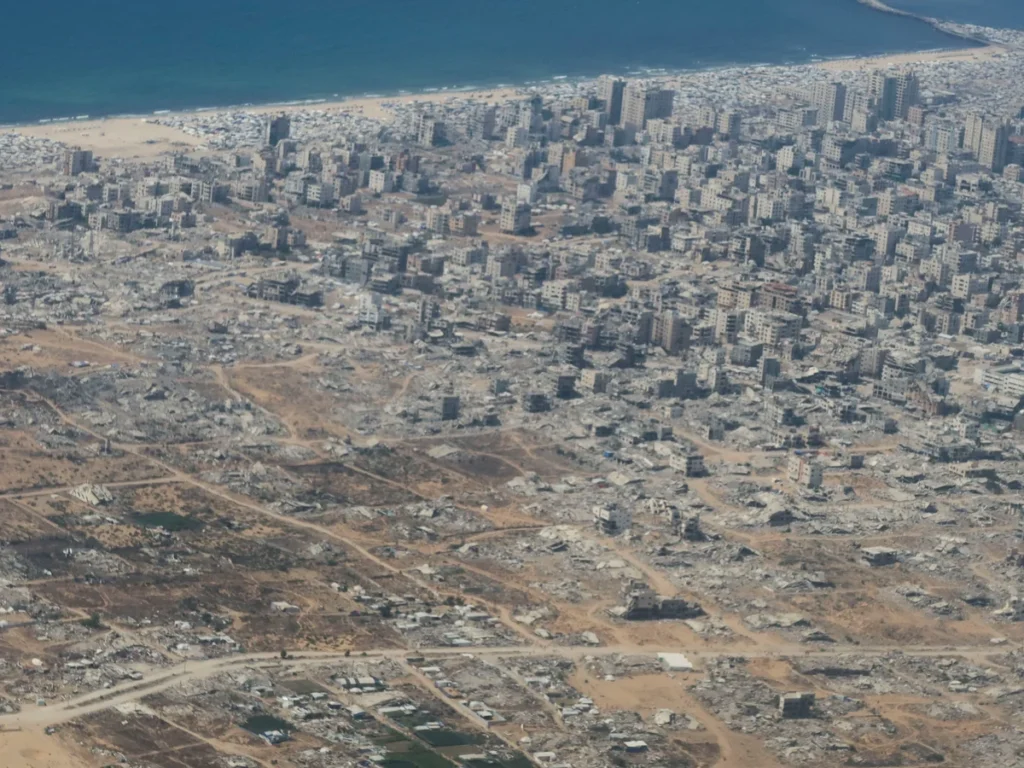
Gaza Herald — Before the war, Naim Abu Amra’s land in Deir al-Balah, central Gaza, was a stretch of green life. On his 11-dunam (one-hectare) farm east of Abu Holi, rows of tomatoes, cucumbers, peppers, and courgettes grew under greenhouses. In rotation, he cultivated eggplants and leafy vegetables to maintain the soil’s fertility. Like thousands of Gaza’s farmers, Abu Amra worked with limited resources due to Israel’s blockade of agricultural materials. Yet he found ways to adapt using solar-powered irrigation and a small diesel pump to keep his fields alive.
His harvests sustained his family of eight and provided seasonal work for others in the community. But when Israel’s genocidal war began in October 2023, everything was erased. The Israeli military declared the area a “no-go zone.” Bulldozers leveled the fields, irrigation lines were torn apart, and the well was filled with debris. The airstrikes melted the metal frames of his greenhouses.
“Everything turned to ashes,” Abu Amra said. “Military bulldozers flattened the land, and even the metal and plastic melted under the bombing.”
Now, his once-thriving farmland lies buried under rubble and unexploded ordnance. Still, Abu Amra refuses to give up. With the help of his sons, he cleared small patches of soil with shovels and donkeys and planted okra and molokhia using collected rainwater.
“The war didn’t just take our crops. It took our future,” he said, describing the psychological devastation of seeing the land that once fed hundreds reduced to dust.
According to a joint July report by the Food and Agriculture Organization (FAO) and the United Nations Satellite Center (UNOSAT), more than 95 percent of Gaza’s agricultural land has become inaccessible after two years of war. As of May, 80 percent of croplands were destroyed, 77.8 percent rendered unreachable, and over 70 percent of greenhouses damaged. Nearly 83 percent of water wells are no longer functioning. The FAO described this as the “collapse of Gaza’s agrifood system and lifelines.”
A Deliberate Destruction
Before October 2023, agriculture contributed 11 percent to Gaza’s GDP and supported around 560,000 livelihoods. Now, the sector’s contribution has fallen below two percent.
“The destruction was deliberate and carefully planned,” said Bahaa Zaqout, director of external relations at the Palestinian Agricultural Development Association (PARC). “The sector is almost wiped out.”
Israel has long weaponized Gaza’s food system, tightening control over fertilizers, spare parts, irrigation pipes, and even seeds. Since October 2023, this policy has evolved into what Zaqout calls “total eradication.” The World Bank estimates it will cost $8.4 billion to restore Gaza’s agricultural sector.
But rebuilding will not be easy. The territory is blanketed with 61 million tonnes of debris, some 15 percent of which contains toxic materials such as asbestos. Israel continues to block heavy machinery required to clear it, though it briefly allowed Egyptian vehicles to retrieve the remains of Israeli captives. “Even testing water and soil for contamination is impossible without the equipment and materials Israel forbids,” Zaqout said.
The cost of rebuilding greenhouses has soared. “If the materials were available, it would take seven to ten years to restore Gaza’s agriculture,” Zaqout added.
‘Not Even a Tomato Seed’
Since the start of the war, Israel has all but stopped agricultural imports to Gaza, including seeds, which it classifies as “dual use.” Even fruits containing seeds are banned. NGOs were told to remove pits from dates before entry.
“Not even a tomato seed was allowed through,” said Mariam Al-Jaajaa, general manager of the Arab Group for the Protection of Nature (APN). “Seeds are weaponized because they are a source of life.”
The blockade on agricultural inputs began long before October 2023. When Israel imposed its siege in 2007, it banned countless items, including pasta and olives, labeling them “dual use.”
Despite the devastation, APN has worked with more than 700 farmers, cultivating 1,300 dunams and producing seven million kilograms of vegetables using locally sourced seeds. “Before the war, cultivating a dunam cost $5,000. Now it costs $25,000,” Jaajaa said.
The Politics of Food and Survival
Jaajaa explained that APN’s independence allows it to act where larger NGOs cannot. “When we began outreach, hundreds of farmers wanted only one thing: access to their lands and production inputs. But most international organizations focus only on distributing food aid, not rebuilding Gaza’s agriculture,” she said.
For Jaajaa, the reluctance to rebuild Gaza’s food system is political. “Agriculture is more than an economic activity; it’s resistance. Cultivated land cannot easily be confiscated. A thriving agricultural sector gives Palestinians self-sufficiency, and that’s what Israel and its allies fear.”
Before the current war, Palestinian farmers already faced severe restrictions on exports, forcing them to grow only crops Israel permitted, such as strawberries and flowers. Roughly 30 percent of Gaza’s arable land had already been seized for Israel’s so-called “buffer zone.”
Similarly, Palestinian fishermen were confined to small coastal zones six nautical miles in the north, fifteen in the south. Since October 2023, most have been completely barred from the sea.
‘No Solution Without Justice’
Jaajaa believes that real recovery will only begin when Palestinians control their own production and resources. “You cannot have a sustainable solution without justice,” she said. “Farming is about more than food, it’s about dignity, survival, and the right to live on our land.”
Gaza’s farmlands, once symbols of resilience and self-reliance, have been deliberately destroyed under Israel’s siege. The blockade on seeds, tools, and machinery is not incidental, it is part of a systematic campaign to starve Palestinians into submission and erase their economic independence. Yet farmers like Naim Abu Amra continue to plant small seeds of hope in the ruins, defying the occupation’s efforts to turn Gaza into a wasteland. Their persistence, rooted in the soil of their homeland, stands as one of the clearest forms of resistance left.

