
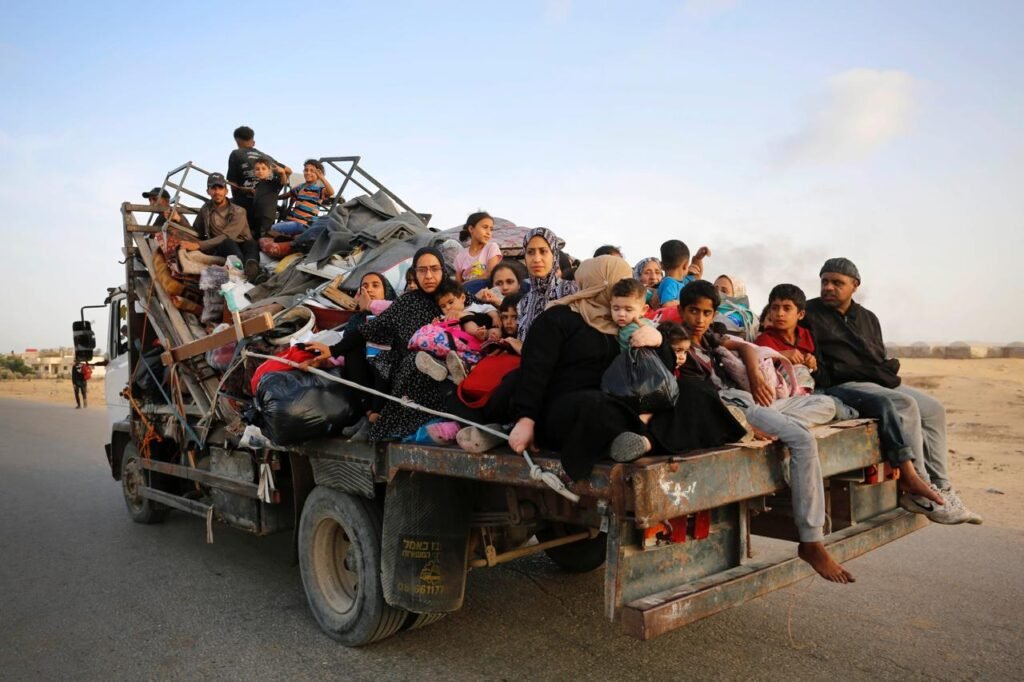
Israel has intensified its attacks on Gaza, especially on the Sheikh Radwan neighborhood in northern Gaza, forcing a hundred families to evacuate their homes under fire.
According to a correspondent from the Palestinian Information Center, Israeli airstrikes have heavily targeted the Abu Iskandar area, reducing entire residential buildings to rubble and causing dozens of casualties, including both the dead and the wounded. Ongoing shelling has made it impossible for ambulances to access the affected areas.
The scene in the neighborhood was widely criticized, with many describing it as one of the most devastating since the start of the war. Entire families were seen fleeing on foot toward the coastal areas of Gaza City, where nearly one million Palestinians are already living in extremely overcrowded and inhumane conditions.
Some displaced families were able to salvage a few personal belongings, while others escaped with nothing more than the clothes they were wearing.
Speaking to our correspondent, Mohammad Al-Ustaz said, “We left with nothing but our children. Our home was destroyed — there is nothing left for us to return to.”
He noted that this marks the tenth time he has been forcibly displaced since the beginning of what he described as a genocide, urging the free people of the world to intervene and help bring an end to the ongoing atrocities.
Intensified Bombardment from Multiple Fronts
The latest escalation appears to be part of a broader military campaign, marked by simultaneous heavy bombardment of several neighborhoods, including Al-Sabra, Al-Zaytoun, and Al-Tuffah.
According to analysts, Israel is intensifying efforts to penetrate Gaza City from multiple directions, aiming to reshape th battlefield by isolating densely populated areas. The strategy combines sustained ground operations with the systematic targeting of civilian infrastructure and residential buildings.
A Neighborhood Born of Displacement
Sheikh Radwan is more than just a district on Gaza’s map — it is a neighborhood rooted in forced displacement.
Established by Israel in 1973, Sheikh Radwan was part of a broader effort to relocate refugees from Al-Shati (Beach) Camp. As thousands of homes in the camp were demolished, approximately 8,000 refugees were moved into newly constructed housing units in what many view as an attempt to alter Gaza’s social and demographic landscape.
Although many refugees initially resisted leaving the camp, Israeli authorities demolished around 2,000 homes within Al-Shati and denied reconstruction permits, effectively coercing families to resettle in Sheikh Radwan.
Social Fabric and Strategic Significance
Since its establishment, Sheikh Radwan has witnessed pivotal moments in Gaza’s history. The neighborhood became a refuge for families displaced from cities and villages such as Jaffa, Al-Majdal, and Al-Yibna, gradually developing into a vibrant center of community life and resistance.
Strategically positioned, Sheikh Radwan borders the North Gaza governorate to the north, Al-Rimal to the south, Al-Tuffah to the east, and Al-Shati Camp to the west. It is also traversed by Al-Jalaa Street, one of Gaza City’s key thoroughfares.
The neighborhood is home to prominent families including Shubeir, Al-Madhoun, Al-Ghoul, Salem, Abu Ubayd, Abu Riyala, and Al-Qouqa, alongside descendants of displaced communities from Al-Majdal, Al-Yibna, and Jaffa.
National Symbolism and the Cemetery of Martyrs
Sheikh Radwan holds profound national significance, largely due to the Sheikh Radwan Cemetery, a notable landmark that serves as the final resting place for prominent Palestinian leaders such as Sheikh Ahmed Yassin, Dr. Abdel Aziz Al-Rantisi, engineer Ismail Abu Shanab, Salah Shehadeh, Ahmad Al-Jaabari, Abu Yousef Al-Qouqa, as well as martyrs from various Palestinian factions.
Although the Ministry of Religious Affairs officially closed the cemetery in 2008 after it reached full capacity, families have continued to bury their deceased there, citing the dangers associated with accessing the Martyrs’ Cemetery located east of Gaza. Over the years, the cemetery has endured repeated attacks and significant damage during multiple conflicts, including the ongoing assault.
Mosques and Community Centers
Sheikh Radwan is home to several prominent mosques that function as both religious and social hubs. These include the historic Al-Radwan Mosque—the oldest in the area—as well as Al-Taqwa, Al-Aman, Beersheba, Al-Rashid, Al-Isra, Al-Noor wal-Iman, Said Siyam, Sayyid al-Shuhada Hamza, and Al-Furqan.
Over the years, the neighborhood has produced notable figures such as Ali Hosni Arafah (1973–2022), a commander in the Al-Qassam Brigades who served until his death from illness, and Major General Jihad Muheisen, commander of Gaza’s National Security Forces, who was killed in 2023 when Israeli airstrikes targeted his home, claiming the lives of several family members.
The Neighborhood in Times of War
Sheikh Radwan has consistently borne the brunt of Gaza’s conflicts. During the 2023–2024 war, it suffered severe devastation, with its streets, markets, schools, and mosques reduced to rubble, forcing thousands of residents to flee.
Today, Sheikh Radwan once again finds itself at the epicenter of the fighting, evoking memories of its origins rooted in forced displacement. Its residents are tragically reliving a familiar ordeal—this time under even more brutal and complex circumstances.
Built upon the ruins of the Nakba and Naksa, the neighborhood faces yet another chapter of violence. It stands as a living testament to Gaza’s recurring tragedies, embodying the convergence of human suffering and national resilience amid relentless aggression. Despite the bloodshed and destruction, Sheikh Radwan remains a powerful symbol of resistance.

